Health Research Institute, Diabetes Research Center, Department of Physiology, Ahvaz Jundishapur University of Medical Sciences, Ahvaz, Iran.
Department of Physiology, Member of Student Research Committee of Ahvaz Jundishapur University of Medical Science, Ahvaz, Iran.
World J Mens Health. 2014 Dec;32(3):176-83. doi: 10.5534/wjmh.2014.32.3.176. Epub 2014 Dec 29.
The purpose of this study was to evaluate the role of exendin-4 on reproductive alteration in a D-galactose-induced aging mouse model.
In this experimental study, 72 male Naval Medical Research Institute mice (20~25 g) were randomly divided into six groups: control, exendin-4 (1 nmol/kg), exendin-4 (10 nmol/kg), D-galactose (500 mg/kg), D-galactose+exendin-4 (1 nmol/kg), and D-galactose+exendin-4 (10 nmol/kg). The aging model animals were gavaged with D-galactose for six weeks, and exendin-4 was injected intraperitoneally in the last 10 days. At the end of treatment serum luteinizing hormone (LH), follicle-stimulating hormone (FSH) and testosterone levels were evaluated and the cauda epididymis and testis were removed to analyze the sperm count and testis morphology.
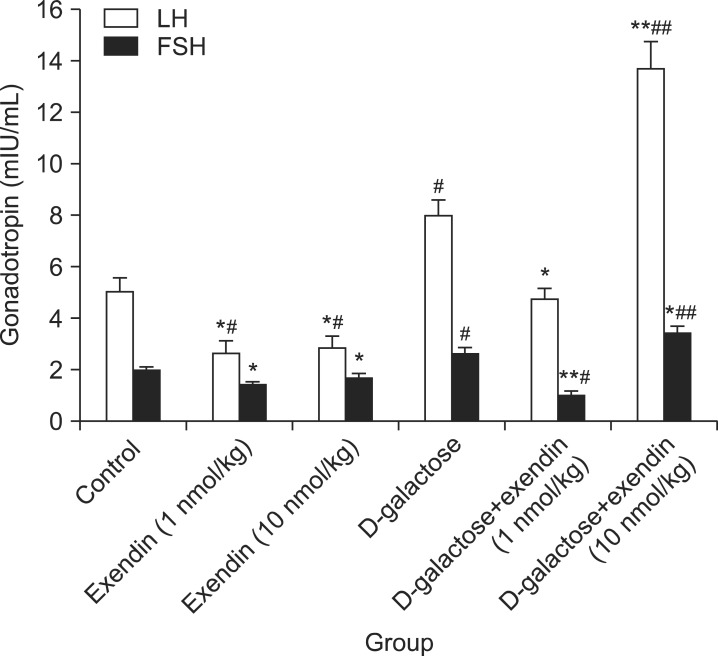
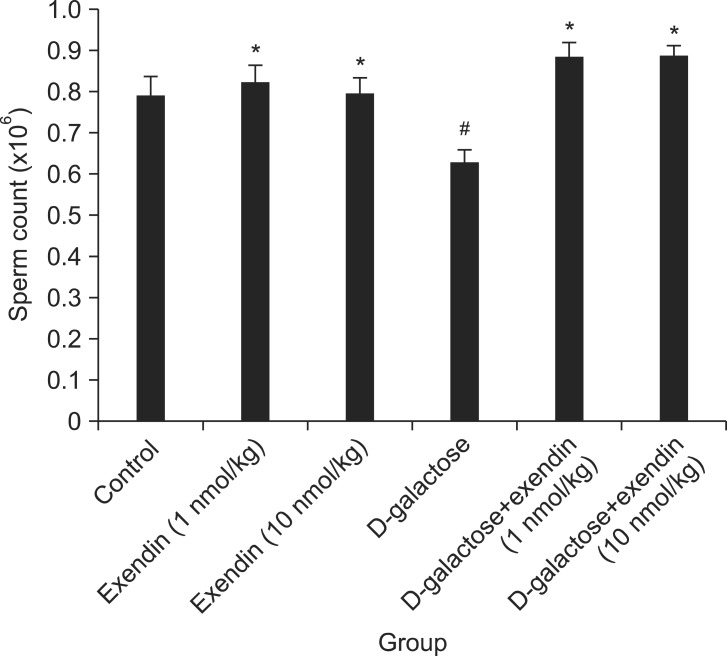
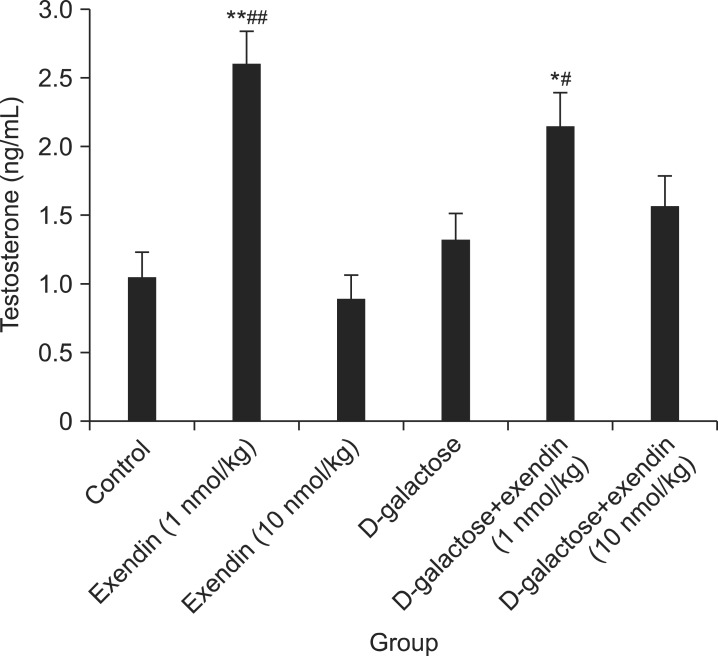
The testis weight and volume decreased in the D-galactose group (p<0.01 and p<0.05) respectively. Exendin-4 (1, 10 nmol/kg) increased these parameters in the normal and aging mouse models. Serum LH and FSH levels increased and the sperm count decreased in the D-galactose group (p<0.05). Further, exendin-4 (1 nmol/kg) decreased LH and FSH levels and increased the serum testosterone level and sperm count in both normal and aging animals.
D-galactose can induce aging alternations in the male reproductive system such as decreased sperm count and increased serum LH and FSH levels through reactive oxygen species over production and reduced antioxidant enzyme activity. Further, co-administration of exendin-4 reduced reproductive complications of D-galactose in an aging mouse model.
本研究旨在评估 exendin-4 在 D-半乳糖诱导的衰老小鼠模型生殖改变中的作用。
在这项实验研究中,72 只雄性海军医学研究所小鼠(20~25 克)被随机分为六组:对照组、exendin-4(1 nmol/kg)组、exendin-4(10 nmol/kg)组、D-半乳糖(500 mg/kg)组、D-半乳糖+exendin-4(1 nmol/kg)组和 D-半乳糖+exendin-4(10 nmol/kg)组。衰老模型动物用 D-半乳糖灌胃 6 周,最后 10 天腹腔内注射 exendin-4。治疗结束时,评估血清黄体生成素(LH)、卵泡刺激素(FSH)和睾酮水平,并取出尾附睾和睾丸分析精子计数和睾丸形态。
D-半乳糖组睾丸重量和体积减小(p<0.01 和 p<0.05)。exendin-4(1、10 nmol/kg)分别增加了正常和衰老小鼠模型的这些参数。D-半乳糖组血清 LH 和 FSH 水平升高,精子计数减少(p<0.05)。此外,exendin-4(1 nmol/kg)降低了 LH 和 FSH 水平,增加了正常和衰老动物的血清睾酮水平和精子计数。
D-半乳糖可通过活性氧过度产生和抗氧化酶活性降低导致精子计数减少、血清 LH 和 FSH 水平升高,从而导致雄性生殖系统衰老改变。此外,exendin-4 的联合给药可减轻 D-半乳糖在衰老小鼠模型中的生殖并发症。