Ahangarpour Akram, Oroojan Ali Akbar, Badavi Mohammad
Diabetes Research Center, Department of Physiology, Health Research Institute, Ahvaz Jundishapur University of Medical Sciences, Ahvaz, Iran.
Department of Physiology, Student Research Committee of Ahvaz Jundishapur University of Medical Science, Ahvaz, Iran.
Pathobiol Aging Age Relat Dis. 2017 Dec 26;8(1):1418593. doi: 10.1080/20010001.2017.1418593. eCollection 2018.
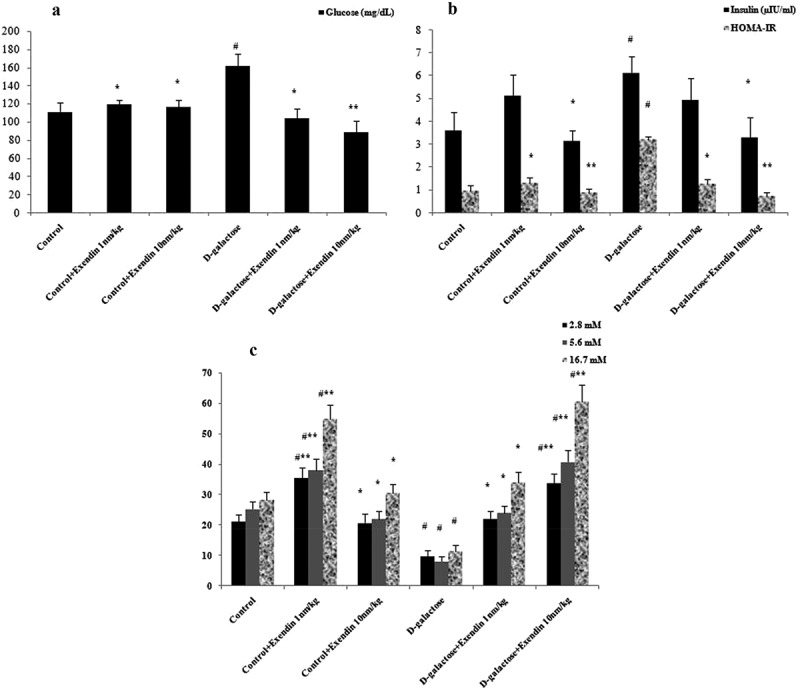
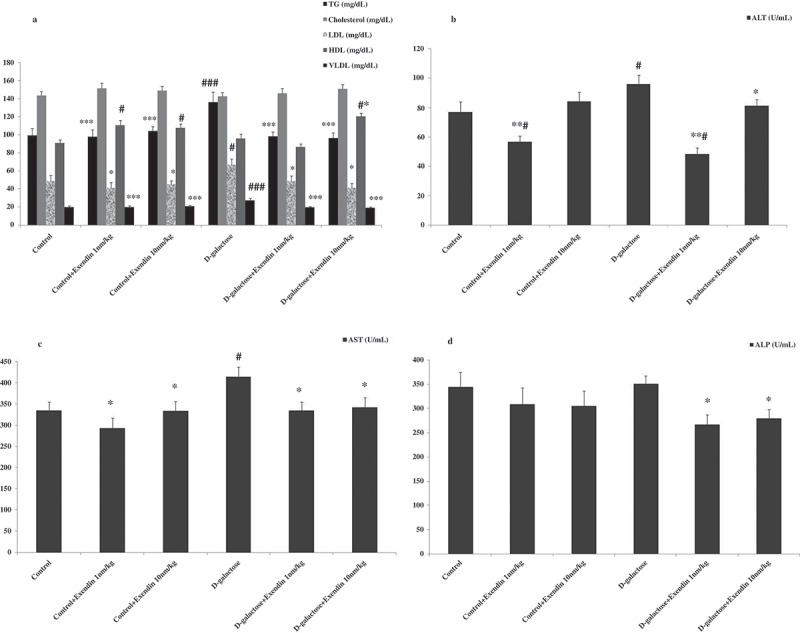
Investigations into pharmaceutical intervention of pancreatic and hepatic dysfunction associated with metabolic disturbances have received relatively little attention. The aim of this study was to investigate the protective effects of exendin-4 in mice receiving D-galactose, a reducing sugar that triggers ROS production and inflammatory mediators affecting the pancreas and liver. Exendin-4 is an United States Food and Drug Administration (FDA) approved glucagon-like peptide that increases insulin dependent glycogen synthesis and glucose uptake. Male NMRI mice (20-25 g), 3 months of age, were randomly divided into 6 groups of 12 mice each: control, exendin-4 (1 nmol/kg), exendin-4 (10 nmol/kg), D-galactose, D-galactose + exendin-4 (1 nmol/kg) and D-galactose + exendin-4 (10 nmol/kg). D-galactose (500 mg/kg) was given daily by oral gavage for 6 weeks. During the last 10 days, exendin-4 (1 and 10 nmol/kg) was injected intraperitoneally daily. Glucose, insulin, insulin resistance, lipid profiles, and hepatic enzyme levels significantly increased in the D-galactose group ( < 0.05), along with a significant decrease in superoxide dismutase activity and pancreatic islet insulin secretion ( < 0.05). Exendin-4 decreased D-galactose-induced increases in serum glucose and insulin, insulin resistance, lipid profiles, and hepatic enzymes, and improved pancreatic islet insulin secretion and antioxidant defense status. The results show that exendin-4 can prevent complications in mice with compromised pancreatic and hepatic function. Long term administration of D-galactose in mice may be a useful model to study insulin resistance, metabolic syndrome, and aging.
针对与代谢紊乱相关的胰腺和肝功能障碍的药物干预研究相对较少受到关注。本研究的目的是探讨艾塞那肽-4对接受D-半乳糖的小鼠的保护作用,D-半乳糖是一种还原糖,可引发活性氧生成和影响胰腺和肝脏的炎症介质。艾塞那肽-4是一种美国食品药品监督管理局(FDA)批准的胰高血糖素样肽,可增加胰岛素依赖性糖原合成和葡萄糖摄取。3月龄雄性NMRI小鼠(20-25克),随机分为6组,每组12只:对照组、艾塞那肽-4(1纳摩尔/千克)、艾塞那肽-4(10纳摩尔/千克)、D-半乳糖组、D-半乳糖+艾塞那肽-4(1纳摩尔/千克)和D-半乳糖+艾塞那肽-4(10纳摩尔/千克)。每天通过口服灌胃给予D-半乳糖(500毫克/千克),持续6周。在最后10天,每天腹腔注射艾塞那肽-4(1和10纳摩尔/千克)。D-半乳糖组的血糖、胰岛素、胰岛素抵抗、血脂和肝酶水平显著升高(<0.05),同时超氧化物歧化酶活性和胰岛胰岛素分泌显著降低(<0.05)。艾塞那肽-4降低了D-半乳糖诱导的血清葡萄糖、胰岛素、胰岛素抵抗、血脂和肝酶的升高,并改善了胰岛胰岛素分泌和抗氧化防御状态。结果表明,艾塞那肽-4可以预防胰腺和肝功能受损小鼠的并发症。长期给小鼠施用D-半乳糖可能是研究胰岛素抵抗、代谢综合征和衰老的有用模型。