Ou Jian-Jun, Shi Li-Juan, Xun Guang-Lei, Chen Chen, Wu Ren-Rong, Luo Xue-Rong, Zhang Feng-Yu, Zhao Jing-Ping
Mental Health Institute of The Second Xiangya Hospital and Key Laboratory of Psychiatry and Mental Health of Hunan Province, The Central South University, 139 Middle Renmin Road, Changsha, 410011, Hunan, P.R. China.
Division of Clinical Sciences, Lieber Institute for Brain Development, John Hopkins University Medical Campus, 855 N. Wolfe Street, Suite 300, Baltimore, MD, 21205, USA.
BMC Psychiatry. 2015 Jan 22;15:3. doi: 10.1186/s12888-015-0382-4.
Autism spectrum disorder (ASD) affects many aspects of family life, such as social and economic burden. Little investigation of this phenomenon has been carried out in China. We designed this study to evaluate the employment and financial burdens of families with ASD-diagnosed preschoolers.
Four hundred and fifty-nine nuclear families of children with ASD, 418 with some other disability (OD) and 424 with typically developing (TD) children were recruited for this study. Employment and financial burdens of families were evaluated using a structured questionnaire; logistic regression was used to examine differences in job change measures by group, and ordinal logistic regression was used to investigate the association between household income and group.
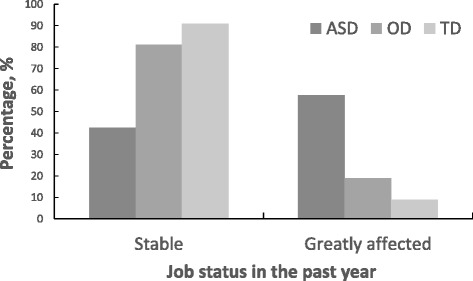
Fifty-eight percent of families with ASD children and 19% of families with OD children reported that childcare problems had greatly affected their employment decisions, compared with 9% of families with TD children (p < 0.001). Age of child, parental education and parental age notwithstanding, having a child with ASD and having a child with OD were both associated with increased odds of reporting that childcare greatly interfered with employment (ASD, OR: 15.936; OD, OR: 2.502; all p < 0.001) and decreased the odds of living in a higher-income household (ASD, estimate = -1.271; OD, estimate = -0.569; all p < 0.001). The average loss of annual income associated with having a child with ASD was Chinese RenMinBi (RMB) 44,077 ($7,226), compared with RMB 20,788 ($3,408) for families of OD children.
ASD is associated with severe employment and financial burdens, much more than for OD, in families with preschool children.
自闭症谱系障碍(ASD)会影响家庭生活的诸多方面,如社会和经济负担。中国对这一现象的研究较少。我们开展本研究以评估家中有被诊断为ASD的学龄前儿童的家庭所面临的就业和经济负担。
本研究招募了459个有ASD儿童的核心家庭、418个有其他残疾(OD)儿童的家庭和424个有发育正常(TD)儿童的家庭。使用结构化问卷评估家庭的就业和经济负担;采用逻辑回归分析不同组间工作变动指标的差异,采用有序逻辑回归分析家庭收入与组间的关联。
有ASD儿童的家庭中58%以及有OD儿童的家庭中19%报告称育儿问题极大地影响了他们的就业决策,而有TD儿童的家庭这一比例为9%(p<0.001)。尽管考虑了孩子年龄、父母教育程度和父母年龄,但家中有ASD儿童和有OD儿童均与报告育儿严重干扰就业的几率增加相关(ASD,比值比:15.936;OD,比值比:2.502;均p<0.001),且生活在高收入家庭的几率降低(ASD,估计值=-1.271;OD,估计值=-0.569;均p<0.001)。与家中有ASD儿童相关的家庭年均收入损失为人民币44,077元(7,226美元),而有OD儿童的家庭为人民币20,788元(3,408美元)。
在有学龄前儿童的家庭中,ASD相关的就业和经济负担比OD严重得多。