Zeng Wenjie, Finlayson Alexander E, Shankar Sushma, de Bruyn Winnie, Godman Brian
School of Management, Chongqing Jiaotong University, No.66 Xuefu Road, Nan'an District, Chongqing, 400074, China.
Green Templeton College, University of Oxford, Oxford, UK.
BMC Health Serv Res. 2015 Jan 22;15:11. doi: 10.1186/s12913-014-0638-6.
Pharmaceutical expenditure is currently rising by 16% per annum in China, greater in recent years. Initiatives to moderate growth include drug pricing regulations, essential medicine lists and encouraging generic prescribing. These are principally concentrated in hospitals, which currently account for over 80% of total pharmaceutical expenditure. However, no monitoring of prescribing and perverse incentives encouraging physicians and hospitals to profit from drug procurement encourages irrational prescribing. This includes greater utilisation of originators versus generics as well as injectables when cheaper oral equivalents are available. The objective of the paper is to assess changes in proton pump inhibitor (PPI) utilisation and expenditure in China as more generics become available including injectables.
Observational retrospective study of PPI utilisation and procured expenditure between 2004 and 2013 in the largest teaching hospital in Chongqing District as representative of China.
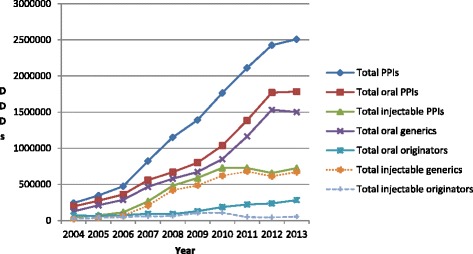
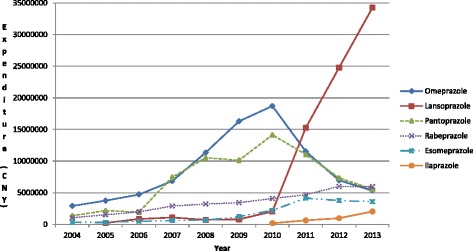
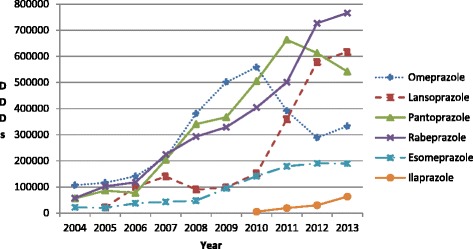
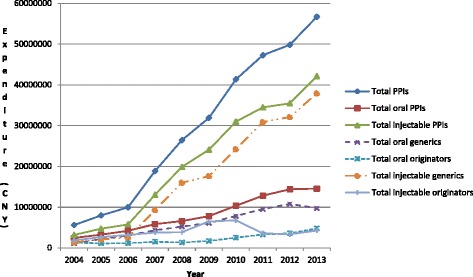
Appreciable increase in PPI utilisation during the study period rising 10.4 fold, with utilisation of generics rising faster than originators. Oral generics reached 84% of total oral preparations in 2013 (defined daily dose basis), with generic injectables 93% of total injectables by 2013. Injectables accounted for 42% of total PPI utilisations in 2008 and 2009 before falling to below 30%. Procured prices for oral preparations reduced over time (-34%). Generic oral omeprazole in 2010 was 87% below 2004 originator prices, mirroring reductions seen in Western Europe. Injectable prices also decreased over time (-19%). However, injectables typically 4.3 to 6.8 fold more expensive than equivalent orals - highest for injectable lansoprazole at 13.4 to 18.0 fold. High utilisation of more expensive oral PPIs as well as injectables meant that PPI expenditure increased 10.1 fold during the study period. Lower use of injectables, and only oral generic omeprazole, would result in accumulated savings of CNY249.65 million, reducing total accumulated expenditure by 84%.
Encouraging to see high utilisation of generic PPIs and low prices for oral generics. However, considerable opportunities to enhance prescribing efficiency through greater use of oral generic omeprazole.
目前中国的药品支出正以每年16%的速度增长,近年来增速更快。控制增长的举措包括药品定价监管、基本药物目录以及鼓励开通用名药处方。这些举措主要集中在医院,目前医院药品支出占总药品支出的80%以上。然而,缺乏对处方的监测以及存在鼓励医生和医院从药品采购中获利的不当激励措施,助长了不合理用药。这包括与通用名药相比更多地使用原研药,以及在有更便宜的口服等效药物时仍使用注射剂。本文的目的是评估随着更多通用名药(包括注射剂)的出现,中国质子泵抑制剂(PPI)使用情况和支出的变化。
对重庆地区最大的教学医院2004年至2013年期间PPI的使用情况和采购支出进行观察性回顾研究,该医院可代表中国情况。
在研究期间,PPI的使用量显著增加,增长了10.4倍,通用名药的使用量增长速度快于原研药。到2013年,口服通用名药占口服制剂总量的84%(按限定日剂量计算),到2013年通用名药注射剂占注射剂总量的93%。注射剂在2008年和2009年占PPI总使用量的42%,之后降至30%以下。口服制剂的采购价格随时间下降(-34%)。2010年通用名药奥美拉唑的价格比2004年原研药价格低87%,与西欧的降价情况相似。注射剂价格也随时间下降(-19%)。然而,注射剂通常比等效口服制剂贵4.3至6.8倍,注射用兰索拉唑最贵,为13.4至18.0倍。更昂贵的口服PPI以及注射剂的高使用量意味着在研究期间PPI支出增长了10.1倍。减少注射剂的使用,仅使用口服通用名药奥美拉唑,将累计节省2.4965亿元人民币,使累计总支出减少84%。
看到通用名PPI的高使用率和口服通用名药的低价格令人鼓舞。然而,通过更多地使用口服通用名药奥美拉唑,仍有很大机会提高处方效率。