Wolański Marcin, Donczew Rafał, Zawilak-Pawlik Anna, Zakrzewska-Czerwińska Jolanta
Department of Molecular Microbiology, Faculty of Biotechnology, University of Wrocław Wrocław, Poland.
Department of Microbiology, Ludwik Hirszfeld Institute of Immunology and Experimental Therapy, Polish Academy of Sciences Wrocław, Poland.
Front Microbiol. 2015 Jan 6;5:735. doi: 10.3389/fmicb.2014.00735. eCollection 2014.
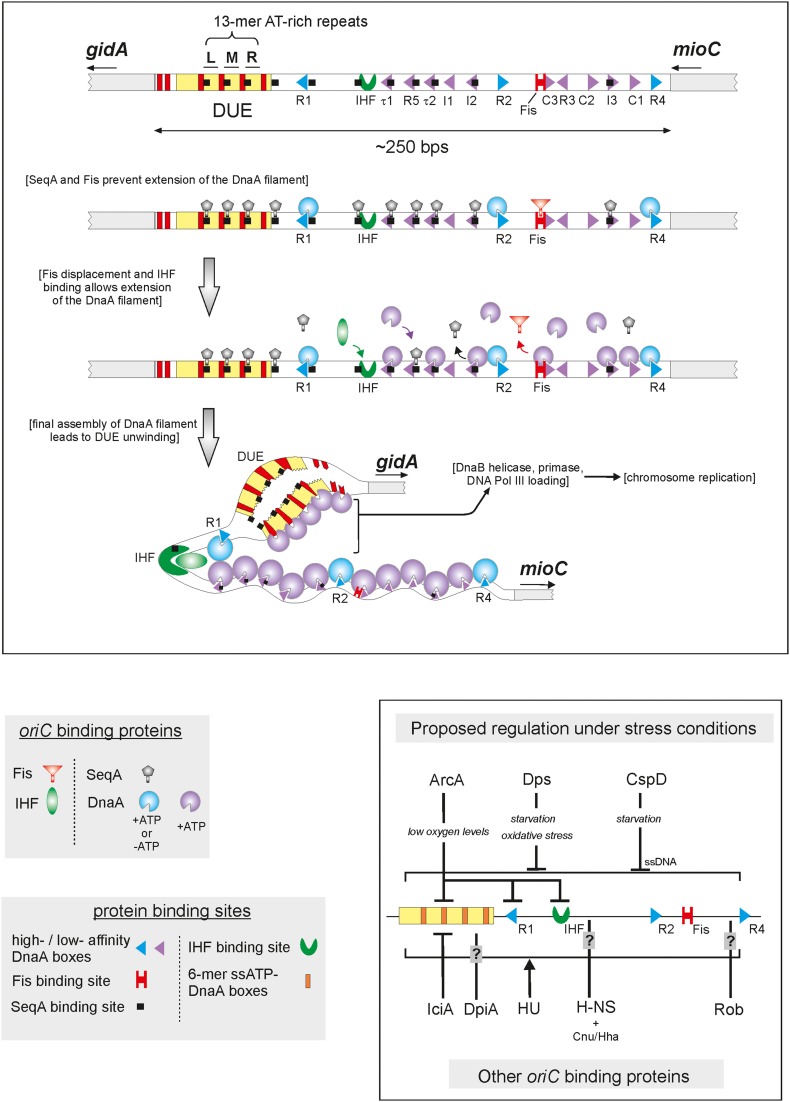
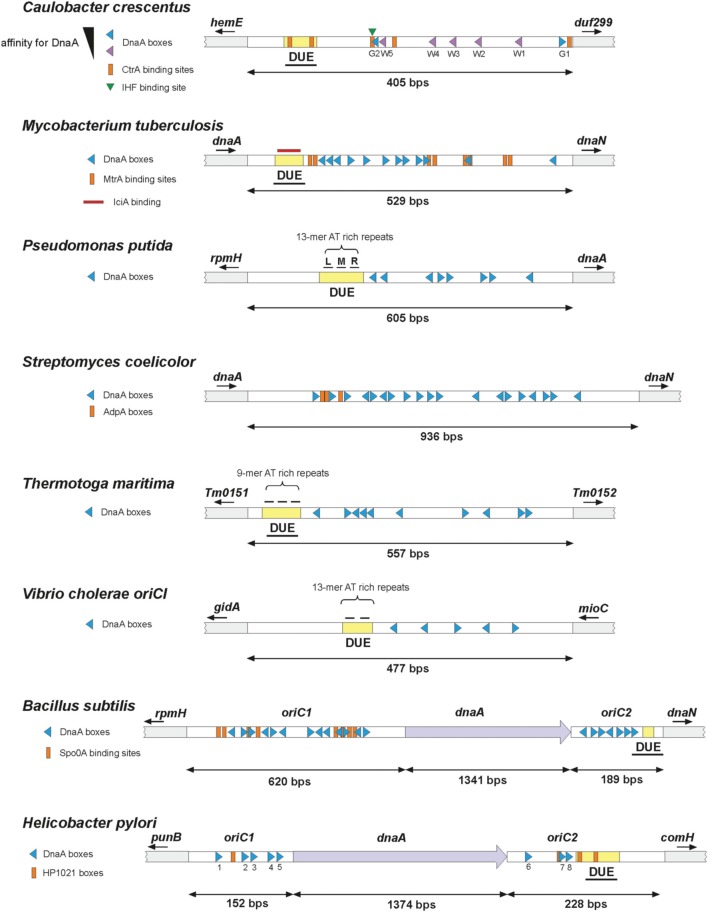
Replication of the bacterial chromosome initiates at a single origin of replication that is called oriC. This occurs via the concerted action of numerous proteins, including DnaA, which acts as an initiator. The origin sequences vary across species, but all bacterial oriCs contain the information necessary to guide assembly of the DnaA protein complex at oriC, triggering the unwinding of DNA and the beginning of replication. The requisite information is encoded in the unique arrangement of specific sequences called DnaA boxes, which form a framework for DnaA binding and assembly. Other crucial sequences of bacterial origin include DNA unwinding element (DUE, which designates the site at which oriC melts under the influence of DnaA) and binding sites for additional proteins that positively or negatively regulate the initiation process. In this review, we summarize our current knowledge and understanding of the information encoded in bacterial origins of chromosomal replication, particularly in the context of replication initiation and its regulation. We show that oriC encoded instructions allow not only for initiation but also for precise regulation of replication initiation and coordination of chromosomal replication with the cell cycle (also in response to environmental signals). We focus on Escherichia coli, and then expand our discussion to include several other microorganisms in which additional regulatory proteins have been recently shown to be involved in coordinating replication initiation to other cellular processes (e.g., Bacillus, Caulobacter, Helicobacter, Mycobacterium, and Streptomyces). We discuss diversity of bacterial oriC regions with the main focus on roles of individual DNA recognition sequences at oriC in binding the initiator and regulatory proteins as well as the overall impact of these proteins on the formation of initiation complex.
细菌染色体的复制起始于一个称为oriC的单一复制起点。这一过程通过多种蛋白质的协同作用来实现,其中包括作为起始因子的DnaA。不同物种的起始序列各不相同,但所有细菌的oriC都包含引导DnaA蛋白复合物在oriC处组装的必要信息,从而引发DNA解旋并开始复制。这些必要信息编码在特定序列(称为DnaA框)的独特排列中,这些序列构成了DnaA结合和组装的框架。细菌起始点的其他关键序列包括DNA解旋元件(DUE,它指定了oriC在DnaA影响下解链的位点)以及对起始过程起正向或负向调节作用的其他蛋白质的结合位点。在本综述中,我们总结了目前对细菌染色体复制起点所编码信息的认识和理解,特别是在复制起始及其调控方面。我们表明,oriC编码的指令不仅允许起始,还能精确调控复制起始,并使染色体复制与细胞周期协调(也可响应环境信号)。我们重点关注大肠杆菌,然后将讨论扩展到其他几种微生物,最近发现这些微生物中有额外的调节蛋白参与将复制起始与其他细胞过程协调起来(例如芽孢杆菌、柄杆菌、幽门螺杆菌、分枝杆菌和链霉菌)。我们讨论细菌oriC区域的多样性,主要关注oriC处各个DNA识别序列在结合起始因子和调节蛋白方面的作用,以及这些蛋白对起始复合物形成的总体影响。