Chang Ke-Vin, Hung Chen-Yu, Li Chia-Ming, Lin Yu-Hung, Wang Tyng-Guey, Tsai Keh-Sung, Han Der-Sheng
Department of Physical Medicine and Rehabilitation, National Taiwan University Hospital, Bei-Hu Branch and National Taiwan University College of Medicine, Taipei, Taiwan.
Department of Physical Medicine and Rehabilitation, National Taiwan University Hospital, Chu-Tung Branch, Hsinchu, Taiwan.
PLoS One. 2015 Jan 23;10(1):e0117167. doi: 10.1371/journal.pone.0117167. eCollection 2015.
The ageing process may lead to reductions in physical fitness, a known risk factor in the development of metabolic syndrome. The purpose of the current study was to evaluate cross-sectional and combined associations of metabolic syndrome with body composition and physical fitness in a community based geriatric population.
A total of 628 community-dwelling elders attending a geriatric health examination were enrolled in the study. The diagnosis of metabolic syndrome was based on the modified National Cholesterol Education Program Adult Treatment Panel III (NCEP ATP III) criterion with Asian cutoff of waist girth was adopted in this study. Body composition was obtained using bioimpedance analysis, and physical fitness was evaluated through the measurement of muscle strength (handgrip force), lower extremity muscle endurance (sit-to-stand test), flexibility (sit-and-reach test), and cardiorespiratory endurance (2-minute step test). Multivariable logistic regression and correlation analysis were performed to determine the association of metabolic syndrome with body composition and functionality variables.
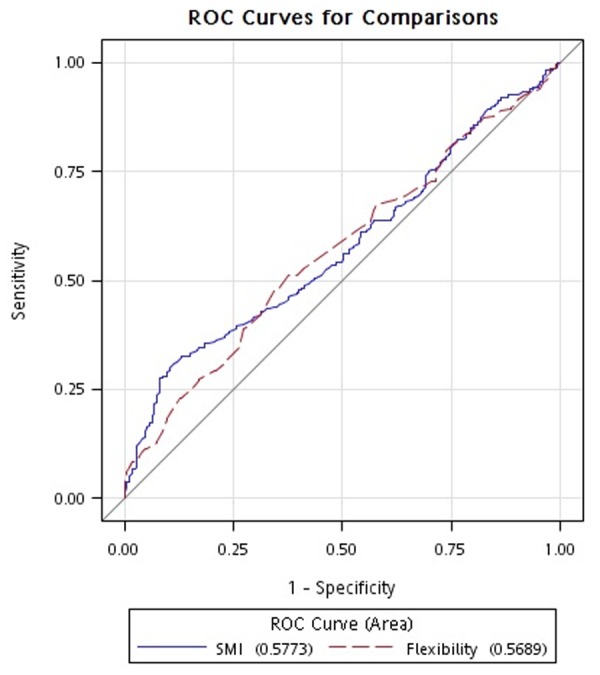
Metabolic syndrome was associated with increased skeletal muscle index (SMI) (odds ratio (OR), 1.61, 95% confidence interval (CI), 1.25-2.07) and decreased flexibility (OR, 0.97, 95% CI, 0.95-0.99) compared with those without metabolic syndrome. When body mass index was accounted for in the analysis, the association of SMI with metabolic syndrome was reduced. Waist circumference was positively correlated with SMI but negatively correlated with flexibility, whereas high density lipoprotein was positively correlated with flexibility but negatively correlated with SMI.
Reduced flexibility was positively associated with metabolic syndrome independent of age, gender, body composition, and functionality measurements in a community based geriatric population. Significant associations between metabolic syndrome with muscle strength and cardiorespiratory fitness in the elderly were not observed. Furthermore, flexibility should be included in the complete evaluation for metabolic syndrome.
衰老过程可能导致身体素质下降,这是代谢综合征发展过程中的一个已知风险因素。本研究的目的是评估基于社区的老年人群中代谢综合征与身体成分和身体素质之间的横断面关联及综合关联。
本研究纳入了628名参加老年健康检查的社区居住老年人。代谢综合征的诊断基于改良的美国国家胆固醇教育计划成人治疗小组第三次报告(NCEP ATP III)标准,本研究采用了亚洲人腰围切点。通过生物电阻抗分析获得身体成分,并通过测量肌肉力量(握力)、下肢肌肉耐力(坐立试验)、柔韧性(坐位体前屈试验)和心肺耐力(2分钟台阶试验)来评估身体素质。进行多变量逻辑回归和相关分析,以确定代谢综合征与身体成分和功能变量之间的关联。
与无代谢综合征者相比,代谢综合征与骨骼肌指数(SMI)增加(优势比(OR)为1.61,95%置信区间(CI)为1.25 - 2.07)和柔韧性降低(OR为0.97,95%CI为0.95 - 0.99)相关。在分析中考虑体重指数时,SMI与代谢综合征的关联减弱。腰围与SMI呈正相关,但与柔韧性呈负相关,而高密度脂蛋白与柔韧性呈正相关,但与SMI呈负相关。
在基于社区的老年人群中,柔韧性降低与代谢综合征呈正相关,且不受年龄、性别、身体成分和功能测量的影响。未观察到代谢综合征与老年人肌肉力量和心肺适能之间的显著关联。此外,在代谢综合征的全面评估中应纳入柔韧性。