van Rooij Daan, Hoekstra Pieter J, Mennes Maarten, von Rhein Daniel, Thissen Andrieke J A M, Heslenfeld Dirk, Zwiers Marcel P, Faraone Stephen V, Oosterlaan Jaap, Franke Barbara, Rommelse Nanda, Buitelaar Jan K, Hartman Catharina A
From the Department of Psychiatry, University Medical Center, University of Groningen, Groningen, the Netherlands; the Department of Cognitive Neuroscience, the Department of Psychiatry, and the Department of Human Genetics, Donders Institute for Brain, Cognition, and Behavior, Radboud University Nijmegen Medical Center, Nijmegen, the Netherlands; Karakter Child and Adolescent Psychiatry University Center Nijmegen, Nijmegen, the Netherlands; the Department of Psychology, VU University Amsterdam, Amsterdam, the Netherlands; and the Department of Psychiatry and the Department of Neuroscience and Physiology, SUNY Upstate Medical University, Syracuse, N.Y.
Am J Psychiatry. 2015 Jul;172(7):674-83. doi: 10.1176/appi.ajp.2014.13121635. Epub 2015 Jan 23.
Dysfunctional response inhibition is a key executive function impairment in attention deficit hyperactivity disorder (ADHD). Still, behavioral response inhibition measures do not consistently differentiate affected from unaffected individuals. The authors therefore investigated neural correlates of response inhibition and the familial nature of these neural correlates.
Functional MRI measurements of neural activation during the stop-signal task and behavioral measures of response inhibition were obtained in adolescents and young adults with ADHD (N=185), their unaffected siblings (N=111), and healthy comparison subjects (N=124).
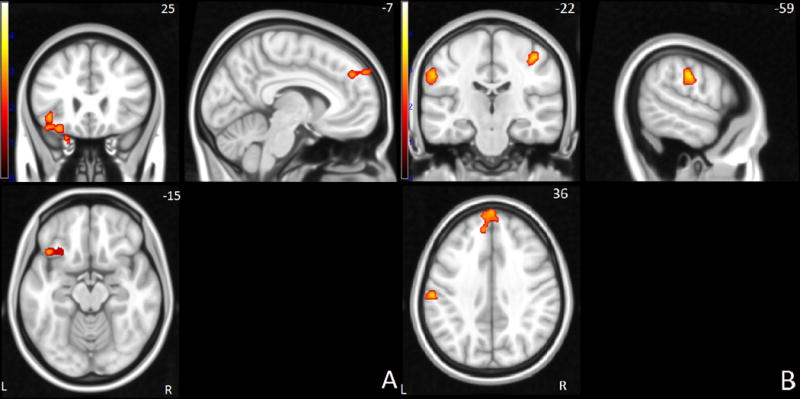
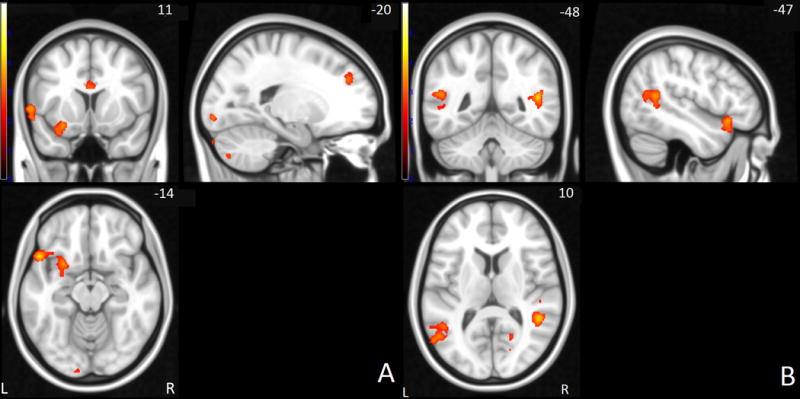
Stop-signal task reaction times were longer and error rates were higher in participants with ADHD, but not in their unaffected siblings, while reaction time variability was higher in both groups than in comparison subjects. Relative to comparison subjects, participants with ADHD and unaffected siblings had neural hypoactivation in frontal-striatal and frontal-parietal networks, whereby activation in inferior frontal and temporal/parietal nodes in unaffected siblings was intermediate between levels of participants with ADHD and comparison subjects. Furthermore, neural activation in inferior frontal nodes correlated with stop-signal reaction times, and activation in both inferior frontal and temporal/parietal nodes correlated with ADHD severity.
Neural activation alterations in ADHD are more robust than behavioral response inhibition deficits and explain variance in response inhibition and ADHD severity. Although only affected participants with ADHD have deficient response inhibition, hypoactivation in inferior frontal and temporal-parietal nodes in unaffected siblings supports the familial nature of the underlying neural process. Activation deficits in these nodes may be useful as endophenotypes that extend beyond the affected individuals in the family.
功能失调的反应抑制是注意力缺陷多动障碍(ADHD)中关键的执行功能损害。然而,行为反应抑制测量并不能始终如一地区分受影响个体和未受影响个体。因此,作者研究了反应抑制的神经相关性以及这些神经相关性的家族性质。
对患有ADHD的青少年和年轻人(N = 185)、他们未受影响的兄弟姐妹(N = 111)以及健康对照受试者(N = 124)进行了停止信号任务期间神经激活的功能磁共振成像测量和反应抑制的行为测量。
ADHD参与者的停止信号任务反应时间更长,错误率更高,但他们未受影响的兄弟姐妹则不然,而两组的反应时间变异性均高于对照受试者。相对于对照受试者,患有ADHD的参与者和未受影响的兄弟姐妹在额叶 - 纹状体和额叶 - 顶叶网络中存在神经激活不足,未受影响的兄弟姐妹的额下回和颞叶/顶叶节点的激活介于患有ADHD的参与者和对照受试者之间。此外,额下回节点的神经激活与停止信号反应时间相关,额下回和颞叶/顶叶节点的激活均与ADHD严重程度相关。
ADHD中的神经激活改变比行为反应抑制缺陷更显著,并解释了反应抑制和ADHD严重程度的差异。虽然只有受影响的ADHD参与者有反应抑制缺陷,但未受影响的兄弟姐妹的额下回和颞叶 - 顶叶节点的激活不足支持了潜在神经过程的家族性质。这些节点的激活缺陷可能作为超越家庭中受影响个体的内表型有用。