• 文献检索
  • 文档翻译
  • 深度研究
  • 学术资讯
  • Suppr Zotero 插件Zotero 插件
  • 邀请有礼
  • 套餐&价格
  • 历史记录
应用&插件
Suppr Zotero 插件Zotero 插件浏览器插件Mac 客户端Windows 客户端微信小程序
定价
高级版会员购买积分包购买API积分包
服务
文献检索文档翻译深度研究API 文档MCP 服务
关于我们
关于 Suppr公司介绍联系我们用户协议隐私条款
关注我们

Suppr 超能文献

核心技术专利:CN118964589B侵权必究
粤ICP备2023148730 号-1Suppr @ 2026

文献检索

告别复杂PubMed语法,用中文像聊天一样搜索,搜遍4000万医学文献。AI智能推荐,让科研检索更轻松。

立即免费搜索

文件翻译

保留排版,准确专业,支持PDF/Word/PPT等文件格式,支持 12+语言互译。

免费翻译文档

深度研究

AI帮你快速写综述,25分钟生成高质量综述,智能提取关键信息,辅助科研写作。

立即免费体验

一种使用基于网络的听力测试和主观评分的教室声学筛查方法。

A screening approach for classroom acoustics using web-based listening tests and subjective ratings.

作者信息

Persson Waye Kerstin, Magnusson Lennart, Fredriksson Sofie, Croy Ilona

机构信息

Occupational and Environmental Medicine, The Sahlgrenska Academy at the University of Gothenburg, Gothenburg, Sweden.

Department for Clinical Neuroscience and Rehabilitation, Section for Audiology, University of Gothenburg, Gothenburg, Sweden.

出版信息

PLoS One. 2015 Jan 23;10(1):e0116572. doi: 10.1371/journal.pone.0116572. eCollection 2015.

DOI:10.1371/journal.pone.0116572
PMID:25615692
原文链接:https://pmc.ncbi.nlm.nih.gov/articles/PMC4304827/
Abstract

BACKGROUND

Perception of speech is crucial in school where speech is the main mode of communication. The aim of the study was to evaluate whether a web based approach including listening tests and questionnaires could be used as a screening tool for poor classroom acoustics. The prime focus was the relation between pupils' comprehension of speech, the classroom acoustics and their description of the acoustic qualities of the classroom.

METHODOLOGY/PRINCIPAL FINDINGS: In total, 1106 pupils aged 13-19, from 59 classes and 38 schools in Sweden participated in a listening study using Hagerman's sentences administered via Internet. Four listening conditions were applied: high and low background noise level and positions close and far away from the loudspeaker. The pupils described the acoustic quality of the classroom and teachers provided information on the physical features of the classroom using questionnaires.

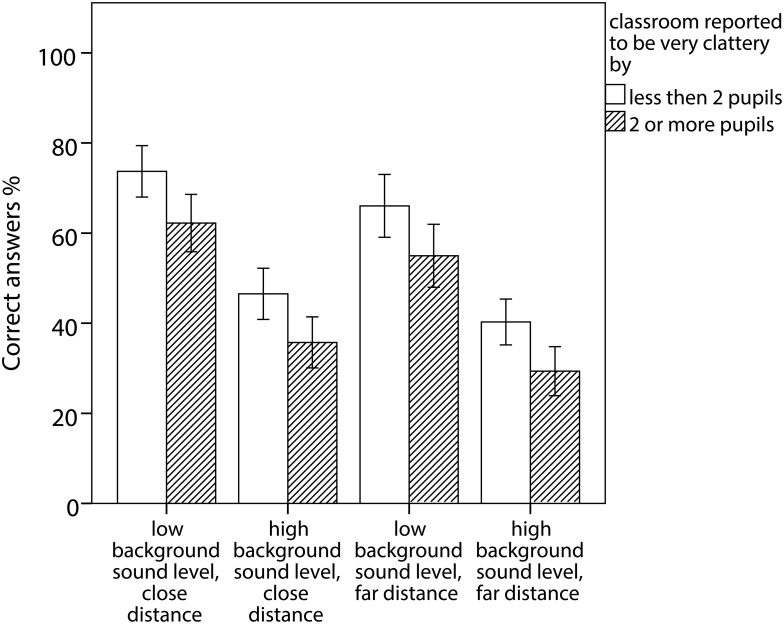
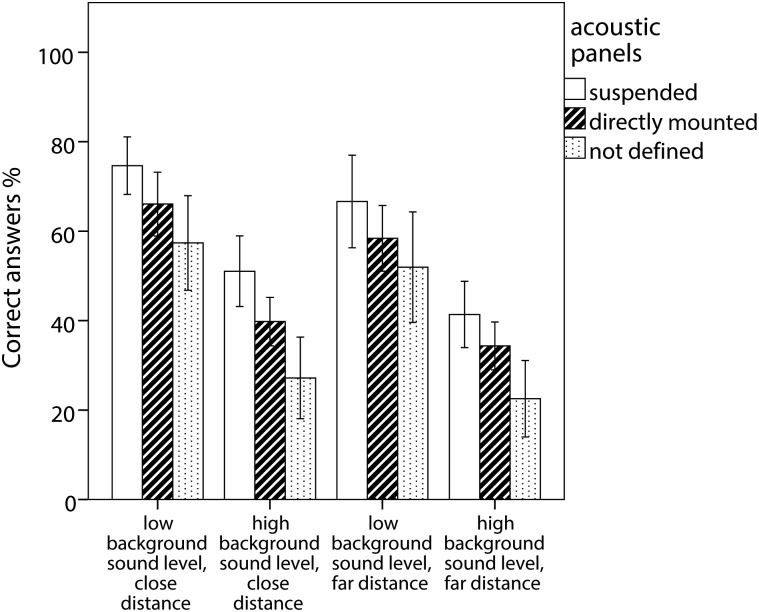
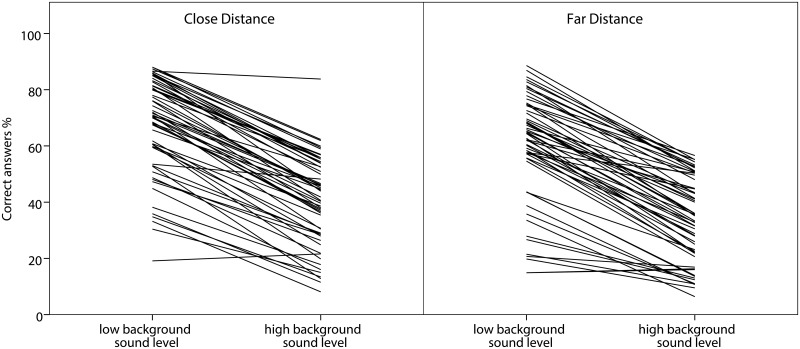
CONCLUSIONS/SIGNIFICANCE: In 69% of the classes, at least three pupils described the sound environment as adverse and in 88% of the classes one or more pupil reported often having difficulties concentrating due to noise. The pupils' comprehension of speech was strongly influenced by the background noise level (p<0.001) and distance to the loudspeakers (p<0.001). Of the physical classroom features, presence of suspended acoustic panels (p<0.05) and length of the classroom (p<0.01) predicted speech comprehension. Of the pupils' descriptions of acoustic qualities, clattery significantly (p<0.05) predicted speech comprehension. Clattery was furthermore associated to difficulties understanding each other, while the description noisy was associated to concentration difficulties. The majority of classrooms do not seem to have an optimal sound environment. The pupil's descriptions of acoustic qualities and listening tests can be one way of predicting sound conditions in the classroom.

摘要

背景

在以言语为主要交流方式的学校环境中,言语感知至关重要。本研究的目的是评估一种基于网络的方法,包括听力测试和问卷调查,是否可作为课堂声学不佳的筛查工具。主要关注点是学生的言语理解、课堂声学以及他们对教室声学质量的描述之间的关系。

方法/主要发现:瑞典38所学校的59个班级中,共有1106名13 - 19岁的学生参与了一项通过互联网进行的使用哈格曼句子的听力研究。应用了四种听力条件:高背景噪声水平和低背景噪声水平,以及靠近扬声器和远离扬声器的位置。学生们描述了教室的声学质量,教师通过问卷调查提供了有关教室物理特征的信息。

结论/意义:在69%的班级中,至少有三名学生将声音环境描述为不利,在88%的班级中,有一名或多名学生报告经常因噪音而难以集中注意力。学生的言语理解受到背景噪声水平(p<0.001)和与扬声器距离(p<0.001)的强烈影响。在教室的物理特征方面,吸音吊顶板的存在(p<0.05)和教室长度(p<0.01)可预测言语理解。在学生对声学质量的描述中,“噼里啪啦”显著(p<0.05)可预测言语理解。此外,“噼里啪啦”与相互理解困难相关,而“嘈杂”的描述与注意力集中困难相关。大多数教室似乎没有最佳的声音环境。学生对声学质量的描述和听力测试可以作为预测教室声音状况的一种方法。
https://cdn.ncbi.nlm.nih.gov/pmc/blobs/0dfd/4304827/1f8df83b3707/pone.0116572.g003.jpg
https://cdn.ncbi.nlm.nih.gov/pmc/blobs/0dfd/4304827/5c23f8c95185/pone.0116572.g001.jpg
https://cdn.ncbi.nlm.nih.gov/pmc/blobs/0dfd/4304827/abbf2e523966/pone.0116572.g002.jpg
https://cdn.ncbi.nlm.nih.gov/pmc/blobs/0dfd/4304827/1f8df83b3707/pone.0116572.g003.jpg
https://cdn.ncbi.nlm.nih.gov/pmc/blobs/0dfd/4304827/5c23f8c95185/pone.0116572.g001.jpg
https://cdn.ncbi.nlm.nih.gov/pmc/blobs/0dfd/4304827/abbf2e523966/pone.0116572.g002.jpg
https://cdn.ncbi.nlm.nih.gov/pmc/blobs/0dfd/4304827/1f8df83b3707/pone.0116572.g003.jpg

相似文献

1
A screening approach for classroom acoustics using web-based listening tests and subjective ratings.一种使用基于网络的听力测试和主观评分的教室声学筛查方法。
PLoS One. 2015 Jan 23;10(1):e0116572. doi: 10.1371/journal.pone.0116572. eCollection 2015.
2
Adolescents' perceptions of their school's acoustic environment: the development of an evidence based questionnaire.青少年对学校声学环境的认知:基于证据的问卷开发
Noise Health. 2013 Jul-Aug;15(65):269-80. doi: 10.4103/1463-1741.113525.
3
The impact of sound-field systems on learning and attention in elementary school classrooms.声场系统对小学教室学习和注意力的影响。
J Speech Lang Hear Res. 2012 Aug;55(4):1163-76. doi: 10.1044/1092-4388(2011/11-0026). Epub 2012 Jan 9.
4
Negative Effect of Acoustic Panels on Listening Effort in a Classroom Environment.吸音板对课堂环境中聆听努力的负面影响。
J Am Acad Audiol. 2016 Nov/Dec;27(10):805-815. doi: 10.3766/jaaa.15096.
5
Effects of noise and reverberation on speech perception and listening comprehension of children and adults in a classroom-like setting.在类似教室的环境中,噪音和混响对儿童及成人言语感知和听力理解的影响。
Noise Health. 2010 Oct-Dec;12(49):270-82. doi: 10.4103/1463-1741.70506.
6
The effect of different open plan and enclosed classroom acoustic conditions on speech perception in Kindergarten children.不同开放式和封闭式教室声学条件对幼儿园儿童言语感知的影响。
J Acoust Soc Am. 2015 Oct;138(4):2458-69. doi: 10.1121/1.4931903.
7
Investigating Listening Effort in Classrooms for 5- to 7-Year-Old Children.调查 5 至 7 岁儿童课堂上的听力努力程度。
Lang Speech Hear Serv Sch. 2019 Apr 23;50(2):196-210. doi: 10.1044/2018_LSHSS-18-0039.
8
The effect of room acoustics and sound-field amplification on word recognition performance in young adult listeners in suboptimal listening conditions.在次优聆听条件下,室内声学和声场放大对年轻成年听众单词识别表现的影响。
Am J Audiol. 2008 Jun;17(1):50-9. doi: 10.1044/1059-0889(2008/006).
9
Influence of Classroom Acoustics on Noise Disturbance and Well-Being for First Graders.教室声学对一年级学生噪声干扰及幸福感的影响。
Front Psychol. 2019 Dec 13;10:2736. doi: 10.3389/fpsyg.2019.02736. eCollection 2019.
10
Using personal response systems to assess speech perception within the classroom: an approach to determine the efficacy of sound field amplification in primary school classrooms.利用个人反应系统评估课堂内的言语感知:一种确定小学教室声场放大效果的方法。
Ear Hear. 2013 Jul-Aug;34(4):491-502. doi: 10.1097/AUD.0b013e31827ad76f.

引用本文的文献

1
How Children Perceive the Acoustic Environment of Their School.儿童如何感知他们学校的声学环境。
Noise Health. 2017 Mar-Apr;19(87):84-94. doi: 10.4103/nah.NAH_33_16.

本文引用的文献

1
Validation of a questionnaire measuring preschool children's reactions to and coping with noise in a repeated measurement design.验证一份用于测量学龄前儿童在重复测量设计中对噪声的反应和应对的问卷。
BMJ Open. 2013 May 28;3(5):e002408. doi: 10.1136/bmjopen-2012-002408.
2
A 3 year update on the influence of noise on performance and behavior.关于噪声对工作表现和行为影响的三年期更新报告。
Noise Health. 2012 Nov-Dec;14(61):292-6. doi: 10.4103/1463-1741.104896.
3
The effects of environmental and classroom noise on the academic attainments of primary school children.
环境噪音和教室噪音对小学生学业成绩的影响。
J Acoust Soc Am. 2008 Jan;123(1):133-44. doi: 10.1121/1.2812596.
4
Effect of age and cognition on childhood speech in noise perception abilities.年龄和认知对儿童噪声环境下言语感知能力的影响。
Audiol Neurootol. 2007;12(1):13-9. doi: 10.1159/000096153. Epub 2006 Oct 10.
5
Qualitative responses of children to environmental noise.儿童对环境噪音的定性反应。
Noise Health. 2003 Apr-Jun;5(19):19-30.
6
Annoyance and effects on work from environmental noise at school.学校环境噪声带来的烦恼及对学习的影响。
Noise Health. 2000;2(8):39-46.
7
Speech recognition threshold in slightly and fully modulated noise for hearing-impaired subjects.听力受损受试者在轻度和完全调制噪声中的言语识别阈值。
Int J Audiol. 2002 Sep;41(6):321-9. doi: 10.3109/14992020209090406.
8
Revisiting speech interference in classrooms.重新审视课堂上的言语干扰问题。
Audiology. 2001 Sep-Oct;40(5):221-44.
9
Children's perception of speech in multitalker babble.儿童对多人交谈中言语的感知。
J Acoust Soc Am. 2000 Dec;108(6):3023-9. doi: 10.1121/1.1323233.
10
Speech intelligibility prediction from calculated C50 values.根据计算出的C50值预测言语清晰度。
J Acoust Soc Am. 1995 Nov;98(5 Pt 1):2845-7. doi: 10.1121/1.413184.