Reither Eric N, Masters Ryan K, Yang Yang Claire, Powers Daniel A, Zheng Hui, Land Kenneth C
Department of Sociology and the Yun Kim Population Research Laboratory, Utah State University, 0730 Old Main Hill, Logan, UT 84322-0730, USA.
Department of Sociology and Institute of Behavioral Science, University of Colorado at Boulder, USA.
Soc Sci Med. 2015 Mar;128:356-65. doi: 10.1016/j.socscimed.2015.01.011. Epub 2015 Jan 13.
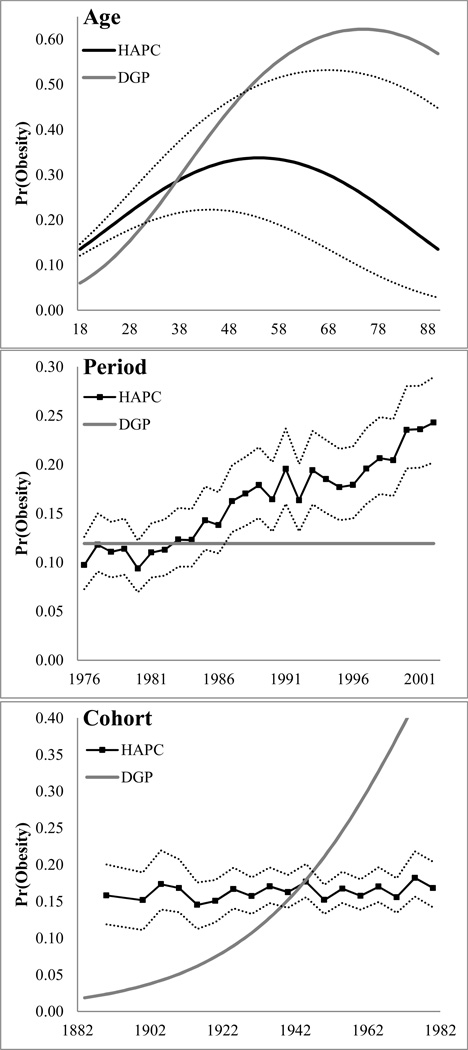
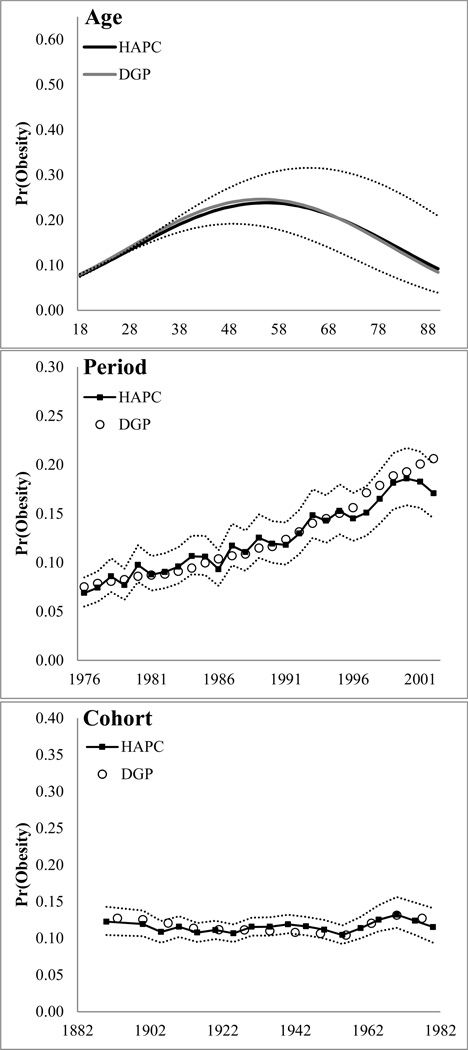
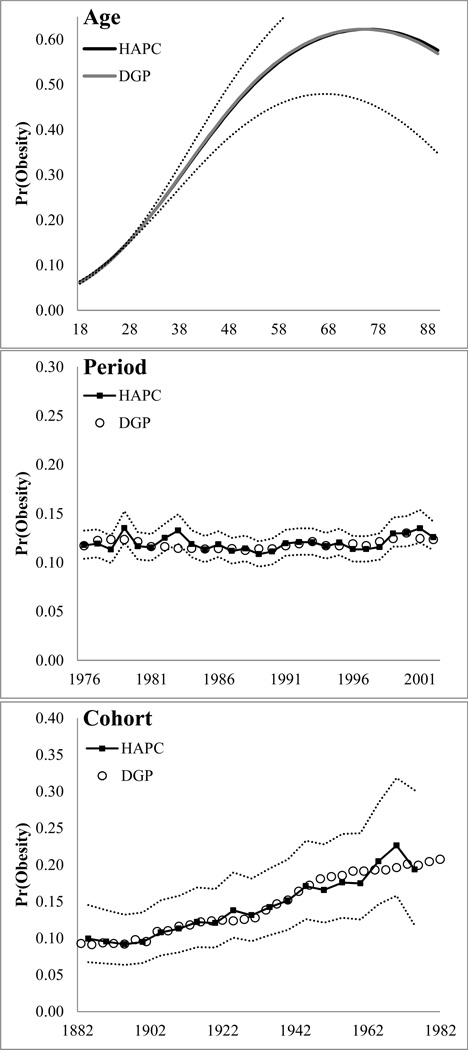
Social scientists have recognized the importance of age-period-cohort (APC) models for half a century, but have spent much of this time mired in debates about the feasibility of APC methods. Recently, a new class of APC methods based on modern statistical knowledge has emerged, offering potential solutions. In 2009, Reither, Hauser and Yang used one of these new methods - hierarchical APC (HAPC) modeling - to study how birth cohorts may have contributed to the U.S. obesity epidemic. They found that recent birth cohorts experience higher odds of obesity than their predecessors, but that ubiquitous period-based changes are primarily responsible for the rising prevalence of obesity. Although these findings have been replicated elsewhere, recent commentaries by Bell and Jones call them into question - along with the new class of APC methods. Specifically, Bell and Jones claim that new APC methods do not adequately address model identification and suggest that "solid theory" is often sufficient to remove one of the three temporal dimensions from empirical consideration. They also present a series of simulation models that purportedly show how the HAPC models estimated by Reither et al. (2009) could have produced misleading results. However, these simulation models rest on assumptions that there were no period effects, and associations between period and cohort variables and the outcome were perfectly linear. Those are conditions under which APC models should never be used. Under more tenable assumptions, our own simulations show that HAPC methods perform well, both in recovering the main findings presented by Reither et al. (2009) and the results reported by Bell and Jones. We also respond to critiques about model identification and theoretically-imposed constraints, finding little pragmatic support for such arguments. We conclude by encouraging social scientists to move beyond the debates of the 1970s and toward a deeper appreciation for modern APC methodologies.
半个世纪以来,社会科学家们已经认识到年龄-时期-队列(APC)模型的重要性,但在此期间的大部分时间里,他们都深陷于关于APC方法可行性的争论之中。最近,基于现代统计知识的一类新的APC方法出现了,提供了潜在的解决方案。2009年,赖瑟、豪泽和杨使用了这些新方法之一——分层APC(HAPC)建模——来研究出生队列可能如何导致了美国的肥胖流行。他们发现,与前辈相比,最近出生的队列肥胖几率更高,但肥胖患病率上升主要是由普遍存在的基于时期的变化造成的。尽管这些发现已在其他地方得到重复验证,但贝尔和琼斯最近的评论对这些发现以及这类新的APC方法提出了质疑。具体而言,贝尔和琼斯声称新的APC方法没有充分解决模型识别问题,并认为“坚实的理论”通常足以将三个时间维度之一从实证考虑中去除。他们还提出了一系列模拟模型,据称这些模型展示了赖瑟等人(2009年)估计的HAPC模型是如何产生误导性结果的。然而,这些模拟模型基于不存在时期效应以及时期与队列变量和结果之间的关联是完全线性的假设。而在这些条件下,APC模型根本就不应该被使用。在更合理的假设下,我们自己的模拟表明,HAPC方法表现良好,既能重现赖瑟等人(2009年)提出的主要发现,也能重现贝尔和琼斯报告的结果。我们还回应了关于模型识别和理论强加约束的批评,发现这些论点几乎没有实际依据。我们鼓励社会科学家们超越20世纪70年代的争论,更深入地理解现代APC方法,以此作为结论。