Watson Hannah, Bolton Mark, Monaghan Pat
Institute of Biodiversity, Animal Health and Comparative Medicine, University of Glasgow, Glasgow G12 8QQ, UK
RSPB Centre for Conservation Science, UK Headquarters, The Lodge, Sandy, Bedfordshire SG19 2DL, UK.
J Exp Biol. 2015 Mar;218(Pt 5):668-74. doi: 10.1242/jeb.104265. Epub 2015 Jan 23.
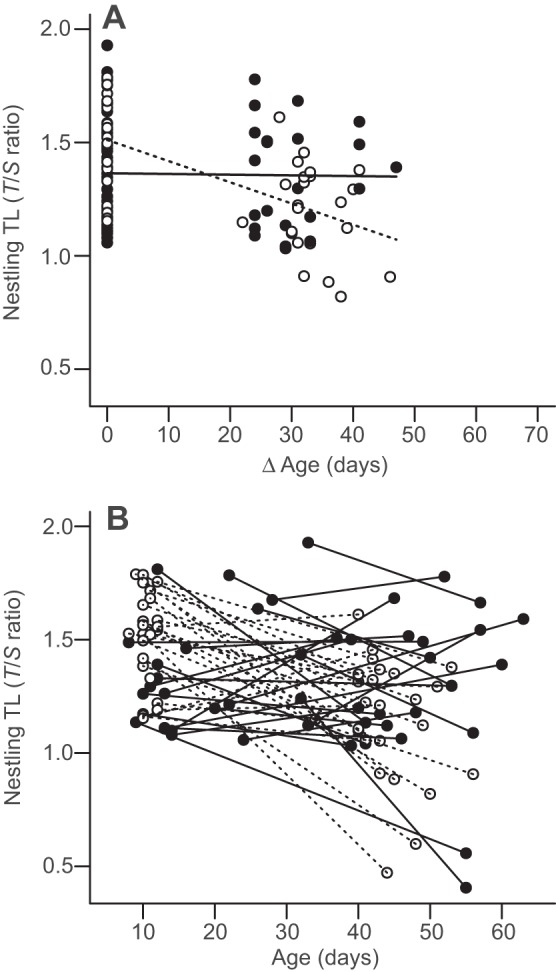
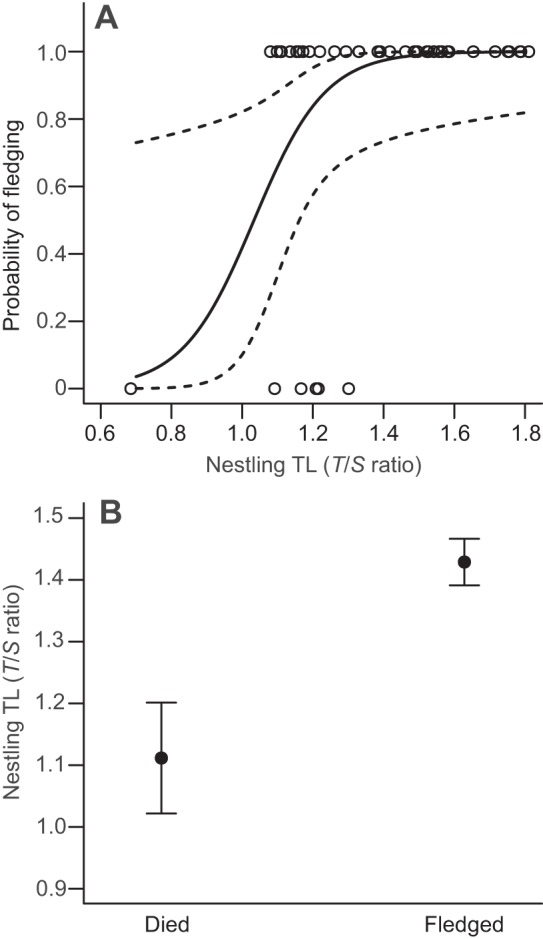
Conditions experienced during early life can have profound consequences for both short- and long-term fitness. Variation in the natal environment has been shown to influence survival and reproductive performance of entire cohorts in wild vertebrate populations. Telomere dynamics potentially provide a link between the early environment and long-term fitness outcomes, yet we know little about how the environment can influence telomere dynamics in early life. We found that environmental conditions during growth have an important influence on early-life telomere length (TL) and attrition in nestlings of a long-lived bird, the European storm petrel Hydrobates pelagicus. Nestlings reared under unfavourable environmental conditions experienced significantly greater telomere loss during postnatal development compared with nestlings reared under more favourable natal conditions, which displayed a negligible change in TL. There was, however, no significant difference in pre-fledging TL between cohorts. The results suggest that early-life telomere dynamics could contribute to the marked differences in life-history traits that can arise among cohorts reared under different environmental conditions. Early-life TL was also found to be a significant predictor of survival during the nestling phase, providing further evidence for a link between variation in TL and individual fitness. To what extent the relationship between early-life TL and mortality during the nestling phase is a consequence of genetic, parental and environmental factors is currently unknown, but it is an interesting area for future research. Accelerated telomere attrition under unfavourable conditions, as observed in this study, might play a role in mediating the effects of the early-life environment on later-life performance.
生命早期经历的状况会对短期和长期健康产生深远影响。已表明出生环境的差异会影响野生脊椎动物种群中整个群体的生存和繁殖表现。端粒动态变化可能在早期环境与长期健康结果之间提供一种联系,然而我们对环境如何在生命早期影响端粒动态变化知之甚少。我们发现,生长期间的环境条件对一种长寿鸟类——欧洲海燕(Hydrobates pelagicus)雏鸟的早期端粒长度(TL)和损耗有重要影响。与在更有利的出生条件下饲养的雏鸟相比,在不利环境条件下饲养的雏鸟在出生后发育期间端粒损失显著更大,而后者的TL变化可忽略不计。然而,不同群体之间离巢前的TL没有显著差异。结果表明,早期端粒动态变化可能导致在不同环境条件下饲养的群体之间出现明显的生活史特征差异。还发现早期TL是雏鸟期存活的一个重要预测指标,这为TL变化与个体健康之间的联系提供了进一步证据。目前尚不清楚早期TL与雏鸟期死亡率之间的关系在多大程度上是遗传、亲代和环境因素的结果,但这是未来研究的一个有趣领域。如本研究中所观察到的,在不利条件下加速的端粒损耗可能在介导生命早期环境对后期表现的影响中发挥作用。