Department of Virology, Tohoku University Graduate School of Medicine, 2-1 Seiryo-machi, Aoba-ku, Sendai, Miyagi, 980-8575, Japan.
Tohoku-RITM Collaborating Research Center on Emerging and Reemerging Infectious Diseases, RITM compound, FCC, Alabang, Muntinlupa City, 1781, Philippines.
BMC Vet Res. 2015 Jan 27;11:11. doi: 10.1186/s12917-015-0322-z.
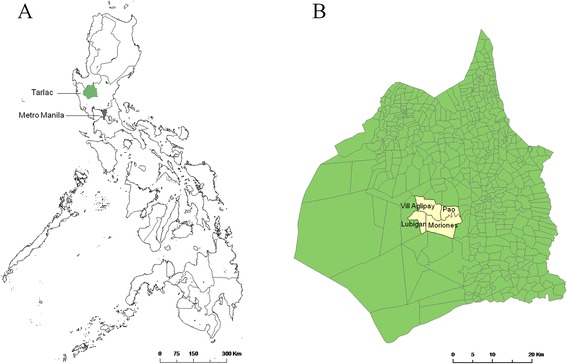
Hepatitis E virus (HEV) infection is a significant public health concern in Asia, and swine is an important source of sporadic HEV infection in human. However, no epidemiological data are available regarding HEV infection among the swine or human population in the Philippines. To assess the HEV infection status among pigs in rural areas, we investigated the molecular characteristics and seroprevalence of HEV among household-raised pigs in San Jose, Tarlac Province, the Philippines.
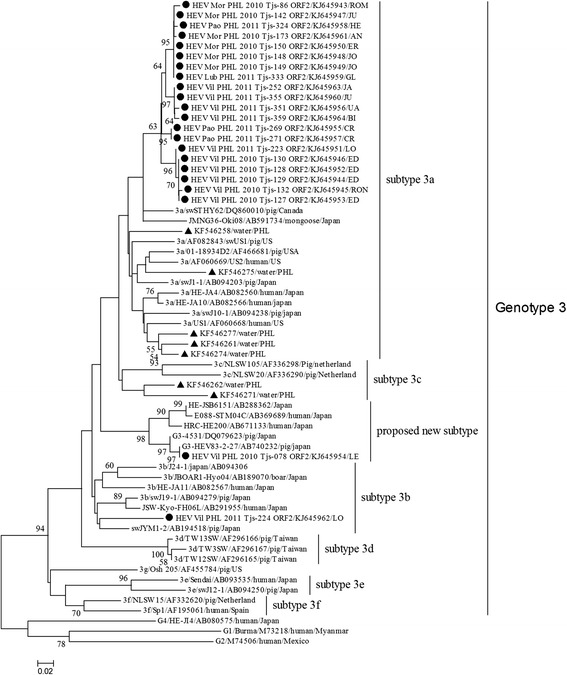
Serum and rectal swab samples were collected from 299 pigs aged 2-24 months from 155 households in four barangays (villages) between July 2010 and June 2011. Enzyme-linked immunosorbent assay (ELISA) revealed that 50.3% [95% confidence interval (CI) 44.5-56.2%] and 22.9% (95% CI 18.2-28.1%) of pigs tested positive for anti-HEV IgG and IgM, respectively. HEV RNA was detected in the feces of 22 pigs (7.4%, 95% CI 4.7-10.9%). A total of 103 households (66.5%, 95% CI 58.4-73.8%) had at least one pig that tested positive for anti-HEV IgG or IgM or HEV RNA. The prevalence of anti-HEV IgG and IgM in breeding pig (8-24 months) were higher than that in growing pigs (2-4 months) (p < 0.0001 and p = 0.008, respectively). HEV RNA was more frequently detected in 2-4-month-old pigs (9.2%, 95% CI 5.4-14.6%) than in ≥5-month-old pigs (4.8%, 95% CI 1.1-8.5%) without statistical significance (p = 0.142). HEV RNA showed 0-27.6% nucleotide difference at the partial ORF2 gene among the detected viruses, and a majority of them belonged to subtype 3a (20/22, 90.9%).
We found a high prevalence of HEV antibodies in the household-raised pig population in rural areas of the Philippines, which indicates the potential risk of HEV infection among local residents. Only genotype 3 of HEV was observed, and genetically diverse strains of HEV were found to be circulating in pigs in this study.
戊型肝炎病毒(HEV)感染是亚洲地区的一个重大公共卫生问题,猪是人类散发性 HEV 感染的重要来源。然而,目前尚无关于菲律宾猪群和人群中 HEV 感染的流行病学数据。为了评估农村地区猪群的 HEV 感染状况,我们调查了菲律宾塔拉克省圣何塞市家庭饲养的猪中 HEV 的分子特征和血清流行率。
2010 年 7 月至 2011 年 6 月,我们从四个村庄的 155 户家庭中采集了 299 头 2-24 月龄的猪的血清和直肠拭子样本。酶联免疫吸附试验(ELISA)显示,50.3%(95%置信区间 44.5-56.2%)和 22.9%(95%置信区间 18.2-28.1%)的猪抗 HEV IgG 和 IgM 检测呈阳性。22 头猪的粪便中检测到 HEV RNA(7.4%,95%置信区间 4.7-10.9%)。共有 103 户家庭(66.5%,95%置信区间 58.4-73.8%)至少有一头猪抗 HEV IgG 或 IgM 或 HEV RNA 检测呈阳性。种猪(8-24 月龄)的抗 HEV IgG 和 IgM 流行率高于生长猪(2-4 月龄)(p<0.0001 和 p=0.008)。2-4 月龄的猪中更频繁地检测到 HEV RNA(9.2%,95%置信区间 5.4-14.6%),而≥5 月龄的猪中则较少(4.8%,95%置信区间 1.1-8.5%),但无统计学意义(p=0.142)。在所检测的病毒中,ORF2 基因部分的 HEV RNA 核苷酸差异为 0-27.6%,其中大多数属于 3a 亚型(20/22,90.9%)。
我们发现菲律宾农村地区家庭饲养的猪群中存在较高的 HEV 抗体流行率,这表明当地居民存在潜在的 HEV 感染风险。仅观察到 HEV 的基因型 3,本研究发现了循环的 HEV 遗传多样株。