Puntumetakul Rungthip, Suvarnnato Thavatchai, Werasirirat Phurichaya, Uthaikhup Sureeporn, Yamauchi Junichiro, Boucaut Rose
School of Physical Therapy, Faculty of Associated Medical Sciences, Khon Kaen University, Khon Kaen, Thailand ; Research Center in Back, Neck, Other Joint Pain and Human Performance, Khon Kaen University, Khon Kaen, Thailand.
School of Physical Therapy, Faculty of Associated Medical Sciences, Khon Kaen University, Khon Kaen, Thailand ; Physical Therapy Unit, Srinagarind Hospital, Faculty of Medicine, Khon Kaen University, Khon Kaen, Thailand.
Neuropsychiatr Dis Treat. 2015 Jan 12;11:137-44. doi: 10.2147/NDT.S69579. eCollection 2015.
Thoracic spine manipulation has become a popular alternative to local cervical manipulative therapy for mechanical neck pain. This study investigated the acute effects of single-level and multiple-level thoracic manipulations on chronic mechanical neck pain (CMNP).
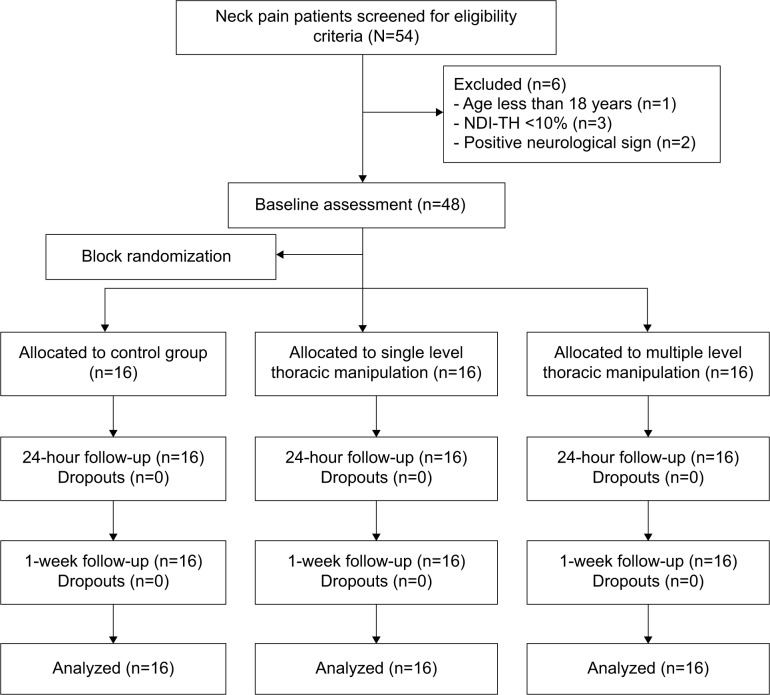
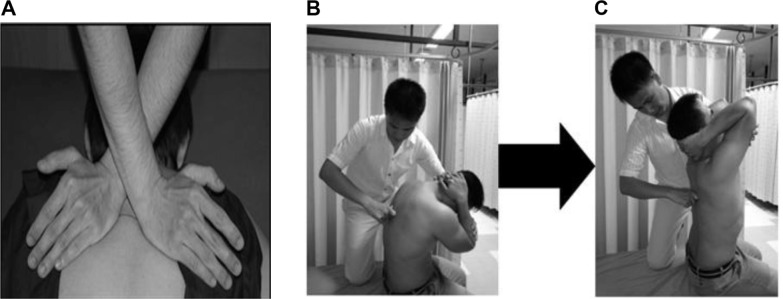
Forty-eight patients with CMNP were randomly allocated to single-level thoracic manipulation (STM) at T6-T7 or multiple-level thoracic manipulation (MTM), or to a control group (prone lying). Cervical range of motion (CROM), visual analog scale (VAS), and the Thai version of the Neck Disability Index (NDI-TH) scores were measured at baseline, and at 24-hour and at 1-week follow-up.
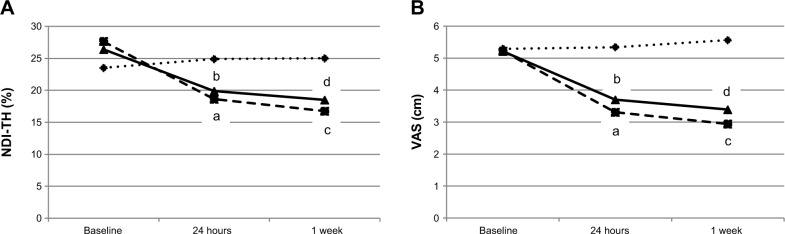
At 24-hour and 1-week follow-up, neck disability and pain levels were significantly (P<0.05) improved in the STM and MTM groups compared with the control group. CROM in flexion and left lateral flexion were increased significantly (P<0.05) in the STM group when compared with the control group at 1-week follow-up. The CROM in right rotation was increased significantly after MTM compared to the control group (P<0.05) at 24-hour follow-up. There were no statistically significant differences in neck disability, pain level at rest, and CROM between the STM and MTM groups.
These results suggest that both single-level and multiple-level thoracic manipulation improve neck disability, pain levels, and CROM at 24-hour and 1-week follow-up in patients with CMNP.
胸椎整复术已成为治疗机械性颈痛的局部颈椎整复疗法的一种流行替代方法。本研究调查了单节段和多节段胸椎整复术对慢性机械性颈痛(CMNP)的急性影响。
48例CMNP患者被随机分配至T6-T7单节段胸椎整复术(STM)组、多节段胸椎整复术(MTM)组或对照组(俯卧位)。在基线、24小时和1周随访时测量颈椎活动度(CROM)、视觉模拟量表(VAS)以及泰语版颈部功能障碍指数(NDI-TH)评分。
在24小时和1周随访时,与对照组相比,STM组和MTM组的颈部功能障碍和疼痛程度均有显著改善(P<0.05)。在1周随访时,与对照组相比,STM组的前屈和左侧屈CROM显著增加(P<0.05)。在24小时随访时,与对照组相比,MTM组后右旋转CROM显著增加(P<0.05)。STM组和MTM组在颈部功能障碍、静息时疼痛程度和CROM方面无统计学显著差异。
这些结果表明,单节段和多节段胸椎整复术均可在24小时和1周随访时改善CMNP患者的颈部功能障碍、疼痛程度和CROM。