Bener Abdulbari, Khattab Azhar O, Al-Dabbagh Mohamad M
Department of Medical Statistics and Epidemiology, Hamad Medical Corporation, Qatar ; Department of Public Health, Weill Cornell Medical College, Qatar ; Department Evidence for Population Health Unit, School of Epidemiology and Health Sciences, The University of Manchester, Manchester, UK.
Department of Pediatrics, Rumeilah Hospital and Hamad General Hospital, Hamad Medical Corporation, Qatar ; Department of Pediatrics, Weill Cornell Medical College, Qatar.
J Pediatr Neurosci. 2014 Sep-Dec;9(3):227-33. doi: 10.4103/1817-1745.147574.
To determine the association between Vitamin D and autism, and the difference in level of Vitamin D in autism children and control.
Case-control study conducted between June 2011 and May 2013, among autism at the Hamad Medical Corporation and controls at the School Health Clinics and Primary Health Care Clinics.
A total of 254 cases and 254 controls. The Autism Diagnostic Observation Schedule-Generic is a semi-structured, standardized assessment of social interaction, communication, play and imaginative use of materials for individuals suspected of having autism spectrum disorders. Data on clinical manifestations and laboratory, family history, body mass index (BMI) and clinical biochemistry variables including serum 25-hydroxy Vitamin D, calcium, phosphorus and magnesium were obtained. Univariate and multivariate statistical analyzes were performed.
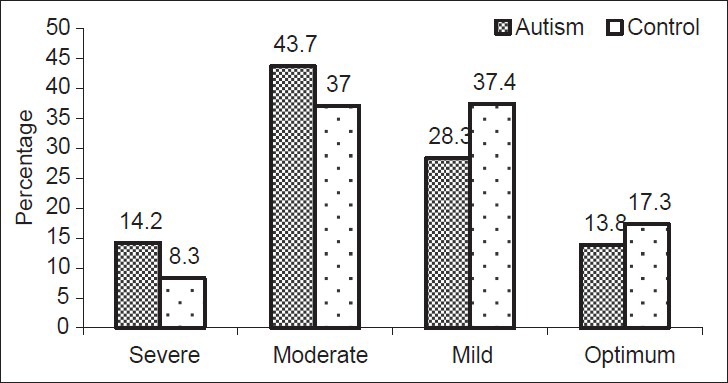
Of the total number of 508 children surveyed, 254 of autism and 254 of healthy children were contacted. The mean age (± standard deviation, in years) for autism versus control children was 5.51 ± 1.58 versus 5.76 ± 1.56. There were statistically significant differences between autism and healthy children control subjects with respect to educational level of mother (P = 0.016); occupation of mother (P = 0.005); BMI (P < 0.001); consanguinity (P = 0.015); exposure to sun (P = 0.002) and walking time per day <60 min (P < 0.001). The mean value of Vitamin D in autism children was much lower than the normal value, and there was a significant difference found in the mean values of Vitamin D between autism (18.39 ± 8.2 with median 18) and versus control children (21.59 ± 8.4) (P < 0.0001) and with median 21 (P = 0.004). Besides mean values of calcium, phosphorous, magnesium, glucose, potassium and alkaline phosphate were statistically significant higher in control healthy children compared to autism children (P < 0.001). Multivariate logistic regression analysis revealed that the mean serum Vitamin D level, calcium, consanguinity, BMI, physical activity, child order, and ferritin, were considered as the main factors associated with autism. Of total 254 of autism children, 14.2% had severe Vitamin D deficiency (<10 ng/ml), 43.7% had moderate insufficient levels (between 10 and 20 ng/ml), 28.3% had mild insufficient levels (between 20 and 30 ng/ml), and only 13.8% of autism had sufficient levels (>30 ng/ml). Similarly, of the total 254 of healthy children 8.3% had severe Vitamin D deficiency (<10 ng/ml), 37% had moderate insufficient levels (between 10 and 20 ng/ml), 37.4% had mild insufficient levels (between 20 and 30 ng/ml), and only 17.3% had sufficient levels (>30 ng/ml). Furthermore, there was statistically significant differences between autism and control subjects with respect to the serum level of Vitamin D (P = 0.023).
The present study revealed that Vitamin D deficiency was higher in autism children compared to healthy children and supplementing infants with Vitamin D might be a safe and more effective strategy for reducing the risk of autism.
确定维生素D与自闭症之间的关联,以及自闭症儿童与对照组儿童维生素D水平的差异。
2011年6月至2013年5月间进行的病例对照研究,研究对象为哈马德医疗公司的自闭症患者以及学校健康诊所和初级保健诊所的对照人群。
共254例病例和254名对照。《自闭症诊断观察量表通用版》是一种半结构化、标准化的评估工具,用于对疑似患有自闭症谱系障碍的个体的社交互动、沟通、游戏及对材料的想象性使用进行评估。收集了临床表现、实验室检查、家族史、体重指数(BMI)以及临床生化变量的数据,包括血清25-羟维生素D、钙、磷和镁。进行了单因素和多因素统计分析。
在总共调查的508名儿童中,联系到了254名自闭症儿童和254名健康儿童。自闭症儿童与对照儿童的平均年龄(±标准差,单位:岁)分别为5.51±1.58和5.76±1.56。自闭症儿童与健康对照儿童在母亲教育程度(P = 0.016)、母亲职业(P = 0.005)、BMI(P < 0.001)、近亲结婚(P = 0.015)、日照情况(P = 0.002)以及每天步行时间<60分钟(P < 0.001)方面存在统计学显著差异。自闭症儿童的维生素D平均值远低于正常值,自闭症儿童(18.39±8.2,中位数为18)与对照儿童(21.59±8.4)的维生素D平均值存在显著差异(P < 0.0001),中位数分别为18和21(P = 0.004)。此外,对照健康儿童的钙、磷、镁、葡萄糖、钾和碱性磷酸酶的平均值与自闭症儿童相比在统计学上显著更高(P < 0.001)。多因素逻辑回归分析显示,血清维生素D平均水平、钙、近亲结婚、BMI、身体活动、孩子出生顺序和铁蛋白被认为是与自闭症相关的主要因素。在总共254名自闭症儿童中,14.2%患有严重维生素D缺乏(<10 ng/ml),43.7%为中度不足(10至20 ng/ml之间),28.3%为轻度不足(20至30 ng/ml之间),只有13.8%的自闭症儿童维生素D水平充足(>30 ng/ml)。同样,在总共254名健康儿童中,8.3%患有严重维生素D缺乏(<10 ng/ml),37%为中度不足(10至20 ng/ml之间),37.4%为轻度不足(20至30 ng/ml之间),只有17.3%的儿童维生素D水平充足(>30 ng/ml)。此外,自闭症儿童与对照儿童在血清维生素D水平方面存在统计学显著差异(P = 0.023)。
本研究表明,自闭症儿童的维生素D缺乏情况高于健康儿童,给婴儿补充维生素D可能是降低自闭症风险的一种安全且更有效的策略。
