Gueven Nuri, Woolley Krystel, Smith Jason
Pharmacy, School of Medicine, University of Tasmania, Hobart, Australia.
School of Chemistry, University of Tasmania, Hobart, Australia.
Redox Biol. 2015;4:289-95. doi: 10.1016/j.redox.2015.01.009. Epub 2015 Jan 14.
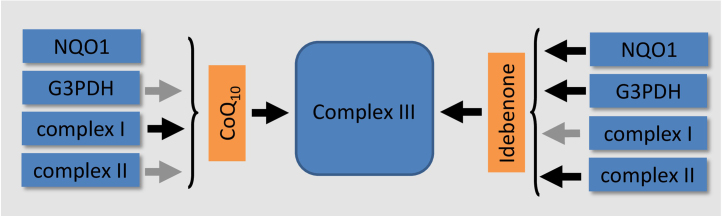
Coenzyme Q10 is a ubiquitous component of cellular membranes and belongs to the class of benzoquinones that mainly differ with regards to the length and composition of their hydrophobic tail. The characteristic quinone group can accept electrons from various biological sources and is converted by a one electron transfer to the unstable semiquinone or by a two electron transfer to the more stable hydroquinone. This feature makes CoQ10 the bona fide cellular electron transfer molecule within the mitochondrial respiratory chain and also makes it a potent cellular antioxidant. These activities serve as justification for its popular use as food supplement. Another quinone with similarities to the naturally occurring CoQ10 is idebenone, which shares its quinone moiety with CoQ10, but at the same time differs from CoQ10 by the presence of a much shorter, less lipophilic tail. However, despite its similarity to CoQ10, idebenone cannot be isolated from any natural sources but instead was synthesized and selected as a pharmacologically active compound in the 1980s by Takeda Pharmaceuticals purely based on its pharmacological properties. Several recent clinical trials demonstrated some therapeutic efficacy of idebenone in different indications and as a consequence, many practitioners question if the freely available CoQ10 could not be used instead. Here, we describe the molecular and pharmacological features of both molecules that arise from their structural differences to answer the question if idebenone is merely a CoQ10 analogue as frequently perpetuated in the literature or a pharmaceutical drug with entirely different features.
辅酶Q10是细胞膜中普遍存在的成分,属于苯醌类,主要区别在于其疏水尾的长度和组成。其特征性的醌基团可以从各种生物来源接受电子,并通过单电子转移转化为不稳定的半醌,或通过双电子转移转化为更稳定的氢醌。这一特性使辅酶Q10成为线粒体呼吸链中真正的细胞电子传递分子,也使其成为一种强大的细胞抗氧化剂。这些活性为其作为食品补充剂的广泛应用提供了依据。另一种与天然存在的辅酶Q10相似的醌是艾地苯醌,它与辅酶Q10共享醌部分,但同时又因存在更短、亲脂性更低的尾巴而与辅酶Q10不同。然而,尽管艾地苯醌与辅酶Q10相似,但它不能从任何天然来源中分离出来,而是在20世纪80年代由武田制药公司纯粹基于其药理特性合成并选为一种具有药理活性的化合物。最近的几项临床试验证明了艾地苯醌在不同适应症中的一些治疗效果,因此,许多从业者质疑是否可以使用现成的辅酶Q10来替代。在这里,我们描述了这两种分子由于其结构差异而产生的分子和药理特征,以回答艾地苯醌仅仅是文献中经常提到的辅酶Q10类似物,还是具有完全不同特征的药物这一问题。