Drechsler Axel, Helling Tobias, Steinfartz Sebastian
Department of Behavioural Biology, Unit of Molecular Ecology and Behaviour, University of Bielefeld Morgenbreede 45, D-33619, Bielefeld, Germany.
Department of Behavioural Biology, Unit of Molecular Ecology and Behaviour, University of Bielefeld Morgenbreede 45, D-33619, Bielefeld, Germany ; Zoological Institute, Department of Evolutionary Biology, Unit Molecular Ecology, Technische Universität Braunschweig, Mendelssohnstr. 4 38106, Braunschweig, Germany.
Ecol Evol. 2015 Jan;5(1):141-51. doi: 10.1002/ece3.1340. Epub 2014 Dec 8.
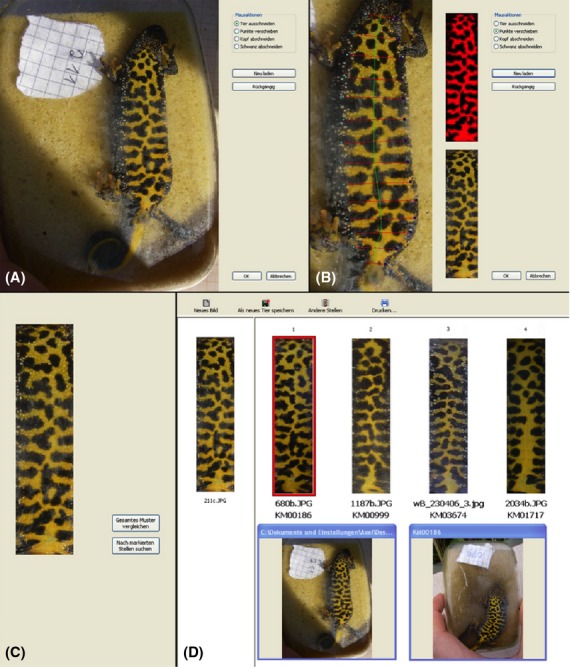
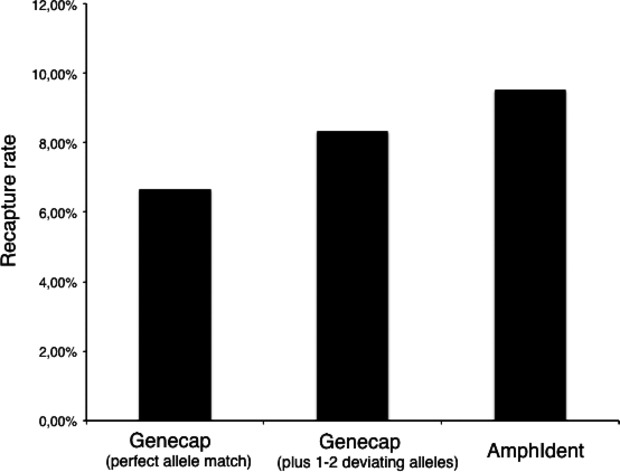
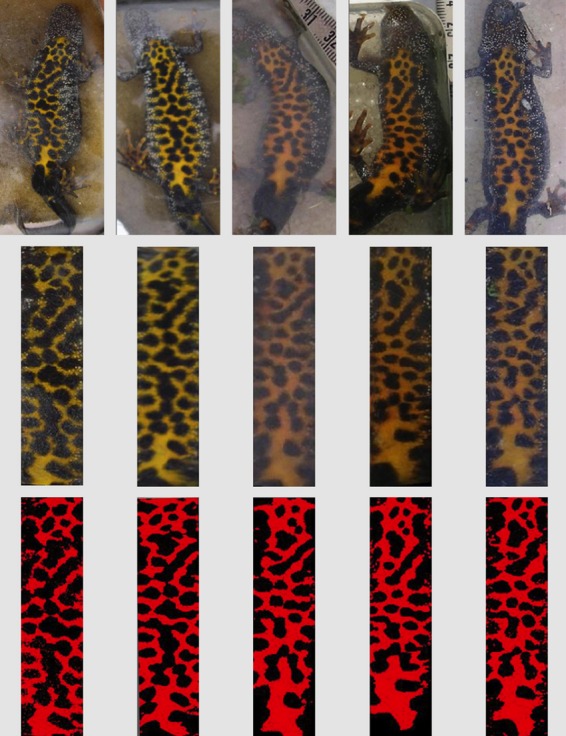
Capture-mark-recapture (CMR) approaches are the backbone of many studies in population ecology to gain insight on the life cycle, migration, habitat use, and demography of target species. The reliable and repeatable recognition of an individual throughout its lifetime is the basic requirement of a CMR study. Although invasive techniques are available to mark individuals permanently, noninvasive methods for individual recognition mainly rest on photographic identification of external body markings, which are unique at the individual level. The re-identification of an individual based on comparing shape patterns of photographs by eye is commonly used. Automated processes for photographic re-identification have been recently established, but their performance in large datasets (i.e., > 1000 individuals) has rarely been tested thoroughly. Here, we evaluated the performance of the program AMPHIDENT, an automatic algorithm to identify individuals on the basis of ventral spot patterns in the great crested newt (Triturus cristatus) versus the genotypic fingerprint of individuals based on highly polymorphic microsatellite loci using GENECAP. Between 2008 and 2010, we captured, sampled and photographed adult newts and calculated for 1648 samples/photographs recapture rates for both approaches. Recapture rates differed slightly with 8.34% for GENECAP and 9.83% for AMPHIDENT. With an estimated rate of 2% false rejections (FRR) and 0.00% false acceptances (FAR), AMPHIDENT proved to be a highly reliable algorithm for CMR studies of large datasets. We conclude that the application of automatic recognition software of individual photographs can be a rather powerful and reliable tool in noninvasive CMR studies for a large number of individuals. Because the cross-correlation of standardized shape patterns is generally applicable to any pattern that provides enough information, this algorithm is capable of becoming a single application with broad use in CMR studies for many species.
捕获-标记-重捕(CMR)方法是许多种群生态学研究的核心,用于深入了解目标物种的生命周期、迁徙、栖息地利用和种群统计学特征。在个体的整个生命周期内对其进行可靠且可重复的识别是CMR研究的基本要求。尽管有侵入性技术可用于永久性标记个体,但个体识别的非侵入性方法主要依赖于对个体层面独特的外部身体标记进行照片识别。基于肉眼比较照片形状模式来重新识别个体是常用的方法。最近已经建立了用于照片重新识别的自动化流程,但它们在大型数据集(即>1000个个体)中的性能很少得到充分测试。在这里,我们评估了AMPHIDENT程序的性能,这是一种基于大冠蝾螈(Triturus cristatus)腹侧斑点模式识别个体的自动算法,并将其与使用GENECAP基于高度多态微卫星位点的个体基因型指纹进行比较。在2008年至2010年期间,我们捕获、采样并拍摄了成年蝾螈,并针对1648个样本/照片计算了两种方法的重捕率。两种方法的重捕率略有不同,GENECAP为8.34%,AMPHIDENT为9.83%。AMPHIDENT的误拒率(FRR)估计为2%,误受率(FAR)为0.00%,被证明是用于大型数据集CMR研究的高度可靠算法。我们得出结论,个体照片自动识别软件的应用在针对大量个体的非侵入性CMR研究中可以是一个相当强大且可靠的工具。由于标准化形状模式的互相关通常适用于提供足够信息的任何模式,该算法有能力成为一种在许多物种的CMR研究中广泛应用的单一应用程序。