Wellborn Gary A, Langerhans R Brian
Department of Biology, University of Oklahoma Norman, Oklahoma, 73019.
Department of Biological Sciences and W.M. Keck Center for Behavioral Biology, North Carolina State University Campus Box 7617, Raleigh, North Carolina, 27695.
Ecol Evol. 2015 Jan;5(1):176-95. doi: 10.1002/ece3.1347. Epub 2014 Dec 17.
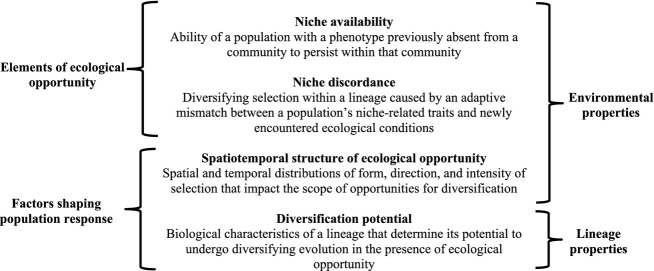
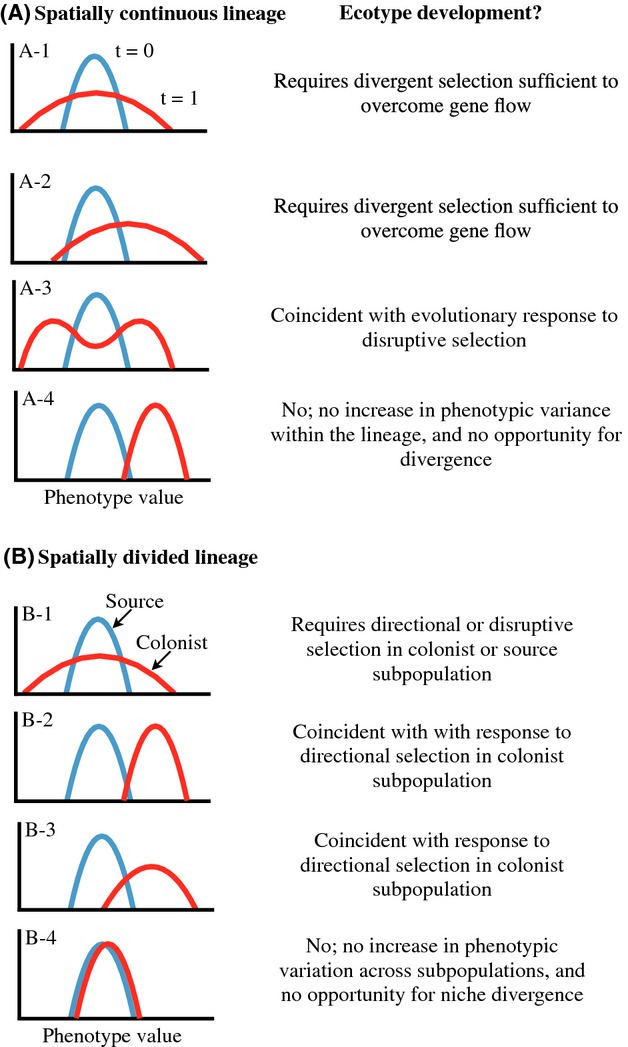
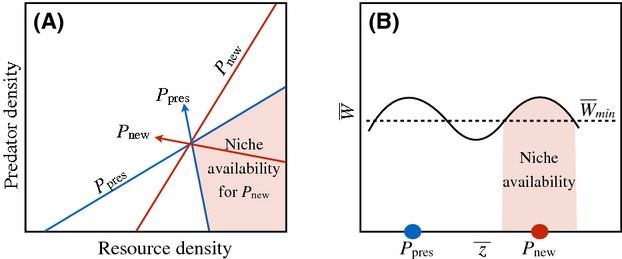
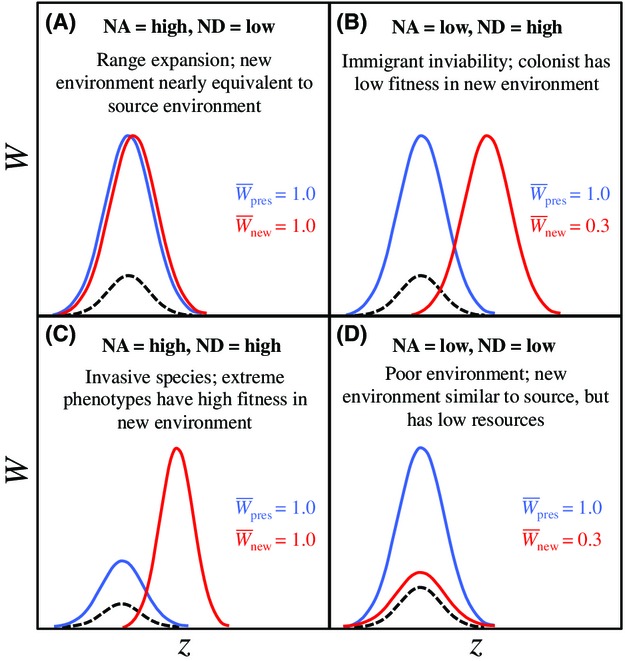
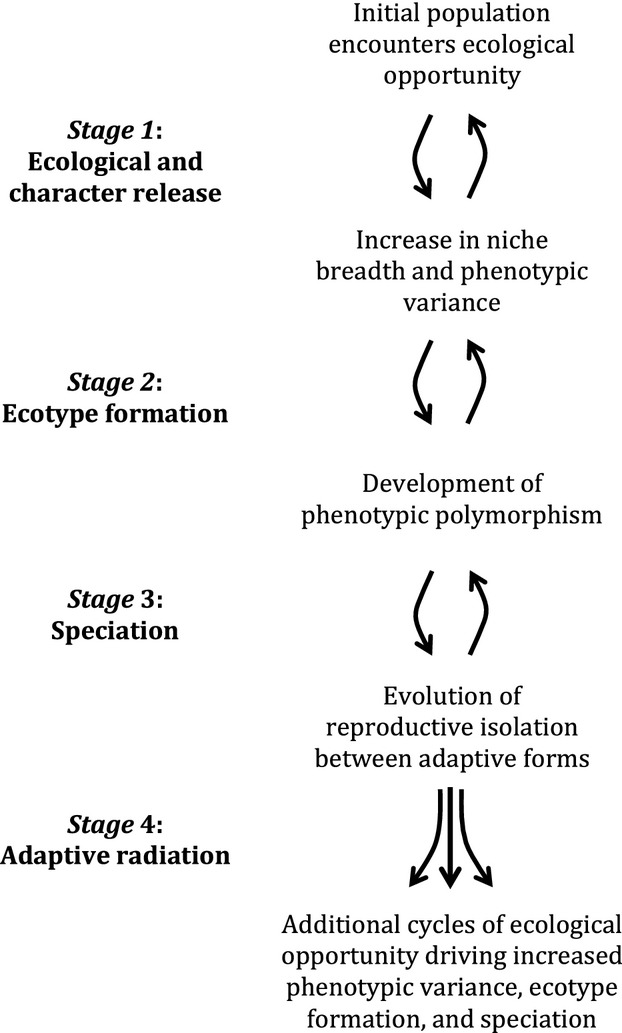
The tenet that ecological opportunity drives adaptive diversification has been central to theories of speciation since Darwin, yet no widely accepted definition or mechanistic framework for the concept currently exists. We propose a definition for ecological opportunity that provides an explicit mechanism for its action. In our formulation, ecological opportunity refers to environmental conditions that both permit the persistence of a lineage within a community, as well as generate divergent natural selection within that lineage. Thus, ecological opportunity arises from two fundamental elements: (1) niche availability, the ability of a population with a phenotype previously absent from a community to persist within that community and (2) niche discordance, the diversifying selection generated by the adaptive mismatch between a population's niche-related traits and the newly encountered ecological conditions. Evolutionary response to ecological opportunity is primarily governed by (1) spatiotemporal structure of ecological opportunity, which influences dynamics of selection and development of reproductive isolation and (2) diversification potential, the biological properties of a lineage that determine its capacity to diversify. Diversification under ecological opportunity proceeds as an increase in niche breadth, development of intraspecific ecotypes, speciation, and additional cycles of diversification that may themselves be triggered by speciation. Extensive ecological opportunity may exist in depauperate communities, but it is unclear whether ecological opportunity abates in species-rich communities. Because ecological opportunity should generally increase during times of rapid and multifarious environmental change, human activities may currently be generating elevated ecological opportunity - but so far little work has directly addressed this topic. Our framework highlights the need for greater synthesis of community ecology and evolutionary biology, unifying the four major components of the concept of ecological opportunity.
自达尔文以来,生态机遇驱动适应性多样化这一原则一直是物种形成理论的核心,但目前该概念尚无被广泛接受的定义或机制框架。我们提出了一个生态机遇的定义,为其作用提供了明确的机制。在我们的表述中,生态机遇指的是既允许一个谱系在群落中持续存在,又能在该谱系内产生分歧性自然选择的环境条件。因此,生态机遇源于两个基本要素:(1)生态位可用性,即具有先前群落中不存在的表型的种群在该群落中持续存在的能力;(2)生态位不一致性,即种群与生态位相关的性状与新遇到的生态条件之间的适应性不匹配所产生的多样化选择。对生态机遇的进化响应主要受以下因素支配:(1)生态机遇的时空结构,它影响选择动态和生殖隔离的发展;(2)多样化潜力,即决定一个谱系多样化能力的生物学特性。在生态机遇下的多样化表现为生态位宽度的增加、种内生态型的发展、物种形成以及可能由物种形成本身引发的额外多样化循环。在物种贫乏的群落中可能存在广泛的生态机遇,但尚不清楚在物种丰富的群落中生态机遇是否会减弱。由于在快速且多样的环境变化时期生态机遇通常会增加,人类活动目前可能正在产生更高的生态机遇——但到目前为止,很少有工作直接涉及这个话题。我们的框架强调了更深入整合群落生态学和进化生物学的必要性,将生态机遇概念的四个主要组成部分统一起来。