Cabili Moran N, Dunagin Margaret C, McClanahan Patrick D, Biaesch Andrew, Padovan-Merhar Olivia, Regev Aviv, Rinn John L, Raj Arjun
Broad Institute of MIT and Harvard, 7 Cambridge Center, Cambridge, MA, 02142, USA.
Department of Systems Biology, Harvard Medical School, Boston, MA, 02115, USA.
Genome Biol. 2015 Jan 29;16(1):20. doi: 10.1186/s13059-015-0586-4.
Long non-coding RNAs (lncRNAs) have been implicated in diverse biological processes. In contrast to extensive genomic annotation of lncRNA transcripts, far fewer have been characterized for subcellular localization and cell-to-cell variability. Addressing this requires systematic, direct visualization of lncRNAs in single cells at single-molecule resolution.
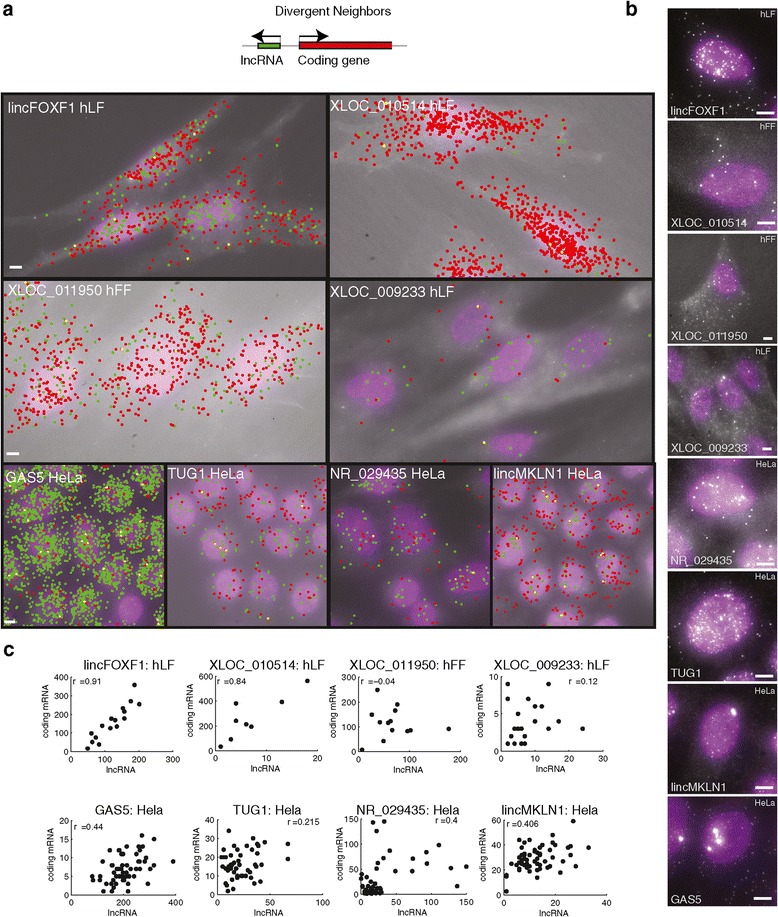
We use single-molecule RNA-FISH to systematically quantify and categorize the subcellular localization patterns of a representative set of 61 lncRNAs in three different cell types. Our survey yields high-resolution quantification and stringent validation of the number and spatial positions of these lncRNA, with an mRNA set for comparison. Using this highly quantitative image-based dataset, we observe a variety of subcellular localization patterns, ranging from bright sub-nuclear foci to almost exclusively cytoplasmic localization. We also find that the low abundance of lncRNAs observed from cell population measurements cannot be explained by high expression in a small subset of 'jackpot' cells. Additionally, nuclear lncRNA foci dissolve during mitosis and become widely dispersed, suggesting these lncRNAs are not mitotic bookmarking factors. Moreover, we see that divergently transcribed lncRNAs do not always correlate with their cognate mRNA, nor do they have a characteristic localization pattern.
Our systematic, high-resolution survey of lncRNA localization reveals aspects of lncRNAs that are similar to mRNAs, such as cell-to-cell variability, but also several distinct properties. These characteristics may correspond to particular functional roles. Our study also provides a quantitative description of lncRNAs at the single-cell level and a universally applicable framework for future study and validation of lncRNAs.
长链非编码RNA(lncRNA)参与多种生物学过程。与lncRNA转录本广泛的基因组注释相比,对其亚细胞定位和细胞间变异性的表征要少得多。解决这个问题需要在单分子分辨率下对单细胞中的lncRNA进行系统、直接的可视化。
我们使用单分子RNA荧光原位杂交技术(RNA-FISH)对三种不同细胞类型中一组具有代表性的61种lncRNA的亚细胞定位模式进行系统定量和分类。我们的研究通过一组mRNA作为对照,对这些lncRNA的数量和空间位置进行了高分辨率定量和严格验证。利用这个基于图像的高定量数据集,我们观察到了多种亚细胞定位模式,从明亮的核内亚结构域到几乎完全位于细胞质中。我们还发现,从细胞群体测量中观察到的lncRNA低丰度不能用一小部分“幸运”细胞中的高表达来解释。此外,核lncRNA亚结构域在有丝分裂期间溶解并广泛分散,这表明这些lncRNA不是有丝分裂的标记因子。而且,我们发现反向转录的lncRNA并不总是与其同源mRNA相关,也没有特征性的定位模式。
我们对lncRNA定位的系统、高分辨率研究揭示了lncRNA与mRNA相似的方面,如细胞间变异性,但也有几个不同的特性。这些特征可能对应于特定的功能作用。我们的研究还提供了单细胞水平上lncRNA的定量描述以及一个普遍适用的框架,用于未来lncRNA的研究和验证。