Pratoomsoot Chayanin, Sruamsiri Rosarin, Dilokthornsakul Piyameth, Chaiyakunapruk Nathorn
Faculty of Public Health, Naresuan University, Phitsanulok, Thailand.
Center of Pharmaceutical Outcomes Research, Department of Pharmacy Practice, Faculty of Pharmaceutical Sciences, Naresuan University, Phitsanulok, Thailand; Department of Population Medicine, Drug Policy Research Group, Harvard Medical School & Harvard Pilgrim Health Care Institute, Boston, MA, United States of America.
PLoS One. 2015 Jan 29;10(1):e108681. doi: 10.1371/journal.pone.0108681. eCollection 2015.
Many randomised controlled trials (RCTs) of herbal interventions have been conducted in the ASEAN Communities. Good quality reporting of RCTs is essential for assessing clinical significance. Given the importance ASEAN placed on herbal medicines, the reporting quality of RCTs of herbal interventions among the ASEAN Communities deserved a special attention.
To systematically review the quality of reporting of RCTs of herbal interventions conducted in the ASEAN Plus Six Countries.
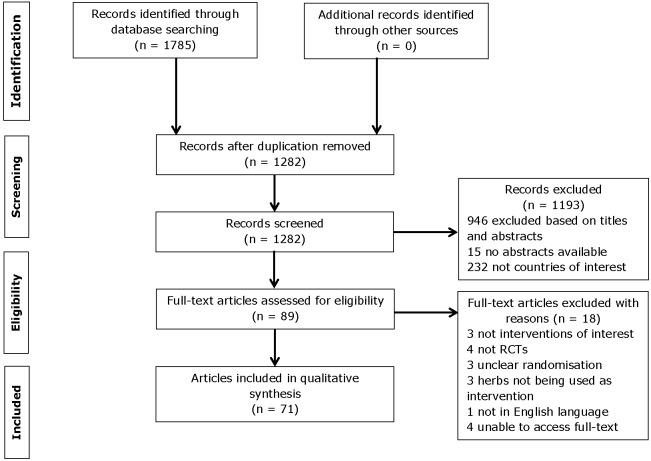
Searches were performed using PubMed, EMBASE, The Cochrane Library, and Allied and Complementary Medicine (AMED), from inception through October 2013. These were limited to studies specific to humans and RCTs. Herbal species search terms were based on those listed in the National List of Essential Medicines [NLEM (Thailand, 2011)]. Studies conducted in the ASEAN Plus Six Countries, published in English were included.
Seventy-one articles were identified. Thirty (42.25%) RCTs were from ASEAN Countries, whereas 41 RCTs (57.75%) were from Plus Six Group. Adherence to the recommended CONSORT checklist items for reporting of RCTs of herbal interventions among ASEAN Plus Six Countries ranged from 0% to 97.18%. Less than a quarter of the RCTs (18.31%) reported information on standardisation of the herbal products. However, the scope of our interventions of interest was limited to those developed from 20 herbal species listed in the NLEM of Thailand.
The present study highlights the need to improve reporting quality of RCTs of herbal interventions across ASEAN Plus Six Communities.
东盟国家开展了许多草药干预的随机对照试验(RCT)。高质量报告RCT对于评估临床意义至关重要。鉴于东盟对草药的重视,东盟国家中草药干预RCT的报告质量值得特别关注。
系统评价东盟加六国开展的草药干预RCT的报告质量。
检索PubMed、EMBASE、Cochrane图书馆和补充与替代医学数据库(AMED),检索时间从建库至2013年10月。检索限于针对人类的研究和RCT。草药种类检索词基于《国家基本药物目录》(泰国,2011年)中列出的那些。纳入在东盟加六国开展且以英文发表的研究。
共识别出71篇文章。30项(42.25%)RCT来自东盟国家,而41项RCT(57.75%)来自六国集团。东盟加六国中,草药干预RCT报告对推荐的CONSORT清单项目的依从率在0%至97.18%之间。不到四分之一的RCT(18.31%)报告了草药产品标准化的信息。然而,我们感兴趣的干预范围仅限于泰国《国家基本药物目录》中列出的20种草药所开发的产品。
本研究强调了提高东盟加六国草药干预RCT报告质量的必要性。