Qi Xingshun, De Stefano Valerio, Su Chunping, Bai Ming, Guo Xiaozhong, Fan Daiming
From the Department of Gastroenterology (XQ, XG), General Hospital of Shenyang Military Area, Shenyang; Xijing Hospital of Digestive Diseases (XQ, MB, DF), Fourth Military Medical University, Xi'an, China; Institute of Hematology (VDS), Catholic University, Rome, Italy; and Library of Fourth Military Medical University (CS), Xi'an, China.
Medicine (Baltimore). 2015 Jan;94(4):e496. doi: 10.1097/MD.0000000000000496.
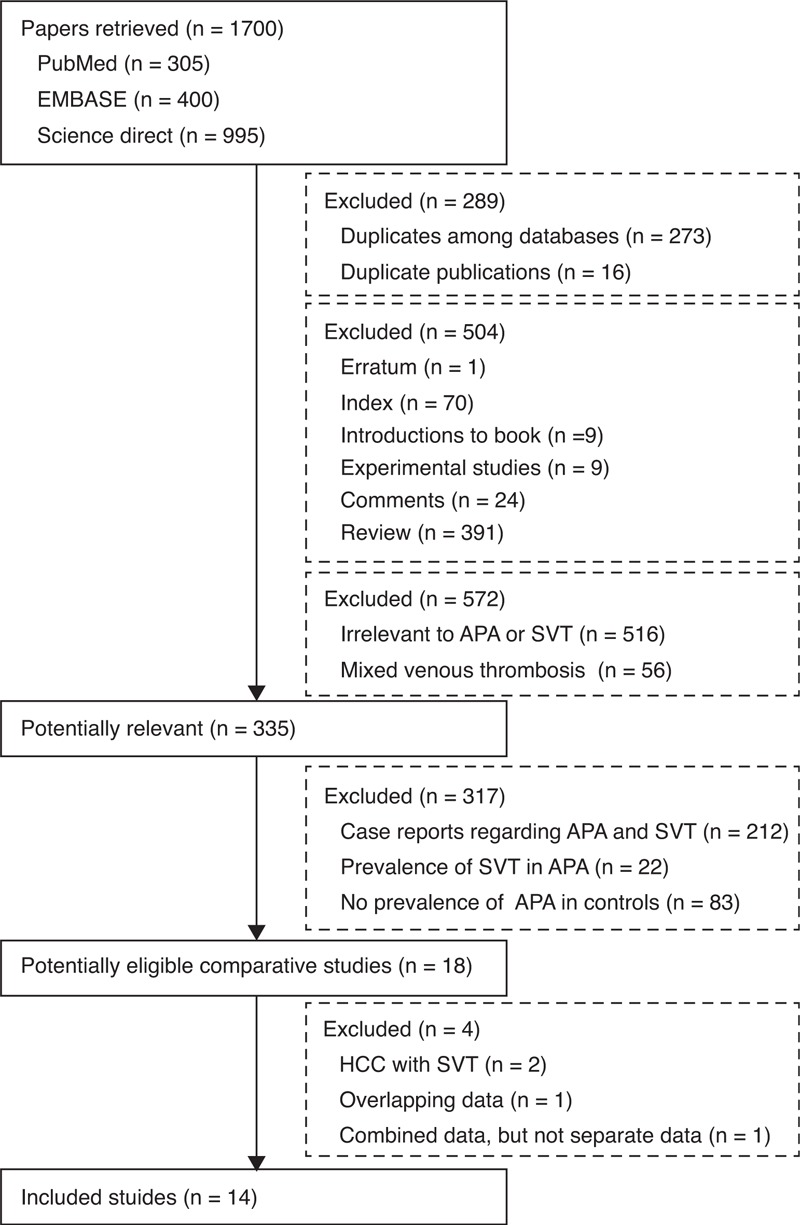
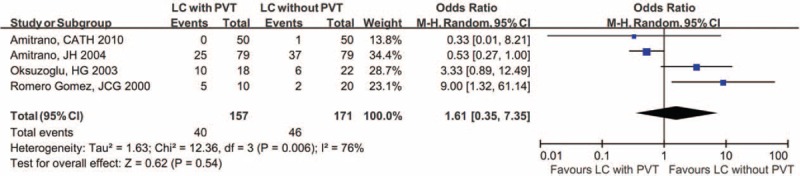
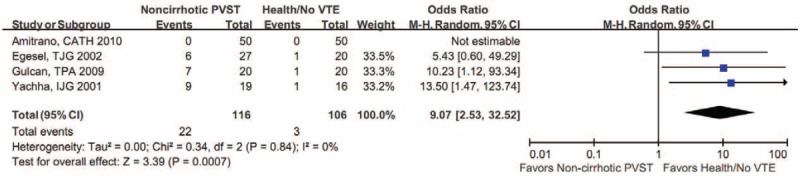
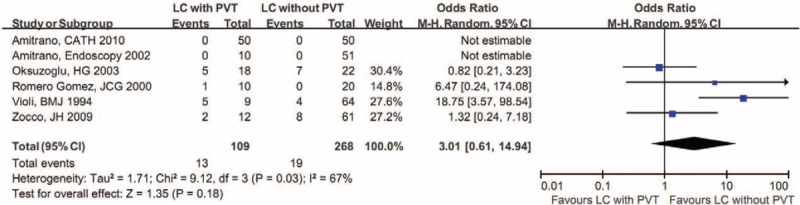
Splanchnic vein thrombosis (SVT) refers to Budd-Chiari syndrome (BCS) and portal vein system thrombosis (PVST). Current practice guidelines have recommended the routine screening for antiphospholipid antibodies (APAs) in patients with SVT. A systematic review and meta-analysis of observational studies was performed to explore the association between APAs and SVT. The PubMed, EMBASE, and ScienceDirect databases were searched for all relevant papers, in which the prevalence of positive APAs or levels of APAs should be compared between BCS or noncirrhotic PVST patients versus healthy controls, or between cirrhotic patients with portal vein thrombosis (PVT) versus those without PVT. Fourteen studies were eligible. Only 1 study evaluated the role of APAs in BCS patients and found that positive immunoglobulin (Ig) G anticardiolipin antibody (aCL) was more frequently observed in BCS patients than in healthy controls; however, the associations of other APAs with BCS were not evaluated. Positive IgG aCL was more frequently observed in noncirrhotic patients with PVST than in healthy controls; however, other APAs, such as IgM aCL, lupus anticoagulants (LAs), anti-β2-glycoprotein-I antibody (aβ2GPI), and aβ2GPI-oxidized low-density lipoprotein antibody (ox-LDL) were not associated with noncirrhotic PVST. Positive unclassified aCL was more frequently observed in cirrhotic patients with PVT than in those without PVT; however, the association of IgG aCL and IgM aCL with the development of PVT in liver cirrhosis remained inconsistent among studies. The risk of BCS and noncirrhotic PVST might be increased by positive IgG aCL but not IgM aCL, LA, aβ2GPI, or aβ2GPI ox-LDL. However, the evidence regarding APAs in BCS originated from only 1 study. The association between APAs and PVT in liver cirrhosis was unclear.
内脏静脉血栓形成(SVT)指布加综合征(BCS)和门静脉系统血栓形成(PVST)。当前的实践指南建议对SVT患者常规筛查抗磷脂抗体(APA)。进行了一项观察性研究的系统评价和荟萃分析,以探讨APA与SVT之间的关联。检索了PubMed、EMBASE和ScienceDirect数据库中的所有相关论文,其中应比较BCS或非肝硬化PVST患者与健康对照之间,或肝硬化门静脉血栓形成(PVT)患者与无PVT患者之间APA阳性的患病率或APA水平。14项研究符合条件。仅有1项研究评估了APA在BCS患者中的作用,发现BCS患者中免疫球蛋白(Ig)G抗心磷脂抗体(aCL)阳性比健康对照更常见;然而,未评估其他APA与BCS的关联。非肝硬化PVST患者中IgG aCL阳性比健康对照更常见;然而,其他APA,如IgM aCL、狼疮抗凝物(LA)、抗β2糖蛋白-I抗体(aβ2GPI)和aβ2GPI氧化型低密度脂蛋白抗体(ox-LDL)与非肝硬化PVST无关。肝硬化PVT患者中未分类aCL阳性比无PVT患者更常见;然而,IgG aCL和IgM aCL与肝硬化PVT发生之间的关联在各研究中仍不一致。IgG aCL阳性可能增加BCS和非肝硬化PVST的风险,但IgM aCL、LA、aβ2GPI或aβ2GPI ox-LDL不会。然而,关于BCS中APA的证据仅来自1项研究。APA与肝硬化PVT之间的关联尚不清楚。