Tian Xueying, Pu William T, Zhou Bin
From the Key Laboratory of Nutrition and Metabolism, Institute for Nutritional Sciences (X.T., B.Z.) and CAS Center for Excellence in Brain Science (B.Z.), Shanghai Institutes for Biological Sciences, Chinese Academy of Sciences, Shanghai, China; Department of Cardiology, Boston Children's Hospital, MA (W.T.P.); and Harvard Stem Cell Institute, Harvard University, Cambridge, MA (W.T.P.).
Circ Res. 2015 Jan 30;116(3):515-30. doi: 10.1161/CIRCRESAHA.116.305097.
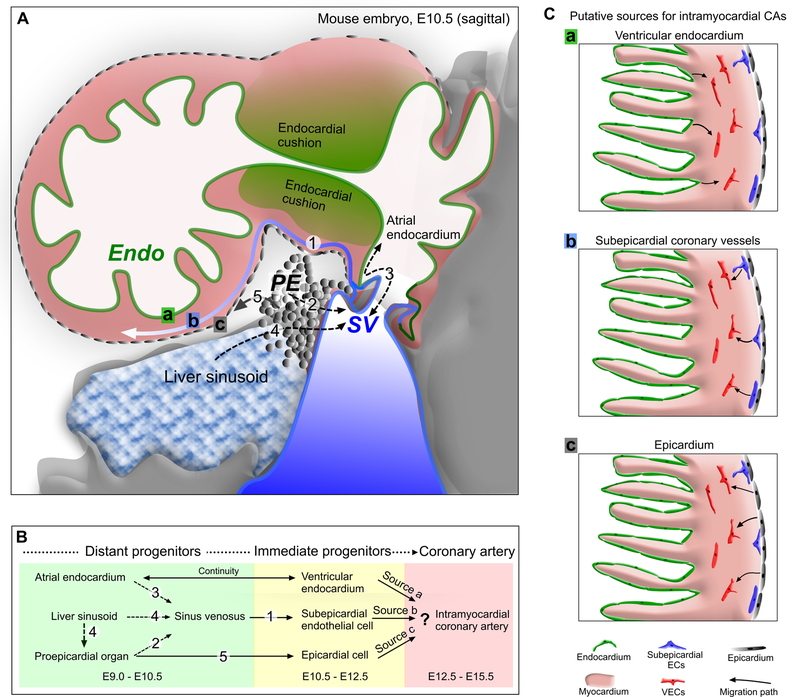
Coronary artery disease causes acute myocardial infarction and heart failure. Identifying coronary vascular progenitors and their developmental program could inspire novel regenerative treatments for cardiac diseases. The developmental origins of the coronary vessels have been shrouded in mystery and debated for several decades. Recent identification of progenitors for coronary vessels within the endocardium, epicardium, and sinus venosus provides new insights into this question. In addition, significant progress has been achieved in elucidating the cellular and molecular programs that orchestrate coronary artery development. Establishing adequate vascular supply will be an essential component of cardiac regenerative strategies, and these findings raise exciting new strategies for therapeutic cardiac revascularization.
冠状动脉疾病会导致急性心肌梗死和心力衰竭。识别冠状动脉祖细胞及其发育程序可能会启发针对心脏病的新型再生治疗方法。冠状动脉的发育起源几十年来一直笼罩在神秘之中且备受争议。最近在内皮、心外膜和静脉窦中发现了冠状动脉的祖细胞,为这个问题提供了新的见解。此外,在阐明协调冠状动脉发育的细胞和分子程序方面已经取得了重大进展。建立充足的血管供应将是心脏再生策略的一个重要组成部分,这些发现为治疗性心脏血管重建提出了令人兴奋的新策略。