Stern Anna L, Naidoo Nirinjini
Center for Sleep and Circadian Neurobiology, Perelman School of Medicine, University of Pennsylvania, Philadelphia, USA.
Springerplus. 2015 Jan 17;4:25. doi: 10.1186/s40064-014-0777-6. eCollection 2015.
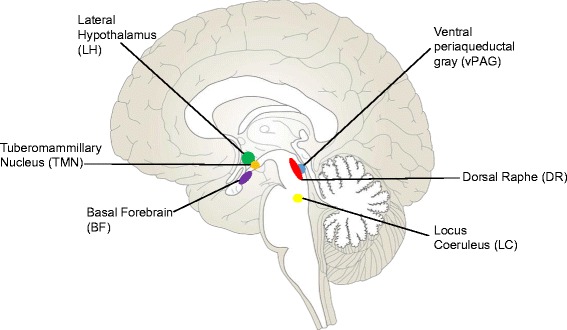
Sleep/wake disturbance is a feature of almost all common age-related neurodegenerative diseases. Although the reason for this is unknown, it is likely that this inability to maintain sleep and wake states is in large part due to declines in the number and function of wake-active neurons, populations of cells that fire only during waking and are silent during sleep. Consistent with this, many of the brain regions that are most susceptible to neurodegeneration are those that are necessary for wake maintenance and alertness. In the present review, these wake-active populations are systematically assessed in terms of their observed pathology across aging and several neurodegenerative diseases, with implications for future research relating sleep and wake disturbances to aging and age-related neurodegeneration.
睡眠/觉醒障碍是几乎所有常见的与年龄相关的神经退行性疾病的一个特征。尽管其原因尚不清楚,但无法维持睡眠和觉醒状态很可能在很大程度上是由于觉醒活跃神经元数量和功能的下降,这些细胞群仅在清醒时放电,睡眠时沉默。与此一致的是,许多最易发生神经退行性变的脑区是维持觉醒和警觉所必需的区域。在本综述中,根据在衰老和几种神经退行性疾病中观察到的病理情况,对这些觉醒活跃细胞群进行了系统评估,这对未来将睡眠/觉醒障碍与衰老及年龄相关神经退行性变联系起来的研究具有启示意义。