Sethi M, Joshi S S, Webb R L, Beckett T L, Donohue K D, Murphy M P, O'Hara B F, Duncan M J
Department of Biology, University of Kentucky, Lexington, KY 40506, USA.
Department of Molecular and Cellular Biochemistry, University of Kentucky College of Medicine, Lexington, KY 40536, USA; Sanders-Brown Center on Aging and Alzheimer's Disease Center, University of Kentucky College of Medicine, Lexington, KY 40536, USA.
Neuroscience. 2015 Apr 2;290:80-9. doi: 10.1016/j.neuroscience.2015.01.035. Epub 2015 Jan 28.
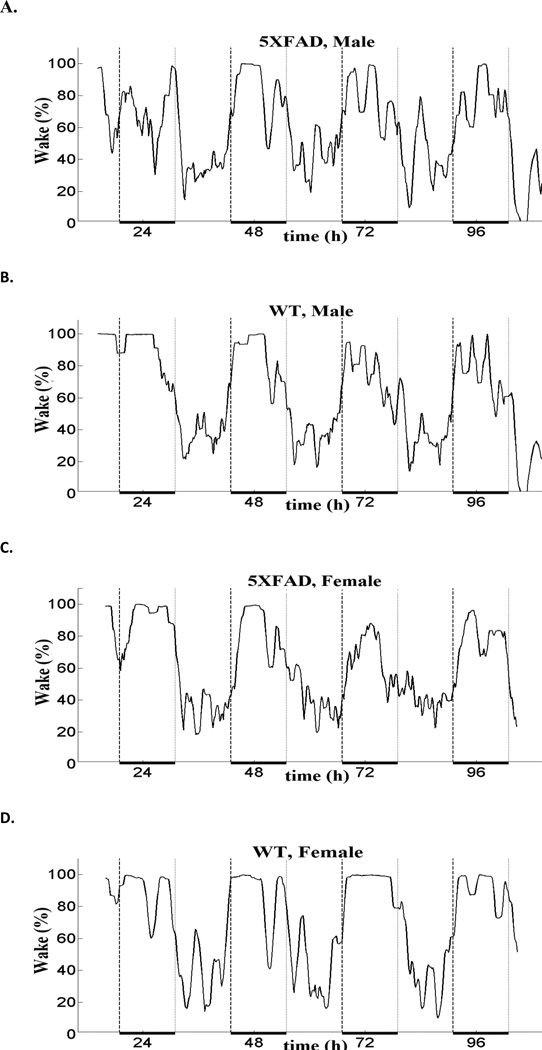
Sleep perturbations including fragmented sleep with frequent night-time awakenings and daytime naps are common in patients with Alzheimer's disease (AD), and these daily disruptions are a major factor for institutionalization. The objective of this study was to investigate if sleep-wake patterns are altered in 5XFAD mice, a well-characterized double transgenic mouse model of AD which exhibits an early onset of robust AD pathology and memory deficits. These mice have five distinct human mutations in two genes, the amyloid precursor protein (APP) and Presenilin1 (PS1) engineered into two transgenes driven by a neuron-specific promoter (Thy1), and thus develop severe amyloid deposition by 4 months of age. Age-matched (4-6.5 months old) male and female 5XFAD mice were monitored and compared to wild-type littermate controls for multiple sleep traits using a non-invasive, high throughput, automated piezoelectric system which detects breathing and gross body movements to characterize sleep and wake. Sleep-wake patterns were recorded continuously under baseline conditions (undisturbed) for 3 days and after sleep deprivation of 4h, which in mice produces a significant sleep debt and challenge to sleep homeostasis. Under baseline conditions, 5XFAD mice exhibited shorter bout lengths (14% lower values for males and 26% for females) as compared to controls (p<0.001). In females, the 5XFAD mice also showed 12% less total sleep than WT (p<0.01). Bout length reductions were greater during the night (the active phase for mice) than during the day, which does not model the human condition of disrupted sleep at night (the inactive period). However, the overall decrease in bout length suggests increased fragmentation and disruption in sleep consolidation that may be relevant to human sleep. The 5XFAD mice may serve as a useful model for testing therapeutic strategies to improve sleep consolidation in AD patients.
睡眠障碍,包括频繁夜间觉醒和日间小睡导致的睡眠碎片化,在阿尔茨海默病(AD)患者中很常见,而这些日常干扰是患者入住养老院的主要因素。本研究的目的是调查5XFAD小鼠的睡眠-觉醒模式是否发生改变,5XFAD小鼠是一种特征明确的AD双转基因小鼠模型,表现出早期出现严重的AD病理和记忆缺陷。这些小鼠在两个基因(淀粉样前体蛋白(APP)和早老素1(PS1))中有五个不同的人类突变,这些突变被设计到由神经元特异性启动子(Thy1)驱动的两个转基因中,因此在4个月大时就会出现严重的淀粉样蛋白沉积。使用非侵入性、高通量、自动压电系统监测年龄匹配(4 - 6.5个月大)的雄性和雌性5XFAD小鼠,并将其与野生型同窝对照小鼠的多种睡眠特征进行比较,该系统通过检测呼吸和总体身体运动来表征睡眠和觉醒。在基线条件下(不受干扰)连续记录3天的睡眠-觉醒模式,以及在剥夺4小时睡眠后进行记录,剥夺睡眠在小鼠中会产生显著的睡眠债务并对睡眠稳态构成挑战。在基线条件下,与对照组相比,5XFAD小鼠的睡眠周期长度较短(雄性降低14%,雌性降低26%,p<0.001)。在雌性中,5XFAD小鼠的总睡眠时间也比野生型少12%(p<0.01)。夜间(小鼠的活跃期)睡眠周期长度的减少幅度大于白天,这与人类夜间睡眠中断(非活跃期)的情况不同。然而,睡眠周期长度的总体减少表明睡眠巩固过程中的碎片化和干扰增加,这可能与人类睡眠相关。5XFAD小鼠可能是测试改善AD患者睡眠巩固治疗策略的有用模型。