Edmondson Jill L, Davies Zoe G, Gaston Kevin J, Leake Jonathan R
Department of Animal and Plant Sciences, University of Sheffield Sheffield, S10 2TN, UK.
Durrell Institute of Conservation and Ecology (DICE), School of Anthropology and Conservation, University of Kent Canterbury, Kent, CT2 7NR, UK.
J Appl Ecol. 2014 Aug;51(4):880-889. doi: 10.1111/1365-2664.12254. Epub 2014 Apr 24.
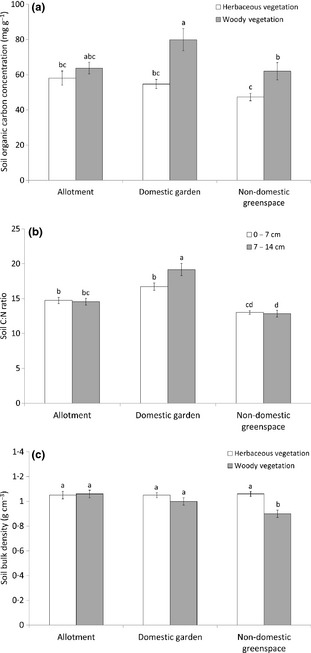
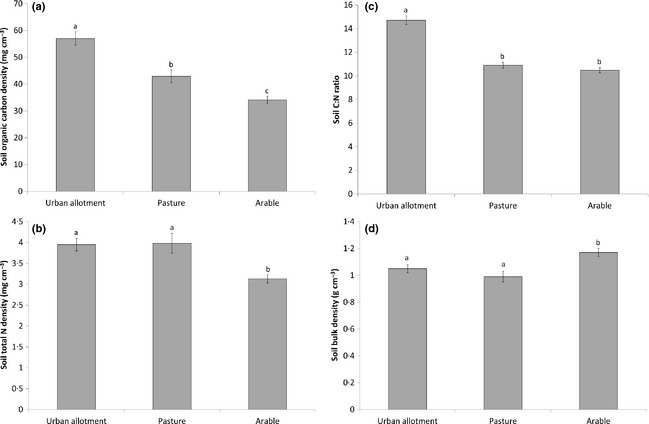
Modern agriculture, in seeking to maximize yields to meet growing global food demand, has caused loss of soil organic carbon (SOC) and compaction, impairing critical regulating and supporting ecosystem services upon which humans also depend. Own-growing makes an important contribution to food security in urban areas globally, but its effects on soil qualities that underpin ecosystem service provision are currently unknown. We compared the main indicators of soil quality; SOC storage, total nitrogen (TN), C : N ratio and bulk density (BD) in urban allotments to soils from the surrounding agricultural region, and between the allotments and other urban greenspaces in a typical UK city. A questionnaire was used to investigate allotment management practices that influence soil properties. Allotment soils had 32% higher SOC concentrations and 36% higher C : N ratios than pastures and arable fields and 25% higher TN and 10% lower BD than arable soils. There was no significant difference between SOC concentration in allotments and urban non-domestic greenspaces, but it was higher in domestic gardens beneath woody vegetation. Allotment soil C : N ratio exceeded that in non-domestic greenspaces, but was lower than that in garden soil. Three-quarters of surveyed allotment plot holders added manure, 95% composted biomass on-site, and many added organic-based fertilizers and commercial composts. This may explain the maintenance of SOC, C : N ratios, TN and low BD, which are positively associated with soil functioning. . Maintenance and protection of the quality of our soil resource is essential for sustainable food production and for regulating and supporting ecosystem services upon which we depend. Our study establishes, for the first time, that small-scale urban food production can occur without the penalty of soil degradation seen in conventional agriculture, and maintains the high soil quality seen in urban greenspaces. Given the involvement of over 800 million people in urban agriculture globally, and its important contribution to food security, our findings suggest that to better protect soil functions, local, national and international urban planning and policy making should promote more urban own-growing in preference to further intensification of conventional agriculture to meet increasing food demand.
现代农业为了实现产量最大化以满足全球不断增长的粮食需求,导致了土壤有机碳(SOC)流失和土壤压实,损害了人类赖以生存的关键调节和支持生态系统服务。自耕自种对全球城市地区的粮食安全做出了重要贡献,但其对支撑生态系统服务的土壤质量的影响目前尚不清楚。我们比较了城市自留地土壤质量的主要指标;与周边农业区域的土壤相比,以及与英国一个典型城市的其他城市绿地相比,城市自留地土壤中的SOC储量、总氮(TN)、碳氮比和容重(BD)。通过问卷调查来调查影响土壤性质的自留地管理实践。自留地土壤的SOC浓度比牧场和耕地高32%,碳氮比高36%,TN比耕地土壤高25%,BD比耕地土壤低10%。自留地的SOC浓度与城市非家庭绿地之间没有显著差异,但在木本植被下的家庭花园中更高。自留地土壤的碳氮比超过了非家庭绿地,但低于花园土壤。四分之三接受调查的自留地地块持有者添加了粪肥,95%在现场堆肥生物质,许多人还添加了有机基肥料和商业堆肥。这可能解释了SOC、碳氮比、TN和低BD的维持,这些与土壤功能呈正相关。维护和保护我们的土壤资源质量对于可持续粮食生产以及调节和支持我们赖以生存的生态系统服务至关重要。我们的研究首次表明,小规模城市粮食生产可以在不出现传统农业中土壤退化问题的情况下进行,并保持城市绿地中所见的高土壤质量。鉴于全球超过8亿人参与城市农业,以及其对粮食安全的重要贡献,我们的研究结果表明,为了更好地保护土壤功能,地方、国家和国际城市规划及政策制定应优先促进更多城市自耕自种,而不是进一步强化传统农业以满足不断增长的粮食需求。