Gao Ting-ting, Qin Zhao-ling, Ren Hao, Zhao Ping, Qi Zhong-tian
Department of Microbiology, Shanghai Key Laboratory of Medical Biodefense, Second Military Medical University, Shanghai, 200433, China.
Virol J. 2015 Feb 3;12:12. doi: 10.1186/s12985-015-0241-4.
Hepatitis C virus (HCV) infection was recently recognized as an independent risk factor for insulin resistance (IR), the onset phase of type 2 diabetes mellitus (T2DM). Phosphatase and tensin homolog deleted on chromosome 10 (PTEN) negatively regulates PI3K/Akt signaling pathway, which is critical for IR development and progression of cirrhosis to hepatocellular carcinoma (HCC). Here, we investigate the role of PTEN in HCV-associated IR and explored the mechanisms by which HCV regulates PTEN.
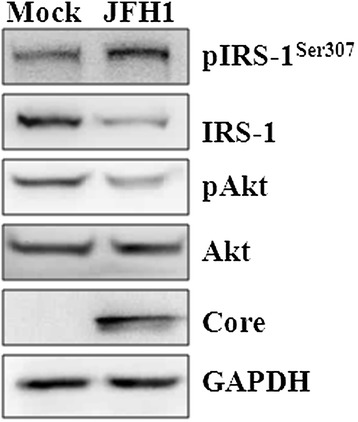
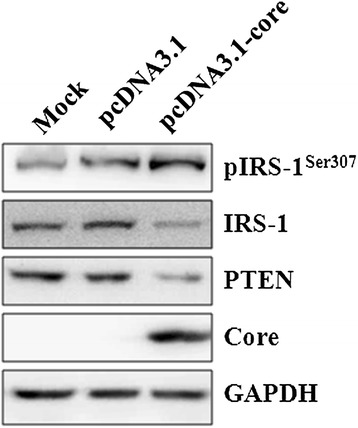
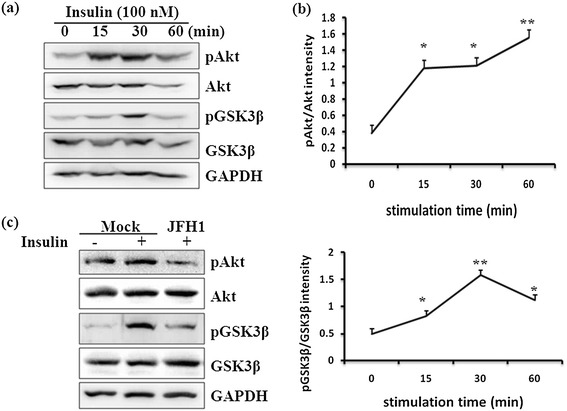
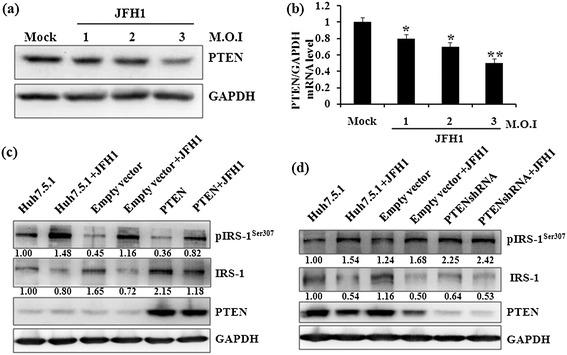
Western blotting was used to detect the levels of insulin signaling pathway components, including insulin receptor substrate-1 (IRS-1), phosphorylated IRS-1 (pIRS-1) at serine 307 (Ser307), both phosphorylated Akt (pAkt) and total Akt. A time-course experiment measuring activation of the insulin signaling pathway was performed to assess the effect of HCV infection on insulin sensitivity by examining the phosphorylation levels of Akt and GSK3β, a downstream target of Akt. Huh7.5.1 cells were transduced with a lentiviral vector expressing PTEN or PTEN shRNA, and IRS-1 and pIRS-1 (Ser307) levels were determined in both HCV-infected and uninfected cells. The pc-JFH1-core plasmid was constructed to explore the underlying mechanisms by which HCV regulated PTEN and therefore IRS-1 levels.
HCV infection inhibited the insulin signaling pathway by reducing the levels of IRS-1 and pAkt/Akt while increasing phosphorylation of IRS-1 Ser307. In addition, HCV infection decreased the sensitivity to insulin-induced stimulation by inhibiting Akt and GSK3β phosphorylation. Furthermore, PTEN mRNA and protein levels were reduced upon HCV infection as well as transfection with the pc-JFH1-core plasmid. The reduction in IRS-1 level observed in HCV-infected cells was rescued to a limited extent by overexpression of PTEN, which in turn slightly reduced pIRS-1 (Ser307) level. In contrast, IRS-1 level were significantly decreased and phosphorylation of IRS-1 at Ser-307 was strongly enhanced by PTEN knockdown, suggesting that both reduction in IRS-1 level and increase in IRS-1 phosphorylation at Ser307 upon HCV infection occurred in a PTEN-dependent manner.
HCV infection suppresses the insulin signaling pathway and promotes IR by repressing PTEN, subsequently leading to decreased levels of IRS-1 and increased levels of pIRS-1 at Ser307. The findings provide new insight on the mechanism of HCV-associated IR.
丙型肝炎病毒(HCV)感染最近被认为是胰岛素抵抗(IR)的一个独立危险因素,胰岛素抵抗是2型糖尿病(T2DM)的发病阶段。10号染色体缺失的磷酸酶和张力蛋白同源物(PTEN)负向调节PI3K/Akt信号通路,这对IR的发展以及肝硬化向肝细胞癌(HCC)的进展至关重要。在此,我们研究了PTEN在HCV相关IR中的作用,并探讨了HCV调节PTEN的机制。
采用蛋白质免疫印迹法检测胰岛素信号通路成分的水平,包括胰岛素受体底物-1(IRS-1)、丝氨酸307(Ser307)位点磷酸化的IRS-1(pIRS-1)、磷酸化Akt(pAkt)和总Akt。进行了一项测量胰岛素信号通路激活的时间进程实验,通过检测Akt和Akt下游靶点糖原合成酶激酶3β(GSK3β)的磷酸化水平来评估HCV感染对胰岛素敏感性的影响。用表达PTEN或PTEN短发夹RNA(shRNA)的慢病毒载体转导Huh7.5.1细胞,并测定HCV感染和未感染细胞中IRS-1和pIRS-1(Ser307)的水平。构建pc-JFH1核心质粒以探索HCV调节PTEN进而调节IRS-1水平的潜在机制。
HCV感染通过降低IRS-1和pAkt/Akt水平,同时增加IRS-1 Ser307位点的磷酸化,抑制胰岛素信号通路。此外,HCV感染通过抑制Akt和GSK3β磷酸化降低对胰岛素诱导刺激的敏感性。此外,HCV感染以及用pc-JFH1核心质粒转染后,PTEN的mRNA和蛋白水平均降低。在HCV感染细胞中观察到的IRS-1水平降低在一定程度上被PTEN过表达所挽救,而PTEN过表达又会轻微降低pIRS-1(Ser307)水平。相反,PTEN敲低显著降低IRS-1水平,并强烈增强Ser-307位点IRS-1的磷酸化,这表明HCV感染后IRS-1水平降低和Ser307位点IRS-1磷酸化增加均以PTEN依赖的方式发生。
HCV感染通过抑制PTEN抑制胰岛素信号通路并促进IR,随后导致IRS-1水平降低和Ser307位点pIRS-1水平升高。这些发现为HCV相关IR的机制提供了新的见解。