de Vries Claudette, Doggen Carine, Hilbers Ellen, Verheij Robert, IJzerman Maarten, Geertsma Robert, Kusters Ron
Centre for Health Protection, National Institute for Public Health and the Environment (RIVM), P.O. Box 1, NL-3720 BA, Bilthoven, The Netherlands.
Health Technology and Services Research, MIRA institute for Biomedical Technology and Technical Medicine, University of Twente, Enschede, The Netherlands.
BMC Fam Pract. 2015 Feb 5;16:9. doi: 10.1186/s12875-014-0217-2.
Point-of-care (POC) tests are devices or test strips that can be used near or at the site where care is delivered to patients, enabling a relatively fast diagnosis. Although many general practitioners (GPs) in the Netherlands are using POC tests in their practice, little is known on how they manage the corresponding patient safety aspects.
To obtain information on this aspect, an invitation to participate in a web-based questionnaire was sent to a random sample of 750 GP practices. Of this sample 111 GP practices returned a complete questionnaire. Data was analysed by using descriptive statistics.
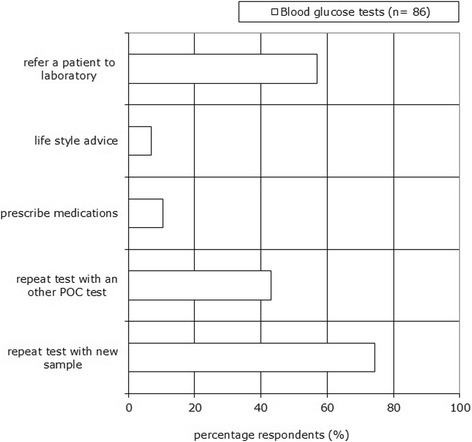
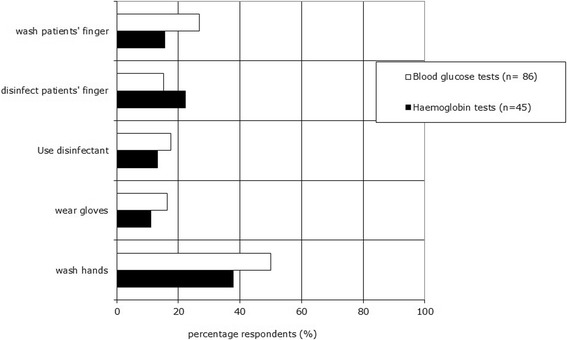
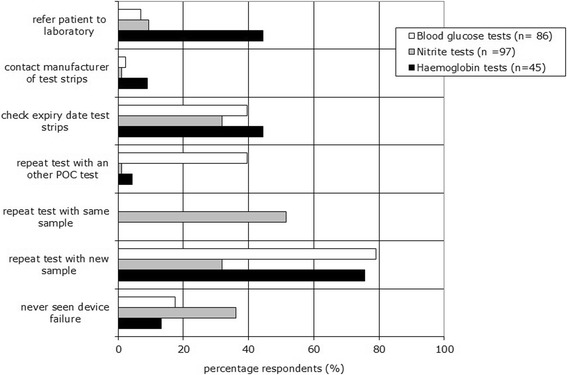
Results show that there is not always attention for quality control measures such as checking storage conditions, executing calibration, and maintenance. In addition, universal hygienic measures, such as washing hands before taking a blood sample, are not always followed. Refresher courses on the use of POC tests are hardly organized. Only a few of the GPs contact the manufacturer of the device when a device failure occurs. Well-controlled aspects include patient identification and actions taken when ambiguous test results are obtained.
We observed a number of risks for errors with POC tests in GP practices that may be reduced by proper training of personnel, introduction of standard operating procedures and measures for quality control and improved hygiene. To encourage proper use of POCT in general practices, a national POCT guideline, dedicated to primary care and in line with ISO standards, should be introduced.
即时检验(POC)设备是可在接近患者护理地点或在该地点使用的设备或试纸条,能够实现相对快速的诊断。尽管荷兰许多全科医生(GP)在其诊疗中使用POC检验,但对于他们如何管理相应的患者安全方面却知之甚少。
为获取这方面的信息,向750家全科医生诊所的随机样本发送了参与基于网络问卷的邀请。在这个样本中,111家全科医生诊所返回了完整的问卷。使用描述性统计方法对数据进行分析。
结果表明,并非总是关注诸如检查储存条件、进行校准和维护等质量控制措施。此外,普遍的卫生措施,如在采集血样前洗手,也并非总是得到遵循。几乎不组织关于POC检验使用的进修课程。当设备出现故障时,只有少数全科医生会联系设备制造商。得到良好控制的方面包括患者识别以及在获得不明确的检验结果时采取的行动。
我们观察到全科医生诊所中POC检验存在一些出错风险,通过对人员进行适当培训、引入标准操作程序以及质量控制和改善卫生的措施,这些风险可能会降低。为鼓励在全科医疗中正确使用即时检验,应引入一项专门针对初级保健且符合ISO标准的国家即时检验指南。