Department of Health Technology and Services Research, Faculty of Behavioural, Management and Social Sciences, Technical Medical Centre, University of Twente, P.O. Box 217, 7500, AE, Enschede, The Netherlands.
Star-SHL diagnostic center, Etten-Leur, The Netherlands.
BMC Fam Pract. 2019 Jan 10;20(1):8. doi: 10.1186/s12875-018-0893-4.
The increasing number of available point-of-care (POC) tests challenges clinicians regarding decisions on which tests to use, how to efficiently use them, and how to interpret the results. Although POC tests may offer benefits in terms of low turn-around-time, improved patient's satisfaction, and health outcomes, only few are actually used in clinical practice. Therefore, this study aims to identify which criteria are, in general, important in the decision to implement a POC test, and to determine their weight. Two POC tests available for use in Dutch general practices (i.e. the C-reactive protein (CRP) test and the glycated haemoglobin (HbA) test) serve as case studies. The information obtained from this study can be used to guide POC test development and their introduction in clinical practice.
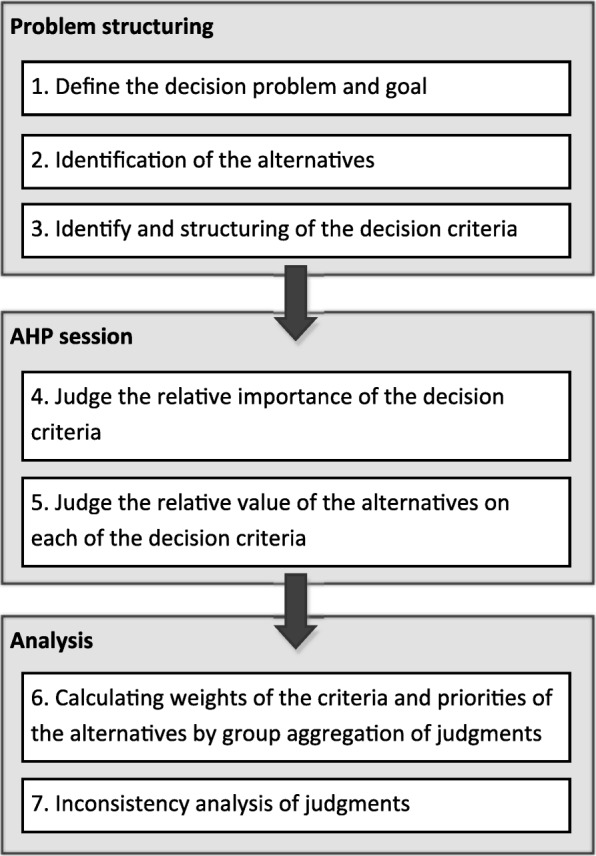
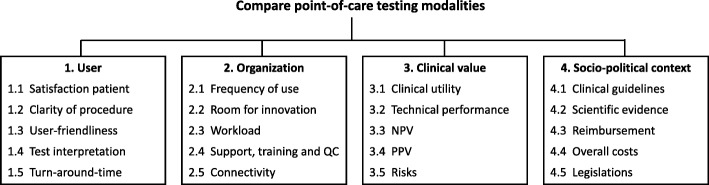
Relevant criteria were identified based on a literature review and semi-structured interviews with twelve experts in the field. Subsequently, the criteria were clustered in four groups (i.e. user, organization, clinical value, and socio-political context) and the relative importance of each criterion was determined by calculating geometric means as implemented in the Analytic Hierarchy Process. Of these twelve experts, ten participated in a facilitated group session, in which their priorities regarding both POC tests (compared to central laboratory testing) were elicited.
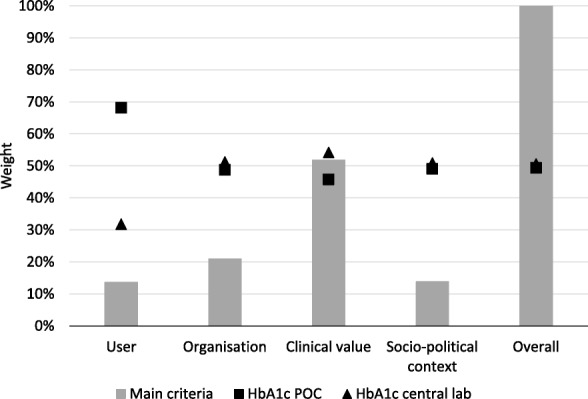
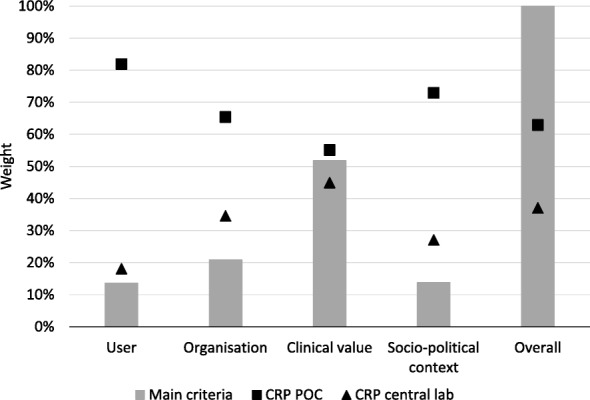
Of 20 criteria in four clusters, the test's clinical utility, its technical performance, and risks (associated with the treatment decision based on the test result) were considered most important for using a POC test, with relative weights of 22.2, 12.6 and 8.5%, respectively. Overall, the experts preferred the POC CRP test over its laboratory equivalent, whereas they did not prefer the POC HbA test. This difference was mainly explained by their strong preference for the POC CRP test with regard to the subcriterion 'clinical utility'.
The list of identified criteria, and the insights in their relative impact on successful implementation of POC tests, may facilitate implementation and use of existing POC tests in clinical practice. In addition, having experts score new POC tests on these criteria, provides developers with specific recommendations on how to increase the probability of successful implementation and use.
随着可供使用的即时检测(POC)测试数量的增加,临床医生需要在选择使用哪些测试、如何高效地使用这些测试以及如何解释这些测试结果方面做出决策。虽然 POC 测试在缩短周转时间、提高患者满意度和改善健康结果方面可能具有优势,但实际上在临床实践中仅使用了少数 POC 测试。因此,本研究旨在确定在决定实施 POC 测试时通常哪些标准是重要的,并确定它们的权重。本研究以两种可在荷兰常规诊所使用的即时检测(即 C 反应蛋白(CRP)测试和糖化血红蛋白(HbA)测试)作为案例研究。本研究获得的信息可用于指导 POC 测试的开发及其在临床实践中的引入。
根据文献回顾和 12 位该领域专家的半结构式访谈,确定了相关标准。随后,将标准分为四个组(即用户、组织、临床价值和社会政治背景),并通过计算层次分析法中的几何平均值来确定每个标准的相对重要性。在这 12 位专家中,有 10 位参加了一个促进小组会议,会上他们对这两种 POC 测试(与中心实验室测试相比)的优先级进行了阐述。
在四个组中的 20 个标准中,测试的临床实用性、技术性能和风险(与基于测试结果的治疗决策相关)被认为是使用 POC 测试最重要的标准,相对权重分别为 22.2%、12.6%和 8.5%。总体而言,专家们更喜欢即时 CRP 测试而不是其实验室等效物,而他们不喜欢即时 HbA 测试。这种差异主要是由于他们对即时 CRP 测试的亚标准“临床实用性”非常偏好。
所确定标准的清单以及对成功实施 POC 测试的相对影响的见解,可能有助于在临床实践中实施和使用现有的 POC 测试。此外,让专家对这些标准对新的 POC 测试进行评分,可以为开发者提供有关如何增加成功实施和使用的具体建议。