Lage Ricardo, Parisi Claudia, Seoane-Collazo Patricia, Fernø Johan, Mazza Roberta, Bosch Fátima, Seoane Luisa M, Nogueiras Ruben, Diéguez Carlos, Quarta Carmelo, López Miguel
Department of Physiology, CIMUS, University of Santiago de Compostela-Instituto de Investigación Sanitaria, Santiago de Compostela, 15782, Spain (Drs Lage, Parisi, Seoane-Collazo, Fernø, Nogueiras, Diéguez, and López); CIBER Fisiopatología de la Obesidad y Nutrición (CIBERobn), 15706, Spain (Drs Lage, Seoane-Collazo, Seoane, Nogueiras, Diéguez, and López); Center of Animal Biotechnology and Gene Therapy and Department of Biochemistry and Molecular Biology, School of Veterinary Medicine, Universitat Autònoma Barcelona, Bellaterra, 08193, Spain (Drs Lage and Bosch); Endocrinology Unit and Center for Applied Biomedical Research, Department of Medical and Surgical Sciences, University of Bologna, Bologna 40138, Italy (Drs Parisi, Mazza, and Quarta); Department of Clinical Science, K. G. Jebsen Center for Diabetes Research, University of Bergen, Bergen, N-5020, Norway (Dr Fernø); Grupo Fisiopatología Endocrina, Complexo Hospitalario Universitario de Santiago (CHUS/SERGAS), Santiago de Compostela, 15706, Spain (Dr Seoane).
Int J Neuropsychopharmacol. 2015 Feb 5;18(9):pyv011. doi: 10.1093/ijnp/pyv011.
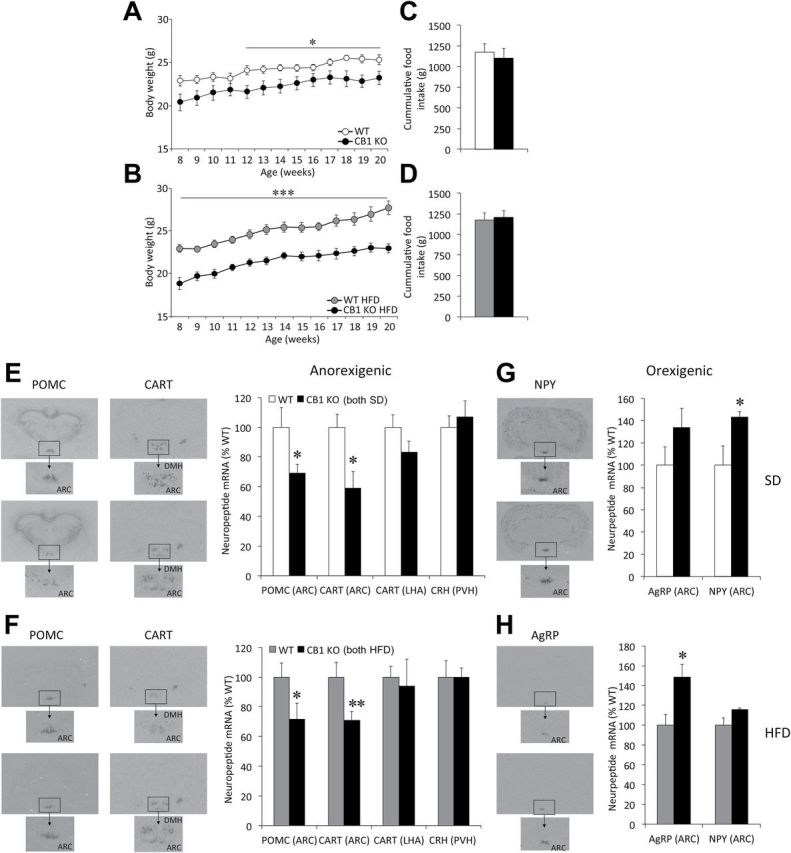
Cumulative data indicate that the endocannabinoid system plays a major role in feeding behavior and energy balance. Genetic silencing of cannabinoid receptor type 1 (CB1) reduces body weight gain, independently of food intake.
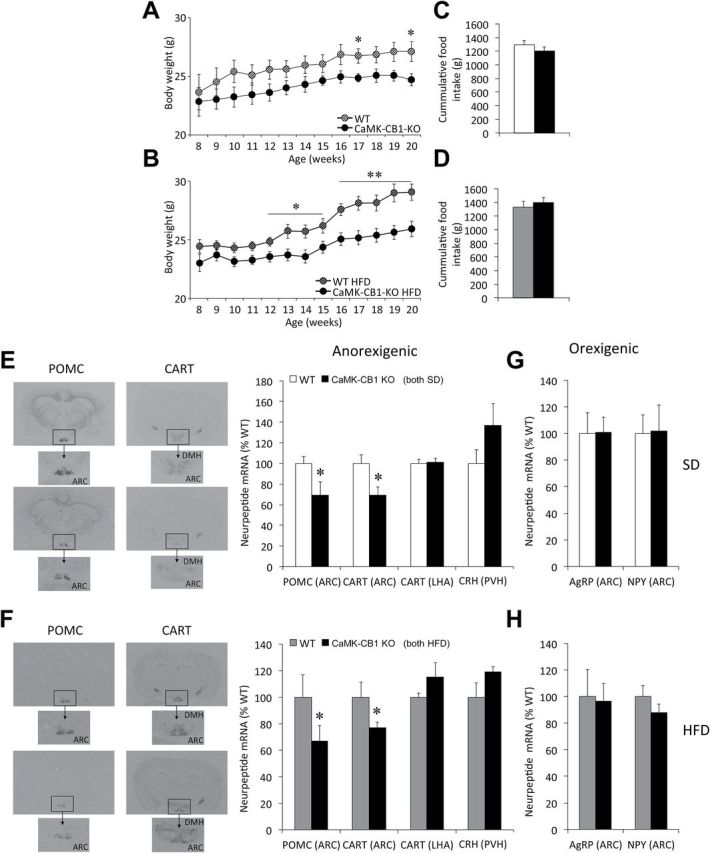
In this work, we investigated whether the hypothalamic neuropeptide expression pattern supports the absence of the anorexigenic response observed under constitutive CB1 ablation, by using neuronal CB1 conditional null mice (CamK-CB1-KO) and whole body CB1 null mice (CB1-KO).
Our data showed that both CB1 null models display a marked decrease in proopiomelanocortin (POMC) and cocaine-amphetamine-regulated transcript (CART) expression in the arcuate nucleus of the hypothalamus (ARC).
This evidence suggests that a lack of hypophagia is associated with the suppression of ARC anorexigenic neuropeptides and that behavioral changes in food intake (or lack thereof) after constitutive CB1 ablation are likely mediated by impaired melanocortin and CART signaling in the hypothalamus.
累积数据表明,内源性大麻素系统在进食行为和能量平衡中起主要作用。1型大麻素受体(CB1)的基因沉默可降低体重增加,且与食物摄入量无关。
在本研究中,我们通过使用神经元CB1条件性敲除小鼠(CamK-CB1-KO)和全身CB1敲除小鼠(CB1-KO),研究下丘脑神经肽表达模式是否支持在组成型CB1基因敲除情况下未观察到的厌食反应。
我们的数据表明,两种CB1基因敲除模型在下丘脑弓状核(ARC)中阿黑皮素原(POMC)和可卡因-安非他明调节转录物(CART)的表达均显著降低。
该证据表明,食欲减退与ARC厌食神经肽的抑制有关,并且组成型CB1基因敲除后食物摄入量的行为变化(或缺乏变化)可能是由下丘脑黑素皮质素和CART信号传导受损介导的。