Ridwan Roni, Rusmana Iman, Widyastuti Yantyati, Wiryawan Komang G, Prasetya Bambang, Sakamoto Mitsuo, Ohkuma Moriya
Study Program of Microbiology, Graduate School of Bogor Agricultural University, Campus IPB Darmaga Bogor, West Java 16680, Indonesia ; Research Center for Biotechnology, Indonesian Institute of Sciences, Cibinong, West Java 16911, Indonesia .
Department of Biology, Faculty of Mathematics and Natural Sciences, Bogor Agricultural University, Campus IPB Darmaga Bogor, West Java 16680, Indonesia .
Asian-Australas J Anim Sci. 2015 Apr;28(4):511-8. doi: 10.5713/ajas.14.0622.
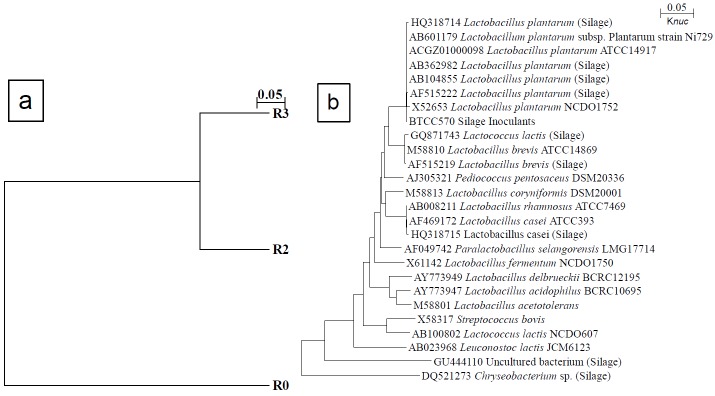
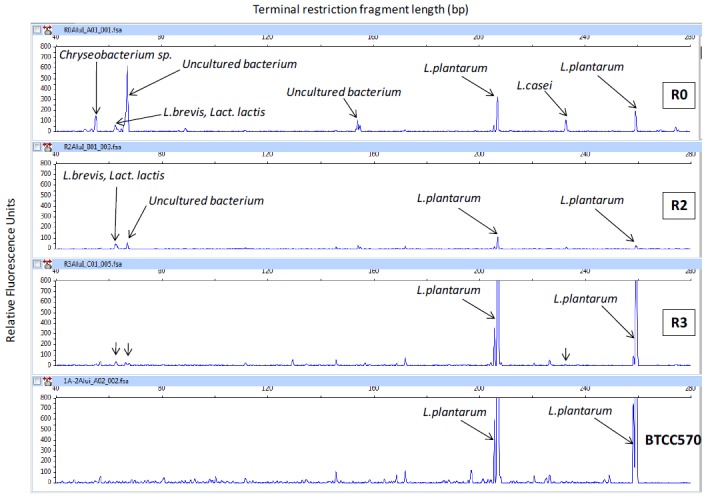
Calliandra calothyrsus preserved in silage is an alternative method for improving the crude protein content of feeds for sustainable ruminant production. The aim of this research was to evaluate the quality of silage which contained different levels of C. calothyrsus by examining the fermentation characteristics and microbial diversity. Silage was made in a completely randomized design consisting of five treatments with three replications i.e.: R0, Pennisetum purpureum 100%; R1, P. purpureum 75%+C. calothyrsus 25%;, R2, P. purpureum 50%+C. calothyrsus 50%; R3, P. purpureum 25%+C. calothyrsus 75%; and R4, C. calothyrsus 100%. All silages were prepared using plastic jar silos (600 g) and incubated at room temperature for 30 days. Silages were analyzed for fermentation characteristics and microbial diversity. Increased levels of C. calothyrsus in silage had a significant effect (p<0.01) on the fermentation characteristics. The microbial diversity index decreased and activity was inhibited with increasing levels of C. calothyrsus. The microbial community indicated that there was a population of Lactobacillus plantarum, L. casei, L. brevis, Lactococcus lactis, Chryseobacterium sp., and uncultured bacteria. The result confirmed that silage with a combination of grass and C. calothyrsus had good fermentation characteristics and microbial communities were dominated by L. plantarum.
青贮保存的红合欢是提高可持续反刍动物生产饲料粗蛋白含量的一种替代方法。本研究的目的是通过检测发酵特性和微生物多样性来评估含有不同水平红合欢的青贮饲料质量。青贮饲料采用完全随机设计制作,包括五个处理,每个处理三个重复,即:R0,100%象草;R1,75%象草 + 25%红合欢;R2,50%象草 + 50%红合欢;R3,25%象草 + 75%红合欢;以及R4,100%红合欢。所有青贮饲料均使用塑料罐青贮(600克),并在室温下培养30天。对青贮饲料进行发酵特性和微生物多样性分析。青贮饲料中红合欢水平的增加对发酵特性有显著影响(p<0.01)。随着红合欢水平的增加,微生物多样性指数下降且活性受到抑制。微生物群落表明存在植物乳杆菌、干酪乳杆菌、短乳杆菌、乳酸乳球菌、金黄杆菌属和未培养细菌种群。结果证实,草与红合欢组合的青贮饲料具有良好的发酵特性,且微生物群落以植物乳杆菌为主。