Gerontechnology and Rehabilitation Group, University of Bern, Bern, Switzerland.
JMIR Serious Games. 2013 Aug 6;1(1):e1. doi: 10.2196/games.2778.
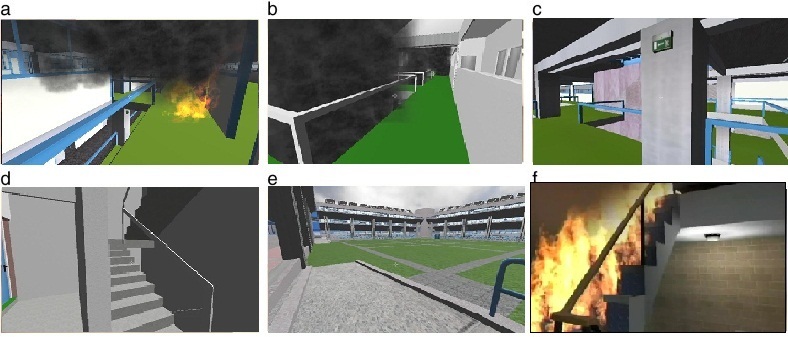
Dementia is a multifaceted disorder that impairs cognitive functions, such as memory, language, and executive functions necessary to plan, organize, and prioritize tasks required for goal-directed behaviors. In most cases, individuals with dementia experience difficulties interacting with physical and social environments. The purpose of this study was to establish ecological validity and initial construct validity of a fire evacuation Virtual Reality Day-Out Task (VR-DOT) environment based on performance profiles as a screening tool for early dementia.
The objectives were (1) to examine the relationships among the performances of 3 groups of participants in the VR-DOT and traditional neuropsychological tests employed to assess executive functions, and (2) to compare the performance of participants with mild Alzheimer's-type dementia (AD) to those with amnestic single-domain mild cognitive impairment (MCI) and healthy controls in the VR-DOT and traditional neuropsychological tests used to assess executive functions. We hypothesized that the 2 cognitively impaired groups would have distinct performance profiles and show significantly impaired independent functioning in ADL compared to the healthy controls.
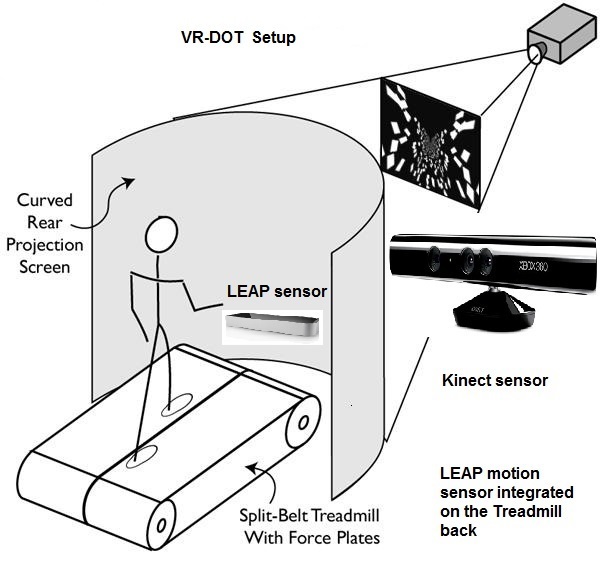
The study population included 3 groups: 72 healthy control elderly participants, 65 amnestic MCI participants, and 68 mild AD participants. A natural user interface framework based on a fire evacuation VR-DOT environment was used for assessing physical and cognitive abilities of seniors over 3 years. VR-DOT focuses on the subtle errors and patterns in performing everyday activities and has the advantage of not depending on a subjective rating of an individual person. We further assessed functional capacity by both neuropsychological tests (including measures of attention, memory, working memory, executive functions, language, and depression). We also evaluated performance in finger tapping, grip strength, stride length, gait speed, and chair stands separately and while performing VR-DOTs in order to correlate performance in these measures with VR-DOTs because performance while navigating a virtual environment is a valid and reliable indicator of cognitive decline in elderly persons.
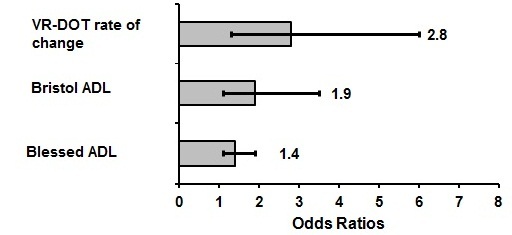
The mild AD group was more impaired than the amnestic MCI group, and both were more impaired than healthy controls. The novel VR-DOT functional index correlated strongly with standard cognitive and functional measurements, such as mini-mental state examination (MMSE; rho=0.26, P=.01) and Bristol Activities of Daily Living (ADL) scale scores (rho=0.32, P=.001).
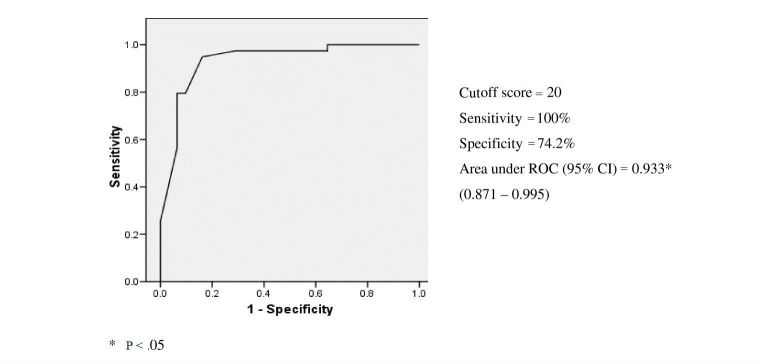
Functional impairment is a defining characteristic of predementia and is partly dependent on the degree of cognitive impairment. The novel virtual reality measures of functional ability seem more sensitive to functional impairment than qualitative measures in predementia, thus accurately differentiating from healthy controls. We conclude that VR-DOT is an effective tool for discriminating predementia and mild AD from controls by detecting differences in terms of errors, omissions, and perseverations while measuring ADL functional ability.
痴呆是一种多方面的障碍,会损害认知功能,例如记忆、语言和执行功能,这些功能对于计划、组织和优先考虑完成目标所需的任务至关重要。在大多数情况下,痴呆症患者在与物理和社会环境互动方面会遇到困难。本研究的目的是建立基于表现特征的火灾疏散虚拟现实日常任务(VR-DOT)环境的生态有效性和初步结构有效性,作为早期痴呆症的筛查工具。
(1)检查 3 组参与者在 VR-DOT 中的表现与用于评估执行功能的传统神经心理学测试之间的关系,以及(2)比较轻度阿尔茨海默病型痴呆(AD)患者与遗忘型单域轻度认知障碍(MCI)患者和健康对照组在 VR-DOT 和用于评估执行功能的传统神经心理学测试中的表现。我们假设,这两个认知障碍组将具有不同的表现特征,并在 ADL 中表现出明显受损的独立功能,与健康对照组相比。
研究人群包括 3 组:72 名健康对照组老年人、65 名遗忘型 MCI 参与者和 68 名轻度 AD 参与者。使用基于火灾疏散 VR-DOT 环境的自然用户界面框架来评估老年人 3 年以上的身体和认知能力。VR-DOT 侧重于执行日常活动时的细微错误和模式,并且具有不依赖于个人主观评分的优点。我们还通过神经心理学测试(包括注意力、记忆、工作记忆、执行功能、语言和抑郁的测量)进一步评估了功能能力。我们还分别评估了手指敲击、握力、步长、步速和椅子站立的表现,同时还评估了在执行 VR-DOT 时的表现,以便将这些测量中的表现与 VR-DOT 相关联,因为在虚拟环境中导航的表现是老年人认知能力下降的有效且可靠的指标。
轻度 AD 组的表现比遗忘型 MCI 组更差,而且两者都比健康对照组更差。新的 VR-DOT 功能指数与标准认知和功能测量密切相关,例如简易精神状态检查(MMSE;rho=0.26,P=.01)和布里斯托尔日常生活活动(ADL)量表评分(rho=0.32,P=.001)。
功能障碍是痴呆前的一个特征,部分取决于认知障碍的程度。与痴呆前的定性测量相比,新的虚拟现实功能能力测量似乎对功能障碍更敏感,因此能够准确地区分健康对照组。我们得出的结论是,VR-DOT 是一种通过检测在测量 ADL 功能能力时的错误、遗漏和坚持来区分痴呆前和轻度 AD 与对照组的有效工具。