Seidman David, Hebert Kathryn S, Truchan Hilary K, Miller Daniel P, Tegels Brittney K, Marconi Richard T, Carlyon Jason A
Department of Microbiology and Immunology, Virginia Commonwealth University School of Medicine, Richmond, Virginia, United States of America.
PLoS Pathog. 2015 Feb 6;11(2):e1004669. doi: 10.1371/journal.ppat.1004669. eCollection 2015 Feb.
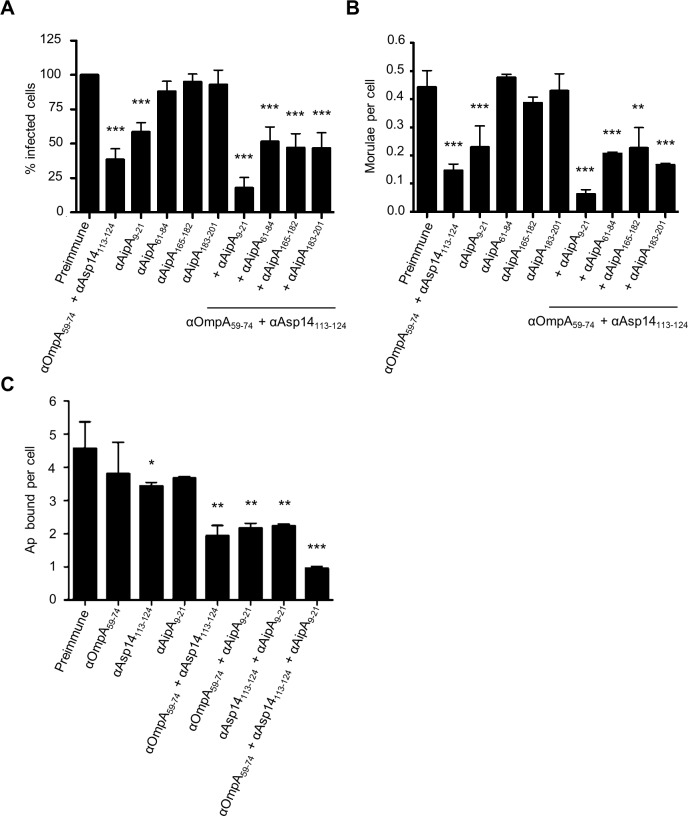
Anaplasma phagocytophilum causes granulocytic anaplasmosis, an emerging disease of humans and domestic animals. The obligate intracellular bacterium uses its invasins OmpA, Asp14, and AipA to infect myeloid and non-phagocytic cells. Identifying the domains of these proteins that mediate binding and entry, and determining the molecular basis of their interactions with host cell receptors would significantly advance understanding of A. phagocytophilum infection. Here, we identified the OmpA binding domain as residues 59 to 74. Polyclonal antibody generated against a peptide spanning OmpA residues 59 to 74 inhibited A. phagocytophilum infection of host cells and binding to its receptor, sialyl Lewis x (sLe(x)-capped P-selectin glycoprotein ligand 1. Molecular docking analyses predicted that OmpA residues G61 and K64 interact with the two sLe(x) sugars that are important for infection, α2,3-sialic acid and α1,3-fucose. Amino acid substitution analyses demonstrated that K64 was necessary, and G61 was contributory, for recombinant OmpA to bind to host cells and competitively inhibit A. phagocytophilum infection. Adherence of OmpA to RF/6A endothelial cells, which express little to no sLe(x) but express the structurally similar glycan, 6-sulfo-sLe(x), required α2,3-sialic acid and α1,3-fucose and was antagonized by 6-sulfo-sLe(x) antibody. Binding and uptake of OmpA-coated latex beads by myeloid cells was sensitive to sialidase, fucosidase, and sLe(x) antibody. The Asp14 binding domain was also defined, as antibody specific for residues 113 to 124 inhibited infection. Because OmpA, Asp14, and AipA each contribute to the infection process, it was rationalized that the most effective blocking approach would target all three. An antibody cocktail targeting the OmpA, Asp14, and AipA binding domains neutralized A. phagocytophilum binding and infection of host cells. This study dissects OmpA-receptor interactions and demonstrates the effectiveness of binding domain-specific antibodies for blocking A. phagocytophilum infection.
嗜吞噬细胞无形体可引发粒细胞无形体病,这是一种在人类和家畜中出现的疾病。这种专性细胞内细菌利用其侵袭素OmpA、Asp14和AipA感染髓样细胞和非吞噬细胞。确定这些蛋白质中介导结合和进入的结构域,并确定它们与宿主细胞受体相互作用的分子基础,将显著推进对嗜吞噬细胞无形体感染的理解。在此,我们确定OmpA结合结构域为第59至74位氨基酸残基。针对跨越OmpA第59至74位氨基酸残基的肽段产生的多克隆抗体可抑制嗜吞噬细胞无形体对宿主细胞的感染及其与受体唾液酸化路易斯x(sLe(x)封端的P-选择素糖蛋白配体1)的结合。分子对接分析预测,OmpA的G61和K64氨基酸残基与感染所需的两种sLe(x)糖类,即α2,3-唾液酸和α1,3-岩藻糖相互作用。氨基酸取代分析表明,K64对于重组OmpA结合宿主细胞并竞争性抑制嗜吞噬细胞无形体感染是必需的,而G61起辅助作用。OmpA与RF/6A内皮细胞的黏附需要α2,3-唾液酸和α1,3-岩藻糖,RF/6A内皮细胞几乎不表达或不表达sLe(x),但表达结构相似的聚糖6-磺酸-sLe(x),且6-磺酸-sLe(x)抗体可拮抗这种黏附。髓样细胞对OmpA包被的乳胶珠的结合和摄取对唾液酸酶、岩藻糖苷酶和sLe(x)抗体敏感。还确定了Asp14结合结构域,因为针对第113至124位氨基酸残基的特异性抗体可抑制感染。由于OmpA、Asp14和AipA均对感染过程有贡献,因此合理的推测是,最有效的阻断方法应针对这三者。一种靶向OmpA、Asp14和AipA结合结构域的抗体混合物可中和嗜吞噬细胞无形体对宿主细胞的结合和感染。本研究剖析了OmpA与受体的相互作用,并证明了结合结构域特异性抗体在阻断嗜吞噬细胞无形体感染方面的有效性。