Radtke Andrea J, Kastenmüller Wolfgang, Espinosa Diego A, Gerner Michael Y, Tse Sze-Wah, Sinnis Photini, Germain Ronald N, Zavala Fidel P, Cockburn Ian A
Johns Hopkins Malaria Research Institute and Department of Molecular Microbiology and Immunology, Johns Hopkins Bloomberg School of Public Health, Baltimore, Maryland, United States of America.
Lymphocyte Biology Section, Laboratory of Systems Biology, National Institute of Allergy and Infectious Diseases, National Institutes of Health, Bethesda, Maryland, United States of America.
PLoS Pathog. 2015 Feb 6;11(2):e1004637. doi: 10.1371/journal.ppat.1004637. eCollection 2015 Feb.
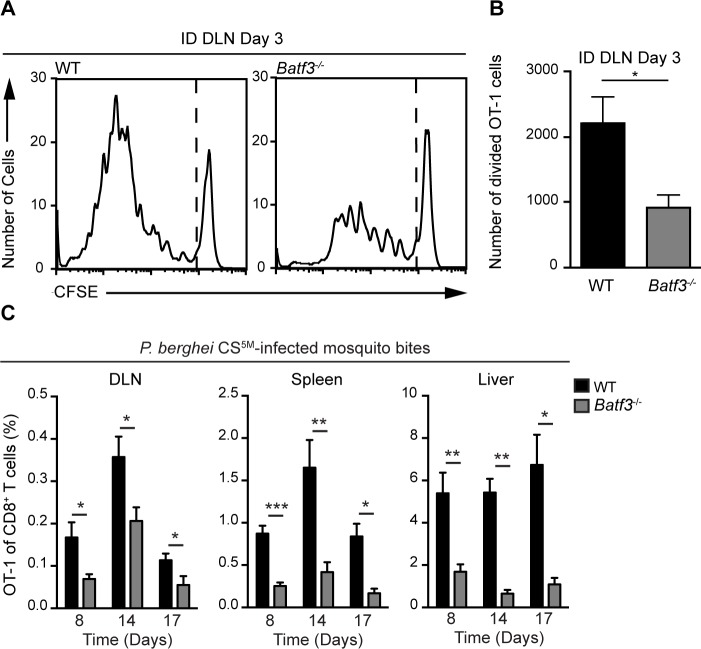
Malaria infection begins when a female Anopheles mosquito injects Plasmodium sporozoites into the skin of its host during blood feeding. Skin-deposited sporozoites may enter the bloodstream and infect the liver, reside and develop in the skin, or migrate to the draining lymph nodes (DLNs). Importantly, the DLN is where protective CD8(+) T cell responses against malaria liver stages are induced after a dermal route of infection. However, the significance of parasites in the skin and DLN to CD8(+) T cell activation is largely unknown. In this study, we used genetically modified parasites, as well as antibody-mediated immobilization of sporozoites, to determine that active sporozoite migration to the DLNs is required for robust CD8(+) T cell responses. Through dynamic in vivo and static imaging, we show the direct uptake of parasites by lymph-node resident DCs followed by CD8(+) T cell-DC cluster formation, a surrogate for antigen presentation, in the DLNs. A few hours after sporozoite arrival to the DLNs, CD8(+) T cells are primed by resident CD8α(+) DCs with no apparent role for skin-derived DCs. Together, these results establish a critical role for lymph node resident CD8α(+) DCs in CD8(+) T cell priming to sporozoite antigens while emphasizing a requirement for motile sporozoites in the induction of CD8(+) T cell-mediated immunity.
疟疾感染始于雌性按蚊在吸血过程中将疟原虫子孢子注入宿主皮肤。沉积在皮肤中的子孢子可能进入血液并感染肝脏,也可能驻留在皮肤中并发育,或者迁移至引流淋巴结(DLN)。重要的是,经皮肤感染途径后,DLN是诱导针对疟疾肝脏期的保护性CD8(+) T细胞反应的部位。然而,皮肤和DLN中的寄生虫对CD8(+) T细胞激活的意义在很大程度上尚不清楚。在本研究中,我们使用基因改造的寄生虫以及抗体介导的子孢子固定化,以确定活跃的子孢子迁移至DLN是强大的CD8(+) T细胞反应所必需的。通过动态体内成像和静态成像,我们展示了淋巴结驻留树突状细胞(DC)直接摄取寄生虫,随后在DLN中形成CD8(+) T细胞-DC簇,这是抗原呈递的一个替代指标。子孢子到达DLN数小时后,驻留的CD8α(+) DC启动CD8(+) T细胞,而皮肤来源的DC没有明显作用。总之,这些结果确立了淋巴结驻留CD8α(+) DC在CD8(+) T细胞针对子孢子抗原启动过程中的关键作用,同时强调了运动性子孢子在诱导CD8(+) T细胞介导的免疫中的必要性。