Sadeh Naomi, Miller Mark W, Wolf Erika J, Harkness Kate L
National Center for Posttraumatic Stress Disorder at Veterans Affairs Boston Healthcare System, 150 South Huntington Avenue, Boston, MA 02130, United States; Boston University School of Medicine, Department of Psychiatry, 715 Albany Street, M-8th Floor, Boston, MA 02118, United States.
National Center for Posttraumatic Stress Disorder at Veterans Affairs Boston Healthcare System, 150 South Huntington Avenue, Boston, MA 02130, United States; Boston University School of Medicine, Department of Psychiatry, 715 Albany Street, M-8th Floor, Boston, MA 02118, United States.
J Anxiety Disord. 2015 Apr;31:20-7. doi: 10.1016/j.janxdis.2015.01.003. Epub 2015 Jan 31.
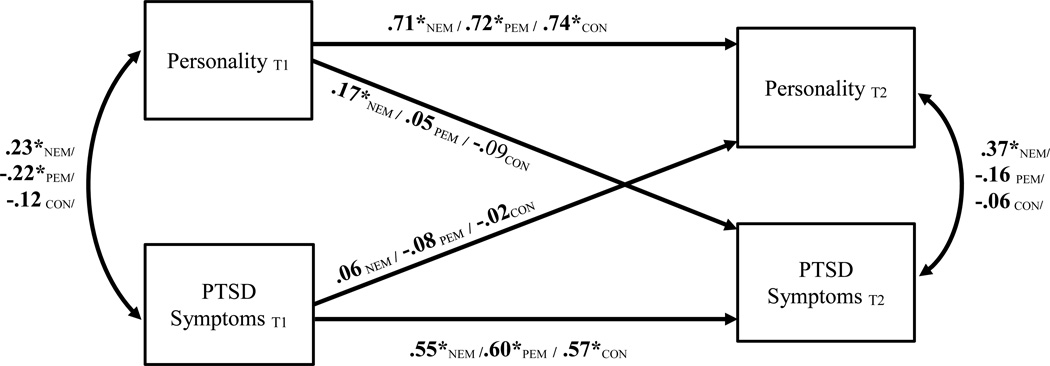
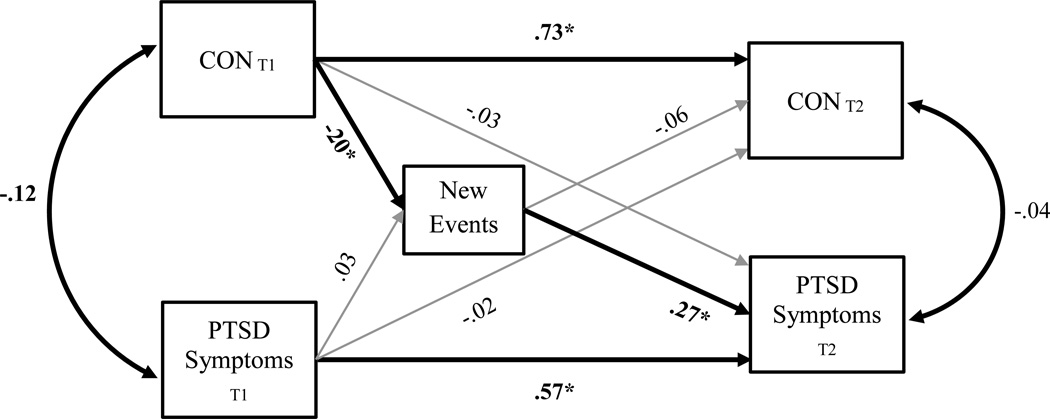
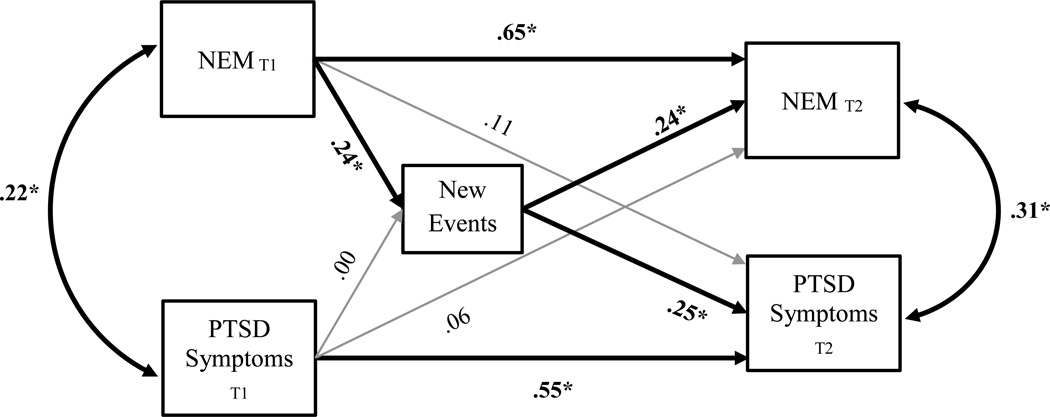
Identifying the factors that influence stability and change in chronic posttraumatic stress disorder (PTSD) is important for improving clinical outcomes. Using a cross-lagged design, we analyzed the reciprocal effects of personality and PTSD symptoms over time and their effects on stress exposure in a sample of 222 trauma-exposed veterans (ages 23-68; 90.5% male). Personality functioning and PTSD were measured approximately 4 years apart, and self-reported exposure to major adverse life events during the interim was also assessed. Negative emotionality positively predicted future PTSD symptoms, and this effect was partially mediated by exposure to new events. Constraint (negatively) indirectly affected PTSD via its association with exposure to new events. There were no significant effects of positive emotionality nor did PTSD symptom severity exert influences on personality over time. Results indicate that high negative affect and disconstraint influence the course of PTSD symptoms by increasing exposure to stressful life events.
识别影响慢性创伤后应激障碍(PTSD)稳定性和变化的因素对于改善临床疗效至关重要。我们采用交叉滞后设计,分析了222名有创伤经历的退伍军人(年龄23 - 68岁;90.5%为男性)样本中人格与PTSD症状随时间的相互影响及其对应激暴露的影响。人格功能和PTSD的测量相隔约4年,同时还评估了期间自我报告的重大不良生活事件暴露情况。消极情绪正向预测未来的PTSD症状,且这一效应部分由接触新事件介导。克制(消极地)通过与接触新事件的关联间接影响PTSD。积极情绪没有显著影响,PTSD症状严重程度随时间也未对人格产生影响。结果表明,高消极情绪和缺乏克制通过增加对压力性生活事件的暴露来影响PTSD症状的病程。