Global Collaboration Center, Osaka University, Osaka, Japan.
Faculty of Medicine, University of The Ryukyus, Okinawa, Japan.
Infect Drug Resist. 2015 Jan 23;8:1-5. doi: 10.2147/IDR.S74934. eCollection 2015.
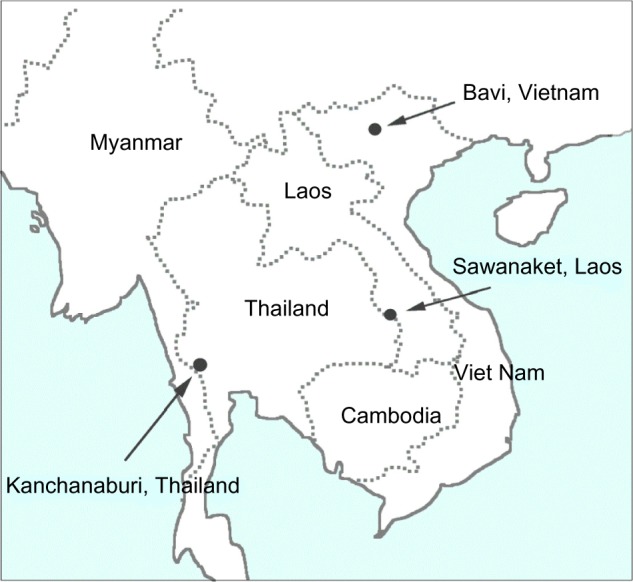
Recent studies have reported a widespread distribution of extended-spectrum β-lactamase (ESBL)-producing bacteria, not only in the nosocomial setting, but also in the community; some local communities in Southeast Asia have been reported to show a high prevalence of ESBL-producing bacteria. However, the details regarding the quantitative/qualitative state of ESBL-producing bacterial spread in Southeast Asia are currently unclear. Thus, the aim of this study was to assess the state of ESBL-producing bacterial spread in community residents from the Indochinese peninsula, as a representative region of Southeast Asia. In order to achieve this aim, local community residents in Laos and Vietnam were examined for fecal carriage of ESBL-producing Enterobacteriaceae, and the findings were compared with data from a previous study in Thailand which was conducted in the same manner as this study. Between 47.0%-70.2% of the Laotian and Vietnamese residents carried ESBL-producing CTX-M genotype Enterobacteriaceae. The most common sub-genotypes of CTX-M were CTX-M-1 (33.0%-47.5%) and CTX-M-9 (47.5%-64.1%), and these rates were similar among all three countries. Taken together, these results confirmed that ESBL-producing Enterobacteriaceae are widely disseminated in Indochinese countries, such as Thailand, Laos, and Vietnam.
最近的研究报告称,不仅在医院环境中,而且在社区中,广泛分布着产生超广谱β-内酰胺酶(ESBL)的细菌;一些东南亚的当地社区被报道显示出高比例的产 ESBL 细菌。然而,目前尚不清楚东南亚地区产 ESBL 细菌传播的定量/定性状态。因此,本研究旨在评估东南亚代表性地区——印度支那半岛社区居民中 ESBL 产生细菌的传播情况。为了实现这一目标,对老挝和越南的社区居民进行了粪便中产 ESBL 肠杆菌科的携带情况检查,并将结果与此前在泰国进行的一项类似研究的数据进行了比较。47.0%-70.2%的老挝和越南居民携带 CTX-M 基因型产 ESBL 肠杆菌科。CTX-M-1(33.0%-47.5%)和 CTX-M-9(47.5%-64.1%)是最常见的 CTX-M 亚型,在这三个国家中都很常见。综上所述,这些结果证实 ESBL 产生的肠杆菌科在泰国、老挝和越南等印度支那国家广泛传播。