Centre for research and knowledge transfer in biotechnology, University of Zagreb, Zagreb, Croatia ; Department for Cellular Immunology, Institute of Immunology, Rockfellerova ulica 10, Zagreb, Croatia.
Centre for research and knowledge transfer in biotechnology, University of Zagreb, Zagreb, Croatia.
Allergy Asthma Clin Immunol. 2014 Aug 20;10(1):43. doi: 10.1186/1710-1492-10-43. eCollection 2014.
Regulatory T cells (Tregs) play a key role in immune homeostasis in vivo. Tregs have a critical role in preventing the development of autoimmune diseases and defects in Treg function are implicated in various autoimmune disorders. Individuals with posttraumatic stress disorder (PTSD) have higher prevalence of autoimmune disorders than the general population. We hypothesized that war veterans with PTSD would exhibit a decreased number and/or altered phenotype of Tregs.
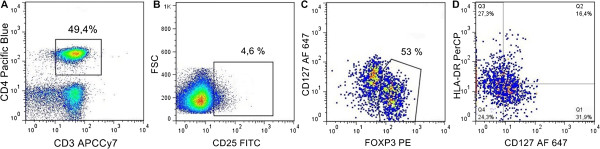
We analyzed peripheral blood mononuclear cells (PBMCs) of patients with PTSD (N = 21) (mean age = 45.9) and age-matched healthy controls (N = 23) (mean age = 45.7) to determine the proportion of Tregs and their phenotype according to the expression of CD127 and HLA-DR markers which describe the differentiation stages of Tregs. In addition, we analyzed the expression of membrane ectoenzyme CD39 on Tregs of the study groups, an important component of the suppressive machinery of Tregs.
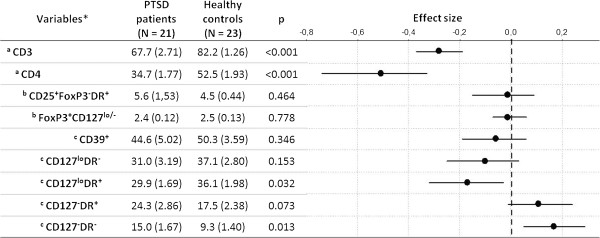
We found no differences in the proportion of Tregs between PTSD patients and controls, but PTSD patients had a higher percentage of CD127(-)HLA-DR(-) Tregs and a lower percentage of CD127(lo)HLA-DR(+) Tregs compared to controls. There was no difference in expression of CD39 on Tregs of the study groups.
Although the proportions of Tregs in PTSD patients were unchanged, we found that they exhibit a different phenotype of Tregs that might be less suppressive. Impaired differentiation and function of Tregs is likely involved in disruption of immune homeostasis in PTSD.
调节性 T 细胞(Tregs)在体内免疫稳态中发挥着关键作用。Tregs 在防止自身免疫疾病的发展方面起着关键作用,而 Treg 功能缺陷与各种自身免疫性疾病有关。患有创伤后应激障碍(PTSD)的个体比一般人群更容易患自身免疫性疾病。我们假设 PTSD 退伍军人的 Tregs 数量减少和/或表型改变。
我们分析了 PTSD 患者(N=21)(平均年龄=45.9)和年龄匹配的健康对照者(N=23)(平均年龄=45.7)的外周血单核细胞(PBMC),以根据 CD127 和 HLA-DR 标志物的表达来确定 Tregs 的比例及其表型,CD127 和 HLA-DR 标志物描述了 Tregs 的分化阶段。此外,我们分析了研究组 Tregs 表面膜外酶 CD39 的表达,CD39 是 Tregs 抑制机制的重要组成部分。
我们没有发现 PTSD 患者和对照组之间 Tregs 的比例有差异,但与对照组相比,PTSD 患者的 CD127(-)HLA-DR(-)Tregs 比例较高,而 CD127(lo)HLA-DR(+)Tregs 比例较低。研究组 Tregs 表面 CD39 的表达无差异。
尽管 PTSD 患者的 Tregs 比例没有变化,但我们发现它们表现出不同的 Tregs 表型,可能抑制作用较弱。Tregs 的分化和功能受损可能与 PTSD 中免疫稳态的破坏有关。