Oofuvong Maliwan, Geater Alan Frederick, Chongsuvivatwong Virasakdi, Chanchayanon Thavat, Worachotekamjorn Juthamas, Sriyanaluk Bussarin, Saefung Boonthida, Nuanjun Kanjana
Department of Anesthesiology, Faculty of Medicine, Prince of Songkla University, Songkhla, 90112 Thailand.
Epidemiology Unit, Faculty of Medicine, Prince of Songkla University, Songkhla, 90112 Thailand.
Springerplus. 2014 Mar 29;3:164. doi: 10.1186/2193-1801-3-164. eCollection 2014.
To determine whether perioperative desaturation (PD) in preschool children undergoing non-cardiac surgery is associated with subsequent impairment of intelligence or subsequent change in age-specific weight and height percentile.
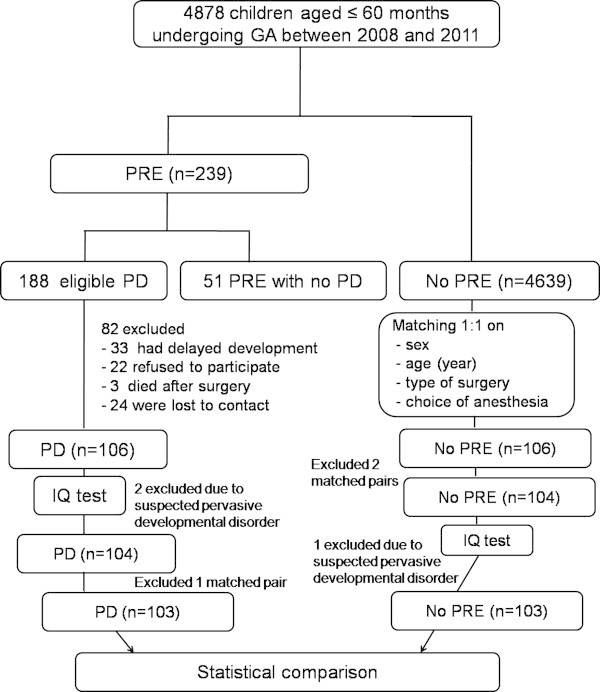
A historical-concurrent follow-up study was conducted in children aged ≤ 60 months who underwent general anesthesia (GA) for non-cardiac surgery between January 2008 and December 2011 at Songklanagarind Hospital. Children who developed PD (PD group) and children who did not develop perioperative respiratory events (no-PRE group) were matched on sex, age, year of having index GA, type of surgery and choice of anesthesia. The children's age-specific weight and height percentile and intelligence quotient (IQ) scores by Standford Binet-LM or Wechsler Intelligence Scale for Children, 3rd edition 12-60 months after GA were compared using Student's t- test and Wilcoxon's rank sum test. Multivariate linear regression models for standardized IQ and multivariate mixed effects linear regression models for the change of age-specific weight and height percentile from the time of index GA to the time of IQ test were performed to identify independent predictors. The coefficients and 95% confidence intervals (CI) were displayed and considered significant if the F test p-values were < 0.05.
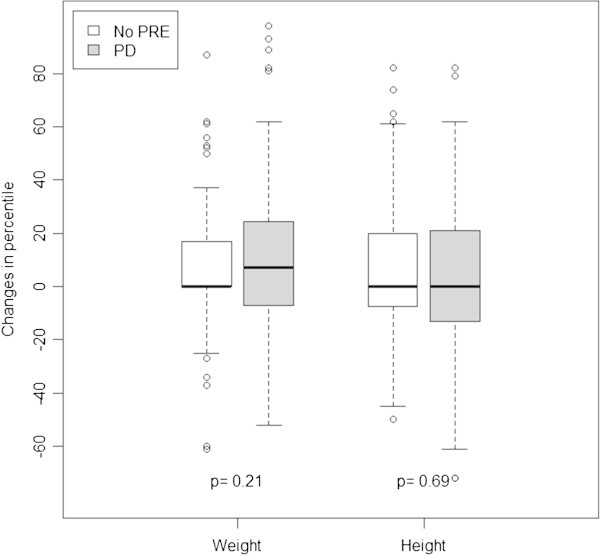
Of 103 subjects in each group (PD vs no-PRE), there were no statistically significant differences in IQ (94.7 vs 98.3, p = 0.13), standardized IQ (-0.1 vs 0.1, p = 0.14) or age-specific weight percentile (38th vs 63th, p = 0.06). However, age-specific height percentile in the PD group at the time of IQ test was significantly lower (38th vs 50th, p = 0.02). In the multivariate analysis, PD was not a significant predictor for standardized IQ (coefficient: -0.06, 95% CI: -0.3, 0.19, p = 0.57), change in age-specific weight percentile (coefficient: 4.66, 95% CI: -2.63, 11.95, p = 0.21) or change in age-specific height percentile (coefficient: -1.65, 95% CI: -9.74, 6.44, p = 0.69) from the time of index GA to the time of IQ test after adjusting for family and anesthesia characteristics.
Our study could not demonstrate any serious effect of PD on subsequent intelligence or on the change in age-specific weight and height percentile of children after non-cardiac surgery.
确定接受非心脏手术的学龄前儿童围手术期低氧血症(PD)是否与随后的智力损害或特定年龄体重和身高百分位数的变化有关。
对2008年1月至2011年12月在宋卡纳加拉医院接受非心脏手术全身麻醉(GA)的60个月及以下儿童进行历史同期随访研究。发生PD的儿童(PD组)和未发生围手术期呼吸事件的儿童(无PRE组)在性别、年龄、首次GA年份、手术类型和麻醉选择方面进行匹配。使用学生t检验和Wilcoxon秩和检验比较GA后12 - 60个月时儿童的特定年龄体重和身高百分位数以及斯坦福-比奈LM智力量表或韦氏儿童智力量表第三版的智商(IQ)分数。进行标准化IQ的多变量线性回归模型以及从首次GA到IQ测试时特定年龄体重和身高百分位数变化的多变量混合效应线性回归模型,以确定独立预测因素。显示系数和95%置信区间(CI),如果F检验p值<0.05,则认为具有统计学意义。
每组103名受试者(PD组与无PRE组),IQ(94.7对98.3,p = 0.13)、标准化IQ(-0.1对0.1,p = 0.14)或特定年龄体重百分位数(第38百分位对第63百分位,p = 0.06)无统计学显著差异。然而,IQ测试时PD组的特定年龄身高百分位数显著较低(第38百分位对第50百分位,p = 0.02)。在多变量分析中,调整家庭和麻醉特征后,从首次GA到IQ测试时,PD不是标准化IQ(系数:-0.06,95% CI:-0.3,0.19,p = 0.57)、特定年龄体重百分位数变化(系数:4.66,95% CI:-2.63,11.95,p = 0.21)或特定年龄身高百分位数变化(系数:-1.65,95% CI:-9.74,6.44,p = 0.69)的显著预测因素。
我们的研究未能证明PD对非心脏手术后儿童随后的智力或特定年龄体重和身高百分位数变化有任何严重影响。