Cirelli Chiara, Tononi Giulio
Department of Psychiatry, University of Wisconsin, Madison, Wisconsin..
Department of Psychiatry, University of Wisconsin, Madison, Wisconsin.
Biol Psychiatry. 2015 Jun 15;77(12):1071-8. doi: 10.1016/j.biopsych.2014.12.017. Epub 2014 Dec 24.
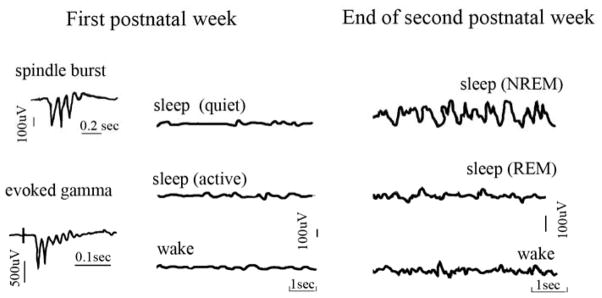
During adulthood, electroencephalogram (EEG) recordings are used to distinguish wake, non-rapid eye movement sleep, and rapid eye movement sleep states. The close association between behavioral states and EEG rhythms is reached late during development, after birth in humans and by the end of the second postnatal week in rats and mice. This critical time is also when cortical activity switches from a discontinuous to a continuous pattern. We review the major cellular and network changes that can account for this transition. After this close link is established, new evidence suggests that the slow waves of non-rapid eye movement sleep may function as markers to track cortical development. However, before the EEG can be used to identify behavioral states, two distinct sleep phases--quiet sleep and active sleep--are identified based on behavioral criteria and muscle activity. During this early phase of development, cortical activity is far from being disorganized, despite the presence of long periods of neuronal silence and the poor modulation by behavioral states. Specific EEG patterns, such as spindle bursts and gamma oscillations, have been identified very early on and are believed to play a significant role in the refinement of brain circuits. Because most early EEG patterns do not map to a specific behavioral state, their contribution to the presumptive role of sleep in brain maturation remains to be established and should be a major focus for future research.
在成年期,脑电图(EEG)记录用于区分清醒、非快速眼动睡眠和快速眼动睡眠状态。行为状态与脑电节律之间的紧密联系在发育后期才得以建立,人类是在出生后,而大鼠和小鼠是在出生后第二周结束时。这个关键时期也是皮质活动从间断模式转变为连续模式的时候。我们回顾了能够解释这种转变的主要细胞和网络变化。在这种紧密联系建立之后,新的证据表明非快速眼动睡眠的慢波可能作为追踪皮质发育的标志物。然而,在脑电图可用于识别行为状态之前,根据行为标准和肌肉活动确定了两个不同的睡眠阶段——安静睡眠和活跃睡眠。在发育的这个早期阶段,尽管存在长时间的神经元沉默以及行为状态调节不佳,但皮质活动远非杂乱无章。特定的脑电模式,如纺锤波爆发和伽马振荡,很早就被识别出来,并且被认为在脑回路的细化中起重要作用。由于大多数早期脑电模式并不对应于特定的行为状态,它们对睡眠在脑成熟中假定作用的贡献仍有待确定,应该是未来研究的主要重点。