Amin Priyal, Levin Linda, Holmes Sarah J, Picard Jillian, Bernstein Jonathan A
Division of Immunology, Allergy & Rheumatology, University of Cincinnati College of Medicine, Cincinnati, Ohio.
Department of Environmental Health, University of Cincinnati, Cincinnati, Ohio.
J Allergy Clin Immunol Pract. 2015 May-Jun;3(3):400-7. doi: 10.1016/j.jaip.2014.12.007. Epub 2015 Feb 11.
Identifying clinical characteristics of patients with chronic urticaria (CU) responsive to medication may help guide clinicians select treatment.
The objective of this study was to investigate patient characteristics and medication use associated with urticaria control.
A retrospective longitudinal chart review of adult patients with CU was conducted at a multisite allergy practice. Inclusion criteria required at least 4 CU office visits to allow for pre- and posttreatment assessment. Control corresponding to medication(s) used was assessed each visit. Univariate analysis followed by multiple logistic regression was performed.
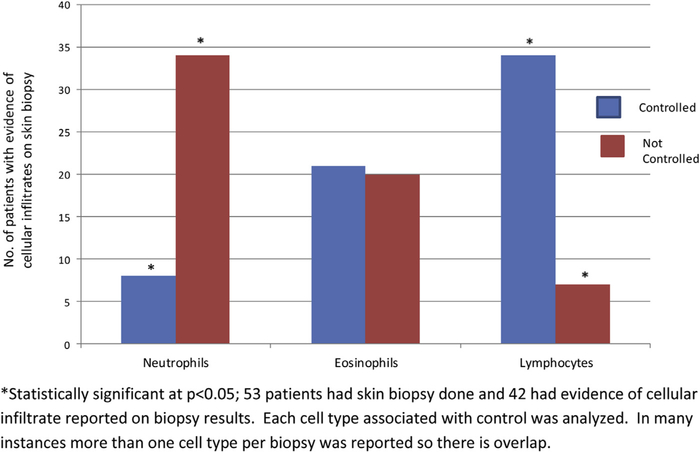
A total of 221 patients with CU were included; 140 (63%) achieved complete control. The average time to control was 1.4 ± 2.7 years, which required 1-3 classes of medications. Dermatographia odds ratio (OR) = 1.85 (95% CI 1.3-2.7) or other physical urticarias, OR = 1.51 (1-2.4) and neutrophilic infiltrates on skin biopsy were markers of poor control. Thyroid autoantibodies were associated with better control using an H1-antihistamine. Whereas 22% were controlled on a second-generation H1-receptor antagonist plus a leukotriene receptor antagonist (LTRA), an additional 33% were controlled when cyclosporine was added. Use of a first or second H1-antagonist or LTRA was associated with a 3.5-16.9 times higher odds of complete CU control in those with dermatographia. The odds of achieving control for other forms of physical urticaria was greatest when colchicine was added (aOR = 32.6 [12.7-83.2]).
Patient-specific CU characteristics associated with medication-disease control may be useful for selecting treatment regimens. A subset of CU patients remains poorly controlled that indicates an unmet need for novel therapeutic agents.
识别对药物治疗有反应的慢性荨麻疹(CU)患者的临床特征可能有助于指导临床医生选择治疗方法。
本研究的目的是调查与荨麻疹控制相关的患者特征和药物使用情况。
在一个多地点过敏诊所对成年CU患者进行回顾性纵向病历审查。纳入标准要求至少进行4次CU门诊就诊,以便进行治疗前和治疗后评估。每次就诊时评估与所用药物相对应的控制情况。进行单因素分析,然后进行多因素逻辑回归分析。
共纳入221例CU患者;140例(63%)实现了完全控制。平均控制时间为1.4±2.7年,需要1 - 3类药物。皮肤划痕征优势比(OR)=1.85(95%可信区间1.3 - 2.7)或其他物理性荨麻疹,OR =1.51(1 - 2.4)以及皮肤活检中的嗜中性粒细胞浸润是控制不佳的标志。甲状腺自身抗体与使用H1抗组胺药时更好的控制相关。虽然22%的患者在第二代H1受体拮抗剂加白三烯受体拮抗剂(LTRA)治疗下得到控制,但当添加环孢素时,另外33%的患者得到控制。在有皮肤划痕征的患者中,使用第一代或第二代H1拮抗剂或LTRA与CU完全控制的几率高3.5 - 16.9倍相关。当添加秋水仙碱时,其他形式的物理性荨麻疹实现控制的几率最大(调整后OR =32.6 [12.7 - 83.2])。
与药物 - 疾病控制相关的特定患者CU特征可能有助于选择治疗方案。一部分CU患者仍然控制不佳,这表明对新型治疗药物存在未满足的需求。