Landeta Cristina, Blazyk Jessica L, Hatahet Feras, Meehan Brian M, Eser Markus, Myrick Alissa, Bronstain Ludmila, Minami Shoko, Arnold Holly, Ke Na, Rubin Eric J, Furie Barbara C, Furie Bruce, Beckwith Jon, Dutton Rachel, Boyd Dana
Department of Microbiology and Immunobiology, Harvard Medical School, Boston, Massachusetts, USA.
Department of Immunology and Infectious Diseases, Harvard School of Public Health, Boston, Massachusetts, USA.
Nat Chem Biol. 2015 Apr;11(4):292-8. doi: 10.1038/nchembio.1752. Epub 2015 Feb 16.
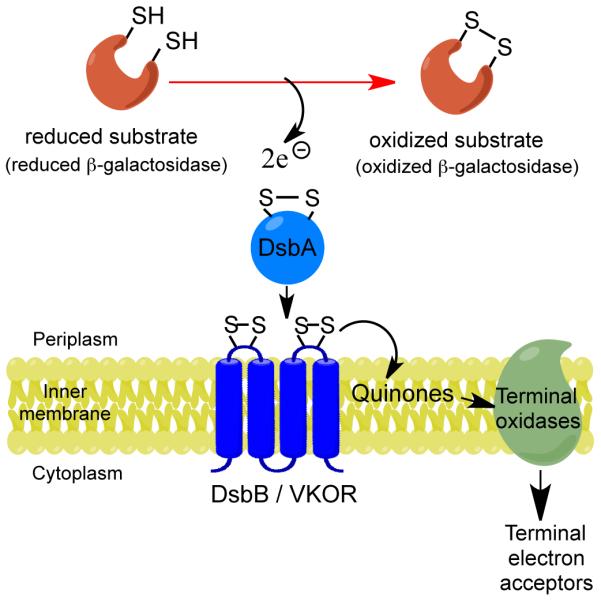
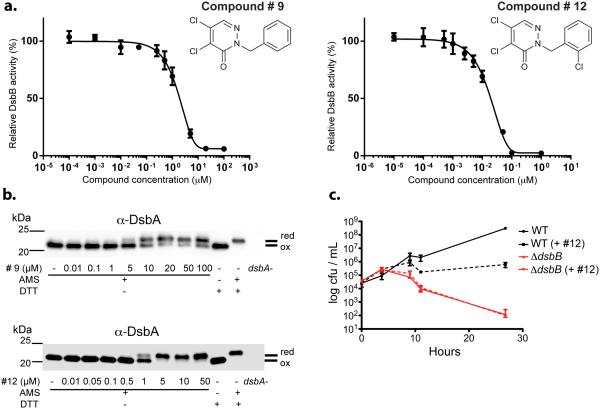
In bacteria, disulfide bonds confer stability on many proteins exported to the cell envelope or beyond. These proteins include numerous bacterial virulence factors, and thus bacterial enzymes that promote disulfide bond formation represent targets for compounds inhibiting bacterial virulence. Here, we describe a new target- and cell-based screening methodology for identifying compounds that inhibit the disulfide bond-forming enzymes Escherichia coli DsbB (EcDsbB) or Mycobacterium tuberculosis VKOR (MtbVKOR), which can replace EcDsbB, although the two are not homologs. Initial screening of 51,487 compounds yielded six specifically inhibiting EcDsbB. These compounds share a structural motif and do not inhibit MtbVKOR. A medicinal chemistry approach led us to select related compounds, some of which are much more effective DsbB inhibitors than those found in the screen. These compounds inhibit purified DsbB and prevent anaerobic growth of E. coli. Furthermore, these compounds inhibit all but one of the DsbBs of nine other Gram-negative pathogenic bacteria tested.
在细菌中,二硫键赋予许多输出到细胞膜或细胞外的蛋白质稳定性。这些蛋白质包括众多细菌毒力因子,因此促进二硫键形成的细菌酶成为抑制细菌毒力的化合物的作用靶点。在此,我们描述了一种基于靶点和细胞的新型筛选方法,用于鉴定抑制二硫键形成酶大肠杆菌DsbB(EcDsbB)或结核分枝杆菌VKOR(MtbVKOR)的化合物,尽管二者并非同源物,但MtbVKOR可替代EcDsbB。对51487种化合物进行初步筛选,得到了6种特异性抑制EcDsbB的化合物。这些化合物具有共同的结构基序,且不抑制MtbVKOR。通过药物化学方法,我们筛选出了相关化合物,其中一些作为DsbB抑制剂比筛选中发现的化合物更有效。这些化合物可抑制纯化的DsbB,并阻止大肠杆菌的厌氧生长。此外,这些化合物能抑制所测试的其他9种革兰氏阴性病原菌中除一种之外的所有DsbB。