Brito-Santos Fábio, Barbosa Gláucia Gonçalves, Trilles Luciana, Nishikawa Marília Martins, Wanke Bodo, Meyer Wieland, Carvalho-Costa Filipe Anibal, Lazéra Márcia dos Santos
Mycology Laboratory, Evandro Chagas Clinical Research Institute, FIOCRUZ, Rio de Janeiro, Brazil.
National Institute for Quality Control in Health, INCQS/FIOCRUZ, Rio de Janeiro, Brazil.
PLoS One. 2015 Feb 17;10(2):e0115866. doi: 10.1371/journal.pone.0115866. eCollection 2015.
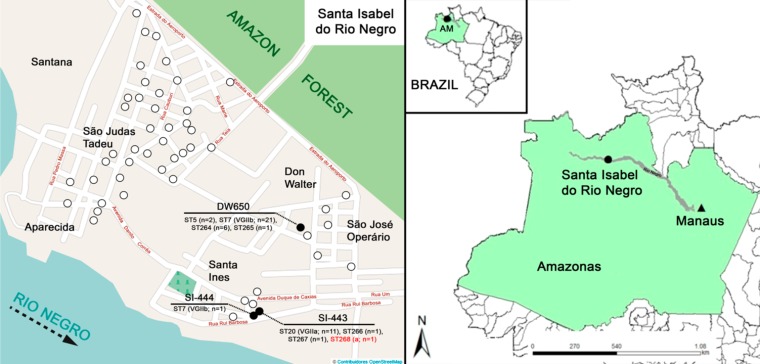
Cryptococcosis is a human fungal infection of significant mortality and morbidity, especially in the meningoencephalitis form. Cryptococcosis is distributed worldwide and its agents, C. neoformans and C. gattii, present eight major molecular types-VNI-VNIV and VGI-VGIV respectively. The primary cryptococcosis caused by molecular type VGII (serotype B, MAT alpha) prevails in immunocompetent patients in the North and Northeast of Brazil, revealing an endemic regional pattern to this molecular type. Since 1999, C. gattii VGII has been involved in an ongoing outbreak in Canada, and is expanding to the Northwest of the United States, two temperate regions. Exposure to propagules dispersed in the environment, related to various organic substrates, mainly decomposing wood in and around dwellings, initiates the infection process. The present study investigated the presence of the agents of cryptococcosis in dust from dwellings in the upper Rio Negro, municipality of Santa Isabel do Rio Negro in Amazonas state. Indoor dust was collected from 51 houses, diluted and plated on bird seed agar. Dark brown colonies were identified phenotypically, and genotypically by URA5 restriction fragment length polymorphism analysis and multilocus sequence typing (MLST). The mating type was identified using pheromone-specific primers. Three of the 51 houses were positive for C. gattii molecular type VGII, MATα and MATa, showing a high prevalence of this agent. MLST studies identified eight subtypes, VGIIb (ST7), VGIIa (ST20), (ST5) and 5 new subtypes unique to the region. For the first time in the state of Amazonas, C. gattii VGII MATα and MATa were isolated from the environment and correlates with endemic cryptococcosis in this state. This is the first description of MLST subtypes on environmental isolates in the Brazilian Amazon, indicating domiciliary dust as a potential source for human infection with different subtypes of C. gattii VGII MATα and MATa.
隐球菌病是一种具有显著死亡率和发病率的人类真菌感染,尤其是脑膜脑炎形式。隐球菌病在全球范围内均有分布,其病原体新型隐球菌和格特隐球菌分别呈现出八种主要分子类型——VNI - VNIV和VGI - VGIV。由分子类型VGII(血清型B,MATα)引起的原发性隐球菌病在巴西北部和东北部的免疫功能正常患者中较为普遍,显示出该分子类型的地方流行模式。自1999年以来,格特隐球菌VGII参与了加拿大的持续疫情爆发,并正在向美国西北部这两个温带地区蔓延。接触分散在环境中的繁殖体,这些繁殖体与各种有机底物有关,主要是住宅内及周围正在分解的木材,引发了感染过程。本研究调查了亚马逊州圣伊莎贝尔·杜里奥内格罗市上里奥内格罗地区住宅灰尘中隐球菌病病原体的存在情况。从51所房屋收集室内灰尘,稀释后接种于鸟籽琼脂平板上。通过表型鉴定深棕色菌落,并通过URA5限制性片段长度多态性分析和多位点序列分型(MLST)进行基因型鉴定。使用信息素特异性引物鉴定交配型。51所房屋中有3所对格特隐球菌分子类型VGII、MATα和MATa呈阳性,表明该病原体的高流行率。MLST研究确定了八个亚型,即VGIIb(ST7)、VGIIa(ST20)、(ST5)以及该地区特有的5个新亚型。在亚马逊州首次从环境中分离出格特隐球菌VGII MATα和MATa,并且与该州的地方性隐球菌病相关。这是巴西亚马逊地区环境分离株MLST亚型的首次描述,表明家庭灰尘是人类感染不同亚型格特隐球菌VGII MATα和MATa的潜在来源。