Division of EcoCreative, Ewha Womans University 52 Ewhayeodae-gil, Seodaemun-gu, Seoul, 120-750, Korea.
Division of EcoScience, Ewha Womans University 52 Ewhayeodae-gil, Seodaemun-gu, Seoul, 120-750, Korea.
Ecol Evol. 2015 Jan;5(2):419-35. doi: 10.1002/ece3.1374. Epub 2014 Dec 28.
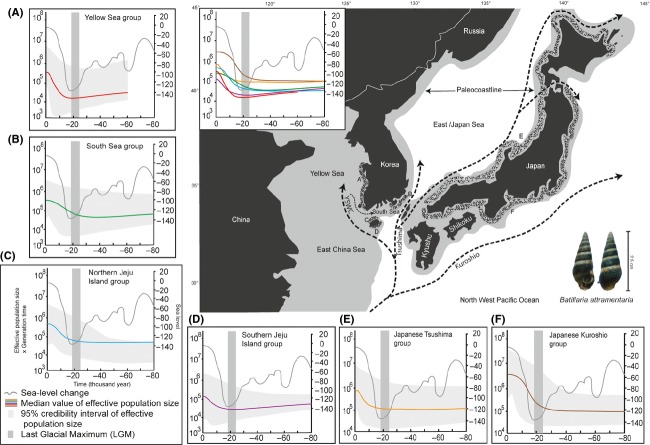
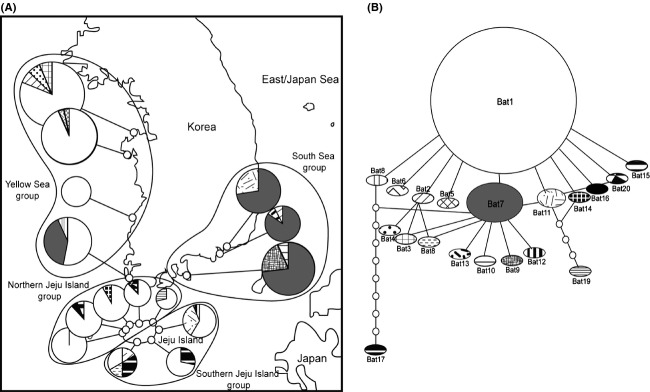
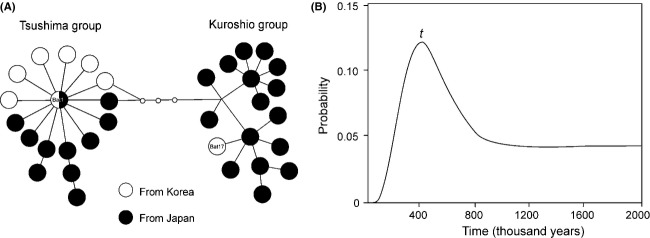
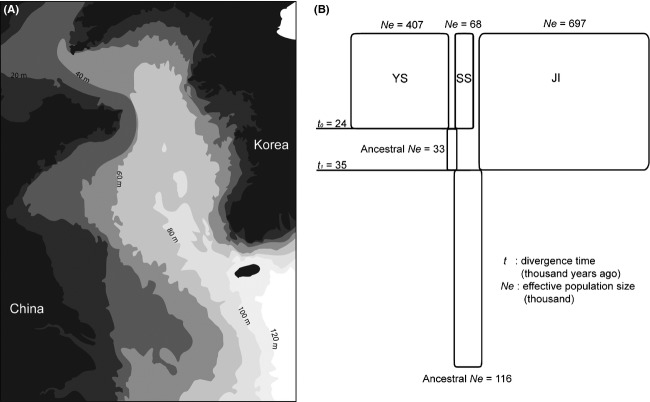
To address the impacts of past climate changes, particularly since the last glacial period, on the history of the distribution and demography of marine species, we investigated the evolutionary and demographic responses of the intertidal batillariid gastropod, Batillaria attramentaria, to these changes, using the snail as a model species in the northwest Pacific. We applied phylogeographic and divergence population genetic approaches to mitochondrial COI sequences from B. attramentaria. To cover much of its distributional range, 197 individuals collected throughout Korea and 507 publically available sequences (mostly from Japan) were used. Finally, a Bayesian skyline plot (BSP) method was applied to reconstruct the demographic history of this species. We found four differentiated geographic groups around Korea, confirming the presence of two distinct, geographically subdivided haplogroups on the Japanese coastlines along the bifurcated routes of the warm Tsushima and Kuroshio Currents. These two haplogroups were estimated to have begun to split approximately 400,000 years ago. Population divergence analysis supported the hypothesis that the Yellow Sea was populated by a northward range expansion of a small fraction of founders that split from a southern ancestral population since the last glacial maximum (LGM: 26,000-19,000 years ago), when the southern area became re-submerged. BSP analyses on six geographically and genetically defined groups in Korea and Japan consistently demonstrated that each group has exponentially increased approximately since the LGM. This study resolved the phylogeography of B. attramentaria as a series of events connected over space and time; while paleoceanographic conditions determining the connectivity of neighboring seas in East Asia are responsible for the vicariance of this species, the postglacial sea-level rise and warming temperatures have played a crucial role in rapid range shifts and broad demographic expansions of its populations.
为了了解过去气候变化(尤其是末次冰期以来)对海洋物种分布和种群历史的影响,我们以西北太平洋的Batillaria attramentaria 为模式生物,利用线粒体 COI 序列,通过系统地理学和分歧种群遗传方法,研究了这种腹足纲贝类对这些变化的进化和种群遗传响应。为了涵盖其分布范围的大部分地区,我们使用了从韩国各地采集的 197 个个体和从日本获得的 507 个公共序列(主要来自日本)。最后,应用贝叶斯天空线图(BSP)方法重建了该物种的种群历史。我们在韩国周围发现了四个分化的地理群体,证实了日本沿海地区存在两个截然不同的、地理上分隔的单倍型群,它们沿着温暖的对马暖流和黑潮的分叉路线分布。这两个单倍型群估计大约在 40 万年前开始分化。种群分歧分析支持了这样的假设,即黄海的种群是由一小部分从末次冰期最大冰期(约 26000-19000 年前,当时南部地区重新被淹没)南部祖先种群向北扩张的祖先的一小部分形成的,BSP 分析在韩国和日本六个地理和遗传定义的群体中一致表明,自末次冰期以来,每个群体的数量都呈指数增长。本研究解决了 B. attramentaria 的系统地理学问题,认为这是一系列跨越时空的事件的结果;虽然决定东亚邻近海域连通性的古海洋条件是导致该物种地理隔离的原因,但冰后期海平面上升和气温升高在其种群的快速分布变化和广泛的种群扩张中发挥了关键作用。