Mennecart Bastien
CR2P - Centre de Recherches sur la Paléobiodiversité et les Paléoenvironnements, UMR 7207, Muséum National d'Histoire Naturelle, CNRS, UPMC, Sorbonne Universités. MNHN, CP38, 8 rue Buffon, 75005 Paris, France; SNMB-Bayerische Staatssammlung für Paläontologie und Geologie, Munich, Germany.
PLoS One. 2015 Feb 18;10(2):e0116830. doi: 10.1371/journal.pone.0116830. eCollection 2015.
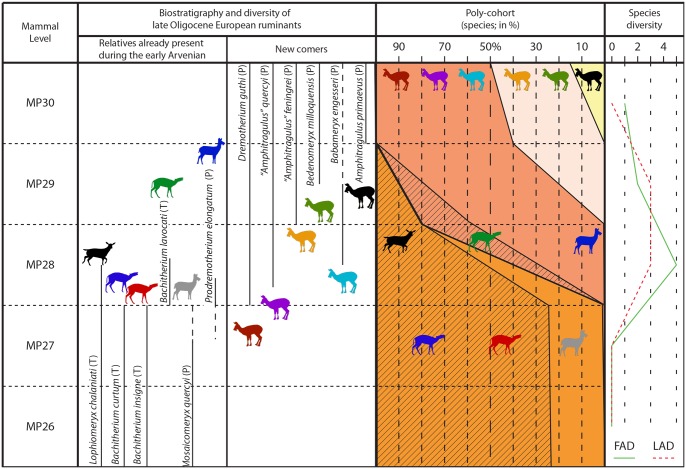
The Earth already experienced numerous episodes of global warming and cooling. One of the latest impressive events of temperature rising was the Late Oligocene Warming that occurred around 25 Mya. An increase of the marine temperature of 2 to 4°C has been observed in a short time interval. In Europe, this major climatic event can be correlated to the continental faunal turnover "Microbunodon Event". This event is marked by a huge faunal turnover (40% of the ungulate fauna during the first 500k years) and environmental changes. Drier conditions associated to the appearance of the seasonality lead to new environmental conditions dominated by wooded savannahs. This is correlated to a major arrival of Asiatic immigrants. Moreover, from a homogenous fauna during the main part of the Oligocene, local climatic variations between the European Western coast and the more central Europe could have provided faunal regionalism during the latest Oligocene and earliest Miocene. Considering the ruminants, this event is the major ever known for this group in Europe. A total renewal at the family level occurred. Thanks to a precise stratigraphic succession, major evolutionary elements are highlighted. Typical Oligocene species, mainly Tragulina, were adapted to wooded environments and were leaves/fruits eaters. They disappeared at the end of MP27 or the early MP28. This corresponds to the appearance of the Asiatic immigrants. The Tragulina (Lophiomerycidae, Bachitheriidae) and stem Pecora gave way to more derived stem and maybe crown Pecora (e.g. "Amphitragulus", Babameryx, Dremotherium). These newcomers were adapted to more open environments and mixed feeding. The disappearance of the Tragulina is probably linked to environmental and vegetation changes, and competition. They give way to more derived ruminants having a more efficient metabolism in drier conditions and a better assimilation of less energetic food.
地球已经经历了无数次全球变暖和变冷的时期。最近一次令人印象深刻的气温上升事件是发生在约2500万年前的晚渐新世变暖。在短时间内观测到海洋温度上升了2至4摄氏度。在欧洲,这一重大气候事件与大陆动物群更替“小鼷鹿事件”相关。该事件的特征是巨大的动物群更替(在最初的50万年里有40%的有蹄类动物群发生更替)以及环境变化。与季节性出现相关的干燥条件导致了以树木繁茂的稀树草原为主导的新环境状况。这与亚洲移民的大量到来相关。此外,在渐新世的主要时期,从一个同质化的动物群来看,欧洲西海岸和中欧更中心地区之间的局部气候差异可能在晚渐新世和早中新世期间形成了动物群的区域化。就反刍动物而言,这是欧洲已知的该类群有史以来最重大的事件。在科级水平上发生了全面更新。得益于精确的地层序列,主要的进化元素得以凸显。典型的渐新世物种,主要是小鼷鹿类,适应树木繁茂的环境,以树叶/果实为食。它们在MP27末期或MP28早期消失。这与亚洲移民的出现相对应。小鼷鹿类(冠柱鹿科、巴氏鹿科)和原始鹿科被更进化的原始鹿科以及可能的冠鹿科(如“双棱齿兽”、巴氏羚、恐角兽)所取代。这些新来者适应更开阔的环境和混合性觅食。小鼷鹿类的消失可能与环境和植被变化以及竞争有关。它们被更进化的反刍动物所取代,这些反刍动物在干燥条件下具有更高效的新陈代谢,并且能更好地同化能量较低的食物。