Lewis Samantha C, Joers Priit, Willcox Smaranda, Griffith Jack D, Jacobs Howard T, Hyman Bradley C
Department of Biology and Interdepartmental Graduate Program in Genetics, Genomics and Bioinformatics, University of California Riverside, Riverside, California, United States of America; BioMediTech and Tampere University Hospital, University of Tampere, Tampere, Finland.
BioMediTech and Tampere University Hospital, University of Tampere, Tampere, Finland; Estonian Biocentre, Tartu, Estonia.
PLoS Genet. 2015 Feb 18;11(2):e1004985. doi: 10.1371/journal.pgen.1004985. eCollection 2015 Feb.
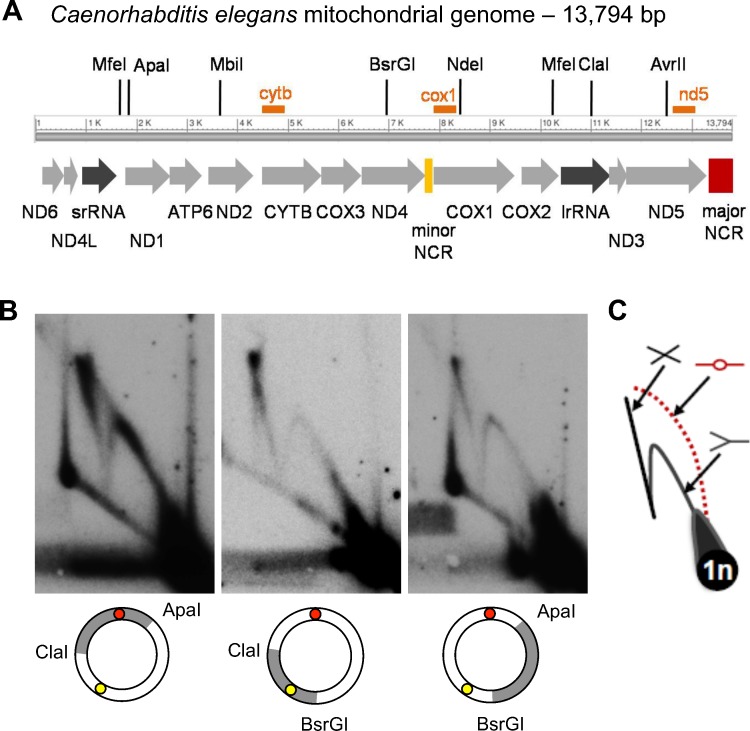
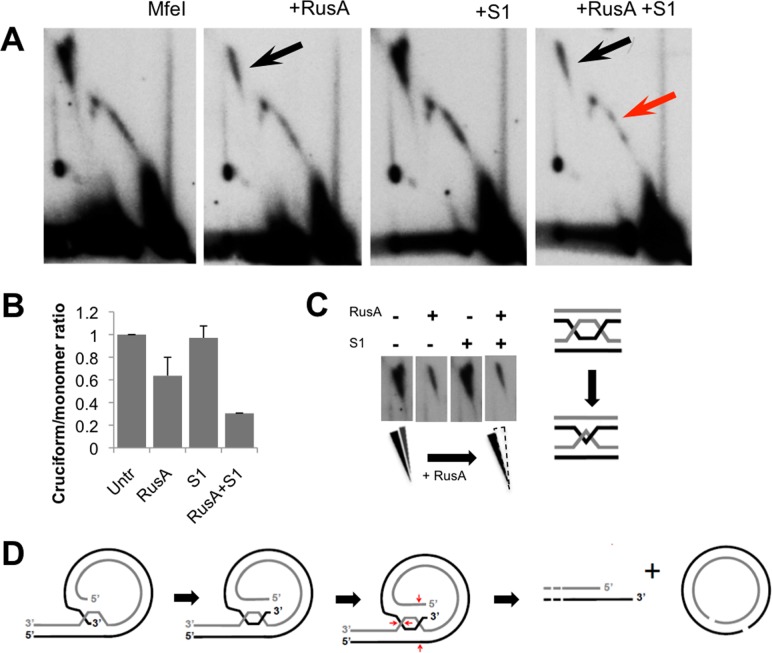
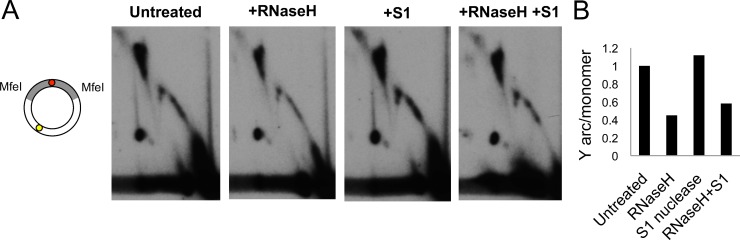
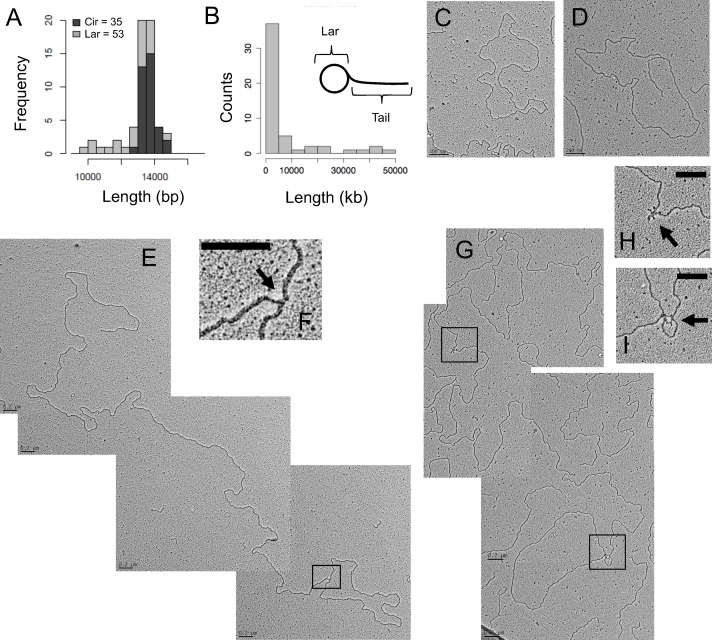
Mitochondrial DNA (mtDNA) encodes respiratory complex subunits essential to almost all eukaryotes; hence respiratory competence requires faithful duplication of this molecule. However, the mechanism(s) of its synthesis remain hotly debated. Here we have developed Caenorhabditis elegans as a convenient animal model for the study of metazoan mtDNA synthesis. We demonstrate that C. elegans mtDNA replicates exclusively by a phage-like mechanism, in which multimeric molecules are synthesized from a circular template. In contrast to previous mammalian studies, we found that mtDNA synthesis in the C. elegans gonad produces branched-circular lariat structures with multimeric DNA tails; we were able to detect multimers up to four mtDNA genome unit lengths. Further, we did not detect elongation from a displacement-loop or analogue of 7S DNA, suggesting a clear difference from human mtDNA in regard to the site(s) of replication initiation. We also identified cruciform mtDNA species that are sensitive to cleavage by the resolvase RusA; we suggest these four-way junctions may have a role in concatemer-to-monomer resolution. Overall these results indicate that mtDNA synthesis in C. elegans does not conform to any previously documented metazoan mtDNA replication mechanism, but instead are strongly suggestive of rolling circle replication, as employed by bacteriophages. As several components of the metazoan mitochondrial DNA replisome are likely phage-derived, these findings raise the possibility that the rolling circle mtDNA replication mechanism may be ancestral among metazoans.
线粒体DNA(mtDNA)编码几乎所有真核生物所必需的呼吸复合体亚基;因此,呼吸功能需要该分子的准确复制。然而,其合成机制仍存在激烈争论。在这里,我们开发了秀丽隐杆线虫作为研究后生动物mtDNA合成的便捷动物模型。我们证明,秀丽隐杆线虫的mtDNA仅通过一种类似噬菌体的机制进行复制,其中多聚体分子是从环状模板合成的。与之前的哺乳动物研究不同,我们发现秀丽隐杆线虫性腺中的mtDNA合成产生具有多聚体DNA尾巴的分支环状套索结构;我们能够检测到长达四个mtDNA基因组单位长度的多聚体。此外,我们未检测到从置换环或7S DNA类似物处的延伸,这表明在复制起始位点方面与人类mtDNA存在明显差异。我们还鉴定出对解离酶RusA切割敏感的十字形mtDNA物种;我们认为这些四向连接可能在多联体到单体的解离中起作用。总体而言,这些结果表明秀丽隐杆线虫中的mtDNA合成不符合任何先前记录的后生动物mtDNA复制机制,而是强烈暗示了噬菌体所采用的滚环复制。由于后生动物线粒体DNA复制体的几个组分可能源自噬菌体,这些发现增加了滚环mtDNA复制机制可能是后生动物祖先机制的可能性。