Poon M C, Russell J A, Low S, Sinclair G D, Jones A R, Blahey W, Ruether B A, Hoar D I
Department of Medicine, University of Calgary, Alberta, Canada.
J Clin Invest. 1989 Sep;84(3):787-92. doi: 10.1172/JCI114237.
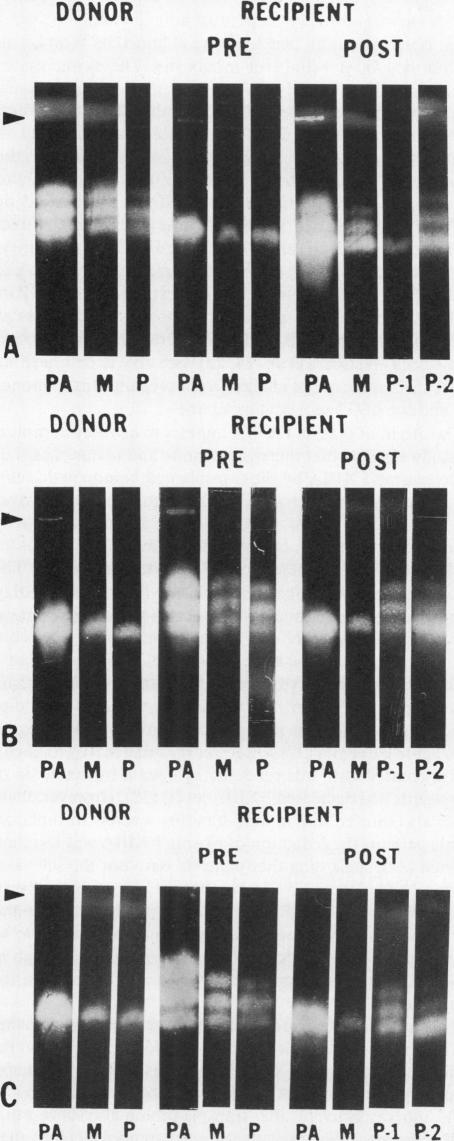
Factor XIII A subunit (FXIIIA) is found in plasma, platelets, and monocytes. The hemopoietic contributions to FXIIIA in these components were studied in patients transplanted with marrows from donors with different FXIIIA phenotypes. In three patients with successful engraftment (by DNA genotyping, red cell phenotyping, and cytogenetic studies) platelet and monocyte FXIIIA changed to donor phenotypes with hematologic recovery. Thus, FXIIIA in platelets and monocytes is synthesized de novo and/or from their progenitor cells. Plasma FXIIIA phenotype change after transplantation was more complex. Patient I changed from phenotype 1-1 (one electrophoretically fast band) to 1-2 (three bands) in 115 d; patients 2 and 3 did not change completely from phenotype 1-2 to 1-1 in up to 458 d, but did show enrichment of the fastest band. Thus, while there is a definite contribution of donor hemopoiesis to plasma FXIIIA, another source of recipient FXIIIA appears to be present to delay or prevent the phenotype change.
凝血因子 XIII A 亚基(FXIIIA)存在于血浆、血小板和单核细胞中。我们在接受了具有不同 FXIIIA 表型供体骨髓移植的患者中,研究了这些成分中造血系统对 FXIIIA 的贡献。在三名移植成功的患者中(通过 DNA 基因分型、红细胞表型分析和细胞遗传学研究),随着血液学恢复,血小板和单核细胞中的 FXIIIA 转变为供体表型。因此,血小板和单核细胞中的 FXIIIA 是重新合成的,和/或来源于它们的祖细胞。移植后血浆 FXIIIA 表型的变化更为复杂。患者 1 在 115 天内从表型 1-1(一条电泳快带)转变为 1-2(三条带);患者 2 和 3 在长达 458 天的时间里没有完全从表型 1-2 转变为 1-1,但确实显示出最快迁移条带的富集。因此,虽然供体造血系统对血浆 FXIIIA 有明确贡献,但受体 FXIIIA 的另一个来源似乎存在,从而延迟或阻止了表型变化。