van Lier Christina J, Tiner Bethany L, Chauhan Sadhana, Motin Vladimir L, Fitts Eric C, Huante Matthew B, Endsley Janice J, Ponnusamy Duraisamy, Sha Jian, Chopra Ashok K
Department of Microbiology and Immunology, University of Texas Medical Branch, Galveston, TX 77555, USA.
Department of Microbiology and Immunology, University of Texas Medical Branch, Galveston, TX 77555, USA; Sealy Center for Vaccine Development, University of Texas Medical Branch, Galveston, TX 77555, USA; Center for Biodefense and Emerging Infectious Diseases, University of Texas Medical Branch, Galveston, TX 77555, USA; Institute for Human Infections and Immunity, University of Texas Medical Branch, Galveston, TX 77555, USA; Department of Pathology, University of Texas Medical Branch, Galveston, TX 77555, USA.
Microb Pathog. 2015 Mar;80:27-38. doi: 10.1016/j.micpath.2015.02.005. Epub 2015 Feb 16.
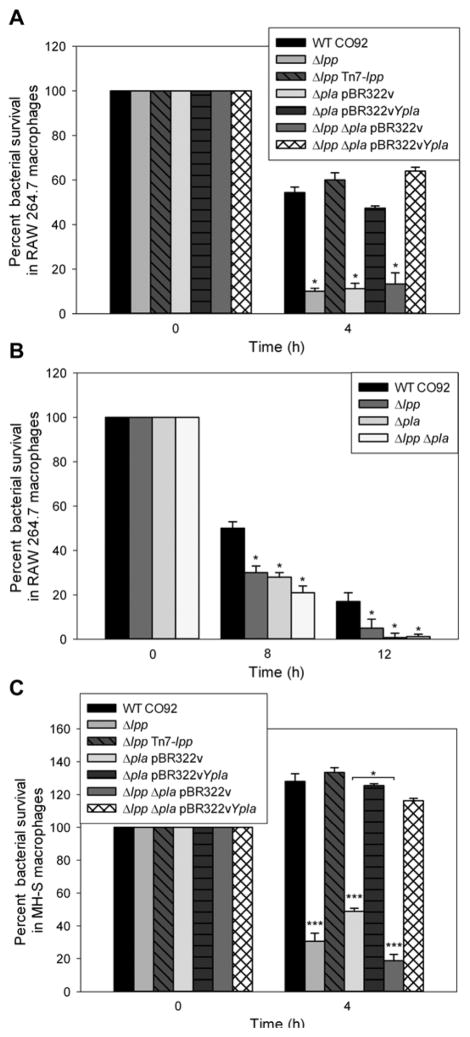
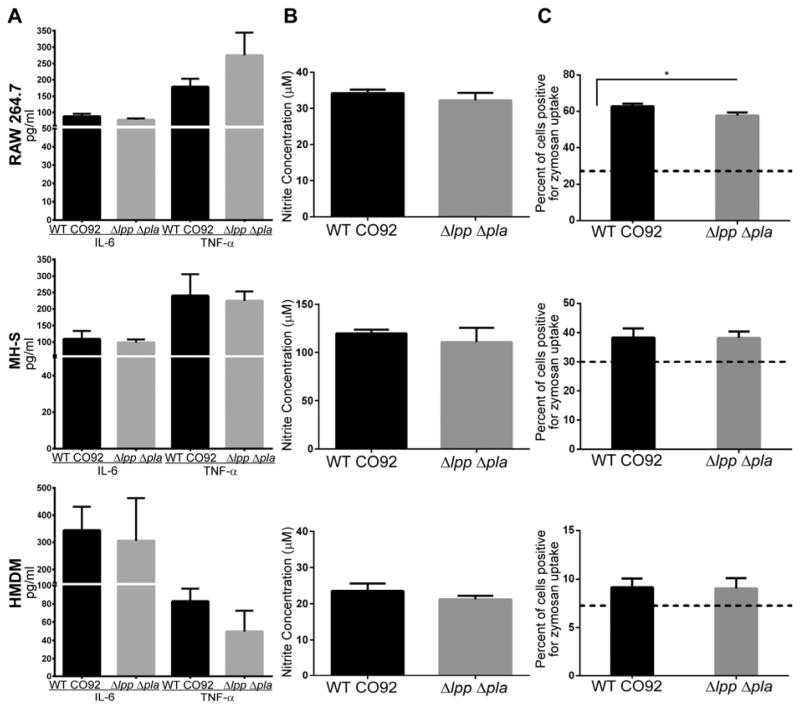
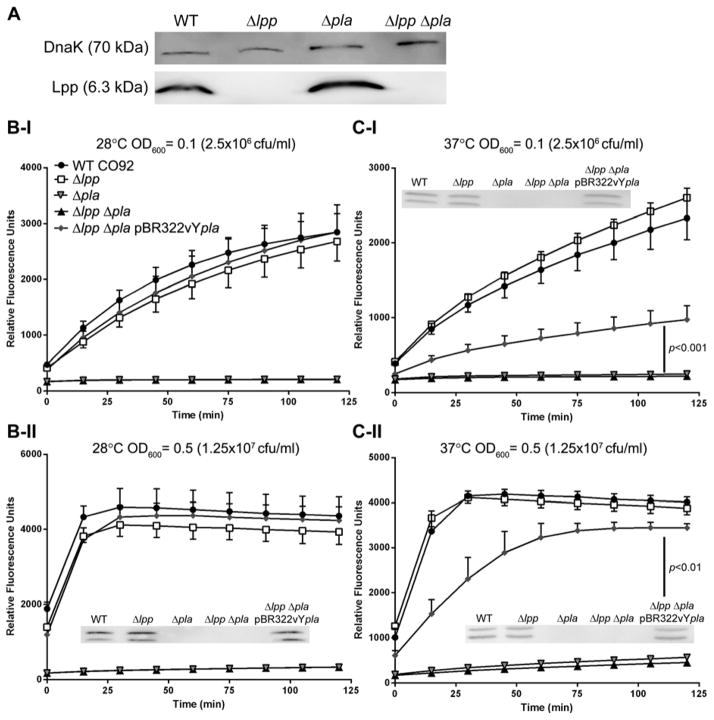
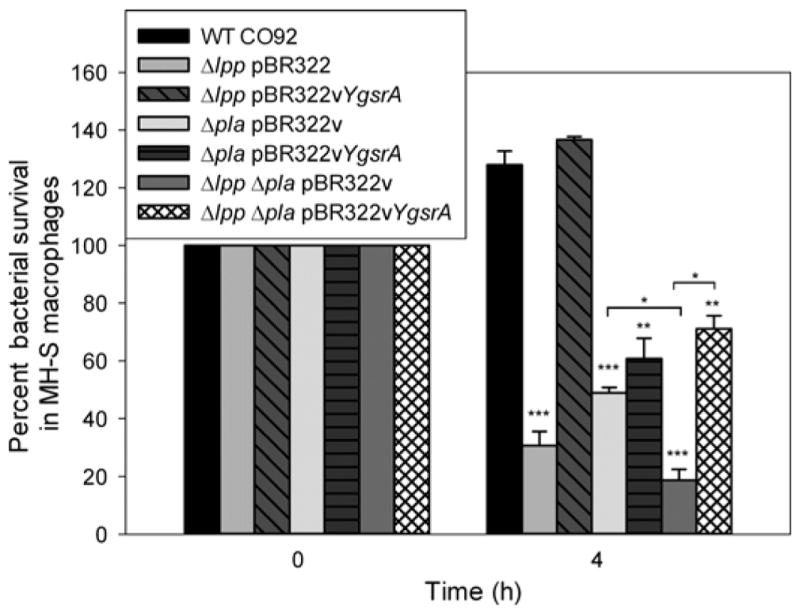
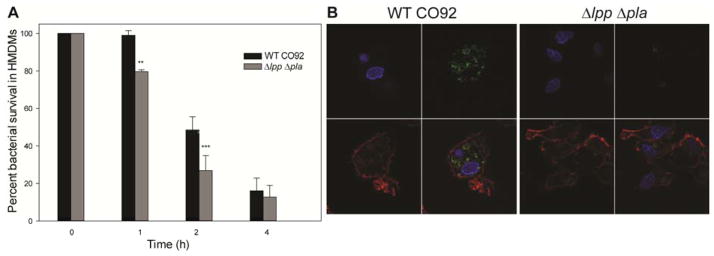
We recently characterized the Δlpp Δpla double in-frame deletion mutant of Yersinia pestis CO92 molecularly, biologically, and immunologically. While Braun lipoprotein (Lpp) activates toll-like receptor-2 to initiate an inflammatory cascade, plasminogen activator (Pla) protease facilitates bacterial dissemination in the host. The Δlpp Δpla double mutant was highly attenuated in evoking bubonic and pneumonic plague, was rapidly cleared from mouse organs, and generated humoral and cell-mediated immune responses to provide subsequent protection to mice against a lethal challenge dose of wild-type (WT) CO92. Here, we further characterized the Δlpp Δpla double mutant in two murine macrophage cell lines as well as in primary human monocyte-derived macrophages to gauge its potential as a live-attenuated vaccine candidate. We first demonstrated that the Δpla single and the Δlpp Δpla double mutant were unable to survive efficiently in murine and human macrophages, unlike WT CO92. We observed that the levels of Pla and its associated protease activity were not affected in the Δlpp single mutant, and, likewise, deletion of the pla gene from WT CO92 did not alter Lpp levels. Further, our study revealed that both Lpp and Pla contributed to the intracellular survival of WT CO92 via different mechanisms. Importantly, the ability of the Δlpp Δpla double mutant to be phagocytized by macrophages, to stimulate production of tumor necrosis factor-α and interleukin-6, and to activate the nitric oxide killing pathways of the host cells remained unaltered when compared to the WT CO92-infected macrophages. Finally, macrophages infected with either the WT CO92 or the Δlpp Δpla double mutant were equally efficient in their uptake of zymosan particles as determined by flow cytometric analysis. Overall, our data indicated that although the Δlpp Δpla double mutant of Y. pestis CO92 was highly attenuated, it retained the ability to elicit innate and subsequent acquired immune responses in the host similar to that of WT CO92, which are highly desirable in a live-attenuated vaccine candidate.
我们最近从分子、生物学和免疫学角度对鼠疫耶尔森菌CO92的Δlpp Δpla双框内缺失突变体进行了表征。虽然布劳恩脂蛋白(Lpp)激活Toll样受体2以启动炎症级联反应,但纤溶酶原激活剂(Pla)蛋白酶促进细菌在宿主体内传播。Δlpp Δpla双突变体在引发腺鼠疫和肺鼠疫方面高度减毒,能迅速从小鼠器官中清除,并产生体液免疫和细胞介导的免疫反应,为小鼠提供后续保护,使其免受致死剂量野生型(WT)CO92的攻击。在此,我们进一步在两种小鼠巨噬细胞系以及原代人单核细胞衍生的巨噬细胞中对Δlpp Δpla双突变体进行表征,以评估其作为减毒活疫苗候选物的潜力。我们首先证明,与WT CO92不同,Δpla单突变体和Δlpp Δpla双突变体无法在小鼠和人类巨噬细胞中有效存活。我们观察到,Pla水平及其相关蛋白酶活性在Δlpp单突变体中不受影响,同样,从WT CO92中缺失pla基因也不会改变Lpp水平。此外,我们的研究表明,Lpp和Pla都通过不同机制促进WT CO92在细胞内存活。重要的是,与感染WT CO92的巨噬细胞相比,Δlpp Δpla双突变体被巨噬细胞吞噬、刺激肿瘤坏死因子-α和白细胞介素-6产生以及激活宿主细胞一氧化氮杀伤途径的能力保持不变。最后,通过流式细胞术分析确定,感染WT CO92或Δlpp Δpla双突变体的巨噬细胞摄取酵母聚糖颗粒的效率相同。总体而言,我们的数据表明,尽管鼠疫耶尔森菌CO92的Δlpp Δpla双突变体高度减毒,但它仍保留了在宿主体内引发先天性和后续获得性免疫反应的能力,这与WT CO92相似,而这在减毒活疫苗候选物中是非常理想的。