Frisch Johanna U, Häusser Jan A, Mojzisch Andreas
Institute of Psychology, University of Hildesheim, Hildesheim Germany.
Front Psychol. 2015 Feb 2;6:14. doi: 10.3389/fpsyg.2015.00014. eCollection 2015.
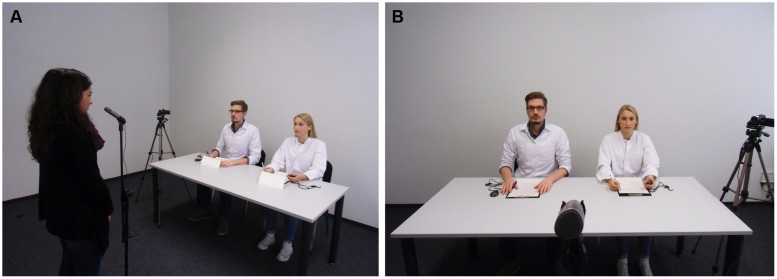
In our lives, we face countless situations in which we are observed and evaluated by our social interaction partners. Social-evaluative threat is frequently associated with strong neurophysiological stress reactions, in particular, an increase in cortisol levels. Yet, social variables do not only cause stress, but they can also buffer the neurophysiological stress response. Furthermore, social variables can themselves be affected by the threat or the threat-induced neurophysiological stress response. In order to study this complex interplay of social-evaluative threat, social processes and neurophysiological stress responses, a paradigm is needed that (a) reliably induces high levels of social-evaluative threat and (b) is extremely adaptable to the needs of the researcher. The Trier Social Stress Test (TSST) is a well-established paradigm in biopsychology that induces social-evaluative threat in the laboratory by subjecting participants to a mock job-interview. In this review, we aim at demonstrating the potential of the TSST for studying the complex interplay of social-evaluative threat, social processes and neurophysiological stress responses.
在我们的生活中,我们面临着无数这样的情况:我们受到社交互动伙伴的观察和评价。社会评价威胁常常与强烈的神经生理应激反应相关联,特别是皮质醇水平的升高。然而,社会变量不仅会引发压力,它们还能缓冲神经生理应激反应。此外,社会变量自身也可能受到威胁或威胁引发的神经生理应激反应的影响。为了研究社会评价威胁、社会过程和神经生理应激反应之间这种复杂的相互作用,需要一种范式,该范式要满足:(a) 可靠地引发高水平的社会评价威胁;(b) 能极其灵活地适应研究者的需求。特里尔社会应激测试(TSST)是生物心理学中一个成熟的范式,它通过让参与者进行模拟求职面试在实验室中引发社会评价威胁。在这篇综述中,我们旨在展示TSST在研究社会评价威胁、社会过程和神经生理应激反应之间复杂相互作用方面的潜力。