Calise S John, Keppeke Gerson D, Andrade Luis E C, Chan Edward K L
Department of Oral Biology, University of Florida , Gainesville, FL , USA.
Rheumatology Division, Universidade Federal de São Paulo , São Paulo , Brazil.
Front Immunol. 2015 Feb 5;6:41. doi: 10.3389/fimmu.2015.00041. eCollection 2015.
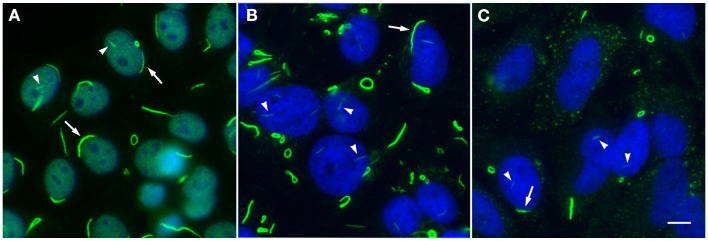
In recent years, autoantibodies targeting subcellular structures described as the rods and rings pattern in HEp-2 ANA have been presented as a unique case of autoantibody generation. These rod and ring structures (RR) are at least partially composed of inosine monophosphate dehydrogenase type 2 (IMPDH2), and their formation can be induced in vitro by several small-molecule inhibitors, including some IMPDH2 inhibitors. Autoantibodies targeting these relatively unknown structures have been almost exclusively observed in hepatitis C virus (HCV) patients who have undergone treatment with pegylated interferon-α/ribavirin (IFN/RBV) combination therapy. To date, anti-RR antibodies have not been found in treatment-naïve HCV patients or in patients from any other disease groups, with few reported exceptions. Here, we describe recent advances in characterizing the RR structure and the strong association between anti-RR antibody response and HCV patients treated with IFN/RBV, detailing why anti-RR can be considered a human model of drug-induced autoantibody generation.
近年来,在人喉表皮样癌细胞(HEp-2)抗核抗体(ANA)检测中,针对呈现杆状和环状模式的亚细胞结构的自身抗体已被视为自身抗体产生的一种独特情况。这些杆状和环状结构(RR)至少部分由2型肌苷单磷酸脱氢酶(IMPDH2)组成,并且它们的形成可以在体外由几种小分子抑制剂诱导,包括一些IMPDH2抑制剂。几乎仅在接受聚乙二醇化干扰素-α/利巴韦林(IFN/RBV)联合治疗的丙型肝炎病毒(HCV)患者中观察到针对这些相对未知结构的自身抗体。迄今为止,在未经治疗的HCV患者或任何其他疾病组的患者中尚未发现抗RR抗体,仅有少数例外情况报道。在此,我们描述了在RR结构表征方面的最新进展以及抗RR抗体反应与接受IFN/RBV治疗的HCV患者之间的强关联,详细说明了为何抗RR可被视为药物诱导自身抗体产生的人类模型。