Brulet Alexandre, Llorca Guy, Letrilliart Laurent
Département de médecine générale, Faculté de Médecine Lyon Est, Université Claude Bernard Lyon 1, Lyon CEDEX 08, France.
J Med Internet Res. 2015 Feb 19;17(2):e48. doi: 10.2196/jmir.3574.
Wikis may give clinician communities the opportunity to build knowledge relevant to their practice. The only previous study reviewing a set of health-related wikis, without specification of purpose or audience, globally showed a poor reliability.
Our aim was to review medical wiki websites dedicated to clinical practices.
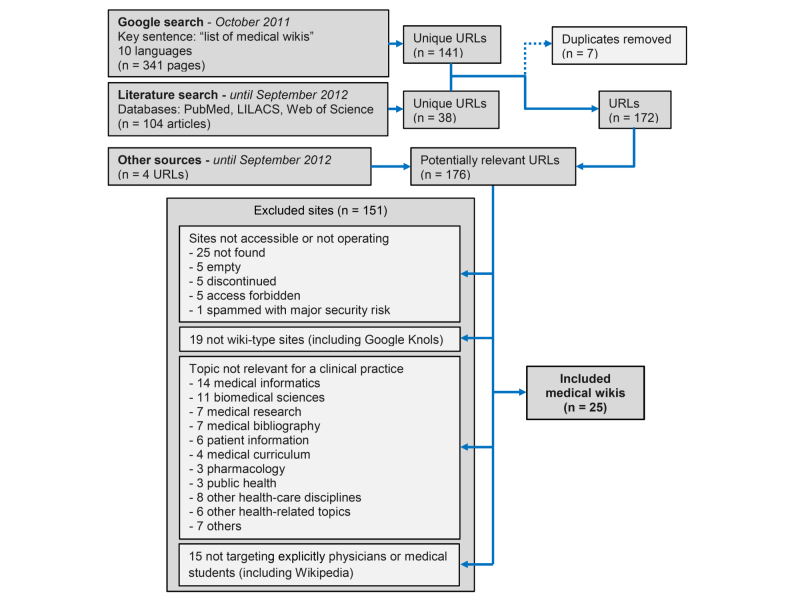
We used Google in ten languages, PubMed, Embase, Lilacs, and Web of Science to identify websites. The review included wiki sites, accessible and operating, having a topic relevant for clinical medicine, targeting physicians or medical students. Wikis were described according to their purposes, platform, management, information framework, contributions, content, and activity. Purposes were classified as "encyclopedic" or "non-encyclopedic". The information framework quality was assessed based on the Health On the Net (HONcode) principles for collaborative websites, with additional criteria related to users' transparency and editorial policy. From a sample of five articles per wikis, we assessed the readability using the Flesch test and compared articles according to the wikis' main purpose. Annual editorial activities were estimated using the Google engine.
Among 25 wikis included, 11 aimed at building an encyclopedia, five a textbook, three lessons, two oncology protocols, one a single article, and three at reporting clinical cases. Sixteen wikis were specialized with specific themes or disciplines. Fifteen wikis were using MediaWiki software as-is, three were hosted by online wiki farms, and seven were purpose-built. Except for one MediaWiki-based site, only purpose-built platforms managed detailed user disclosures. The owners were ten organizations, six individuals, four private companies, two universities, two scientific societies, and one unknown. Among 21 open communities, 10 required users' credentials to give editing rights. The median information framework quality score was 6 out of 16 (range 0-15). Beyond this score, only one wiki had standardized peer-reviews. Physicians contributed to 22 wikis, medical learners to nine, and lay persons to four. Among 116 sampled articles, those from encyclopedic wikis had more videos, pictures, and external resources, whereas others had more posology details and better readability. The median creation year was 2007 (1997-2011), the median number of content pages was 620.5 (3-98,039), the median of revisions per article was 17.7 (3.6-180.5) and 0.015 of talk pages per article (0-0.42). Five wikis were particularly active, whereas six were declining. Two wikis have been discontinued after the completion of the study.
The 25 medical wikis we studied present various limitations in their format, management, and collaborative features. Professional medical wikis may be improved by using clinical cases, developing more detailed transparency and editorial policies, and involving postgraduate and continuing medical education learners.
维基可能为临床医生群体提供构建与其实践相关知识的机会。此前唯一一项对一组与健康相关的维基进行的全球性研究,未明确目的或受众,结果显示可靠性较差。
我们的目的是对致力于临床实践的医学维基网站进行综述。
我们使用十种语言的谷歌、PubMed、Embase、Lilacs和科学网来识别网站。该综述纳入了可访问且运营中的维基网站,其主题与临床医学相关,目标受众为医生或医学生。根据维基的目的、平台、管理、信息框架、贡献、内容和活动对其进行描述。目的分为“百科全书式”或“非百科全书式”。基于健康网络(HONcode)协作网站原则评估信息框架质量,并附加与用户透明度和编辑政策相关的标准。从每个维基的五篇文章样本中,我们使用弗莱什测试评估可读性,并根据维基的主要目的对文章进行比较。使用谷歌引擎估计年度编辑活动。
在纳入的25个维基中,11个旨在构建百科全书,5个旨在编写教科书,3个用于课程,2个用于肿瘤学方案,1个用于单篇文章,3个用于报告临床病例。16个维基专注于特定主题或学科。15个维基按原样使用MediaWiki软件,3个由在线维基农场托管,7个是专门构建的。除了一个基于MediaWiki的网站外,只有专门构建的平台管理详细的用户披露信息。所有者包括十个组织、六个个人、四个私人公司、两所大学、两个科学协会和一个身份不明者。在21个开放社区中,10个要求用户提供凭证才能授予编辑权。信息框架质量得分中位数为16分中的6分(范围为0 - 15)。超过这个分数的,只有一个维基有标准化的同行评审。医生为22个维基做出了贡献,医学学习者为9个,非专业人员为4个。在116篇抽样文章中,百科全书式维基的文章有更多视频、图片和外部资源,而其他文章有更多用药细节且可读性更好。创建年份中位数为2007年(1997 - 2011年),内容页面数量中位数为620.5(3 - 98,039),每篇文章的修订次数中位数为17.7(3.6 - 180.5),每篇文章的讨论页面数为0.015(0 - 0.42)。五个维基特别活跃,而六个在衰落。两项维基在研究完成后已停止使用。
我们研究的25个医学维基在格式、管理和协作功能方面存在各种局限性。专业医学维基可通过使用临床病例、制定更详细的透明度和编辑政策以及让研究生和继续医学教育学习者参与来改进。
