J Acad Nutr Diet. 2015 Jul;115(7):1109-16. doi: 10.1016/j.jand.2014.12.013. Epub 2015 Feb 19.
Food shopping is a complex behavior that consists of multiple dimensions. Little research has explored multiple dimensions of food shopping or examined how it relates to dietary intake.
To identify patterns (or classes) of food shopping across four domains (fresh food purchasing, conscientious food shopping, food shopping locations, and food/beverage purchasing on or near campus) and explore how these patterns relate to dietary intake among college students.
A cross-sectional online survey was administered.
PARTICIPANTS/SETTING: Students attending a public 4-year university and a 2-year community college in the Twin Cities (Minnesota) metropolitan area (N=1,201) participated in this study.
Fast-food and soda consumption as well as meeting fruit and vegetable, fiber, added sugar, calcium, dairy, and fat recommendations.
Crude and adjusted latent class models and adjusted logistic regression models were fit.
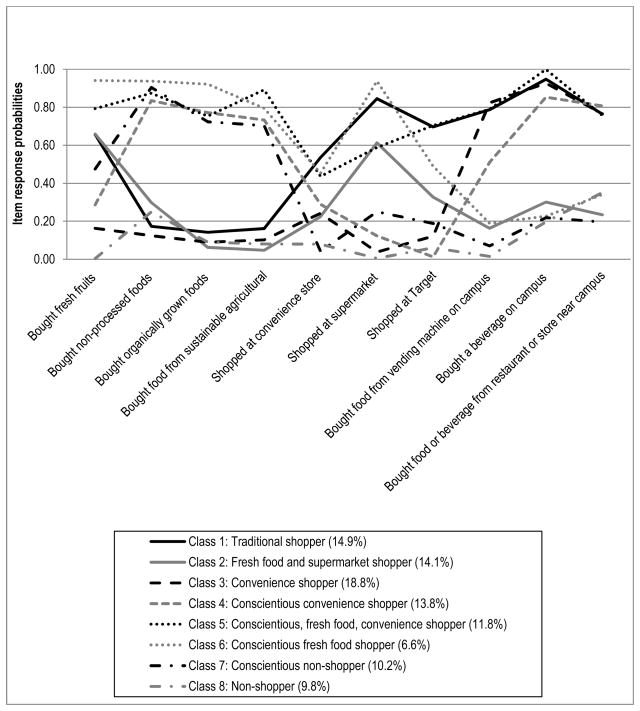
An eight-class solution was identified: "traditional shopper" (14.9%), "fresh food and supermarket shopper" (14.1%), "convenience shopper" (18.8%), "conscientious convenience shopper" (13.8%), "conscientious, fresh food, convenience shopper" (11.8%), "conscientious fresh food shopper" (6.6%), "conscientious nonshopper" (10.2%), and "nonshopper" (9.8%). "Fresh food and supermarket shoppers" and "conscientious fresh food shoppers" had better dietary intake (for fast food, calcium, dairy, and added sugar), whereas "convenience shoppers" and "conscientious convenience shoppers," and "nonshoppers" had worse dietary intake (for soda, calcium, dairy, fiber, and fat) than "traditional shoppers."
These findings highlight unique patterns in food shopping and associated dietary patterns that could inform tailoring of nutrition interventions for college students. Additional research is needed to understand modifiable contextual influences of healthy food shopping.
食品购物是一种复杂的行为,由多个维度组成。很少有研究探索食品购物的多个维度,也很少研究它与饮食摄入的关系。
确定四个领域(新鲜食品购买、认真购物、购物地点以及校园内或附近的食品/饮料购买)的食品购物模式(或类别),并探讨这些模式与大学生饮食摄入的关系。
进行了一项横断面在线调查。
参与者/设置:明尼苏达州双子城(明尼阿波利斯-圣保罗都会区)地区公立 4 年制大学和 2 年制社区学院的学生参加了这项研究(N=1201)。
快餐和苏打水的消费以及满足水果和蔬菜、纤维、添加糖、钙、乳制品和脂肪推荐量的情况。
拟合了粗分类和调整后的潜在类别模型以及调整后的逻辑回归模型。
确定了一个 8 类解决方案:“传统购物者”(14.9%)、“新鲜食品和超市购物者”(14.1%)、“便利购物者”(18.8%)、“认真便利购物者”(13.8%)、“认真、新鲜食品、便利购物者”(11.8%)、“认真购买新鲜食品者”(6.6%)、“认真不购物者”(10.2%)和“不购物者”(9.8%)。“新鲜食品和超市购物者”和“认真购买新鲜食品者”的饮食摄入更好(快餐、钙、乳制品和添加糖),而“便利购物者”和“认真便利购物者”以及“不购物者”的饮食摄入更差(苏打水、钙、乳制品、纤维和脂肪)与“传统购物者”相比。
这些发现突出了食品购物和相关饮食模式的独特模式,可以为针对大学生的营养干预措施提供信息。需要进一步研究以了解健康食品购物的可改变的环境影响。