Oldham Edward Davis, Nunes Larissa M, Varela-Ramirez Armando, Rankin Stephen E, Knutson Barbara L, Aguilera Renato J, Lehmler Hans-Joachim
Department of Chemistry, University of Mary Washington, 1300 College Avenue, Fredericksburg, VA 22401 USA.
Cytometry, Screening and Imaging Core Facility, Border Biomedical Research Center, Department of Biological Sciences, Bioscience Research Building, University of Texas at El Paso, 500 West University Ave., El Paso, TX 79968 USA.
Chem Cent J. 2015 Feb 1;9:3. doi: 10.1186/s13065-014-0072-1. eCollection 2015.
Simple glycoside surfactants represent a class of chemicals that are produced from renewable raw materials. They are considered to be environmentally safe and, therefore, are increasingly used as pharmaceuticals, detergents, and personal care products. Although they display low to moderate toxicity in cells in culture, the underlying mechanisms of surfactant-mediated cytotoxicity are poorly investigated.
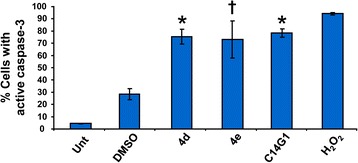
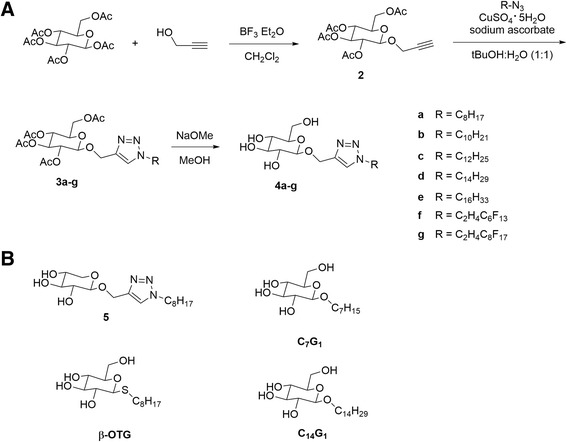
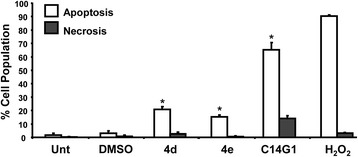
We synthesized a series of triazole-linked (fluoro)alkyl β-glucopyranosides using the copper-catalyzed azide-alkyne reaction, one of many popular "click" reactions that enable efficient preparation of structurally diverse compounds, and investigate the toxicity of this novel class of surfactant in the Jurkat cell line. Similar to other carbohydrate surfactants, the cytotoxicity of the triazole-linked alkyl β-glucopyranosides was low, with IC50 values decreasing from 1198 to 24 μM as the hydrophobic tail length increased from 8 to 16 carbons. The two alkyl β-glucopyranosides with the longest hydrophobic tails caused apoptosis by mechanisms involving mitochondrial depolarization and caspase-3 activation.
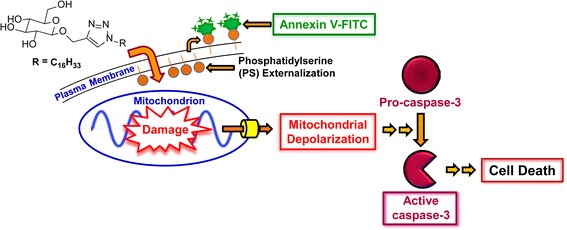
Triazole-linked, glucose-based surfactants 4a-g and other carbohydrate surfactants may cause apoptosis, and not necrosis, at low micromolar concentrations via induction of the intrinsic apoptotic cascade; however, additional studies are needed to fully explore the molecular mechanisms of their toxicity. Graphical AbstractTriazole-linked, glucose-based surfactants cause apoptosis, and not necrosis, at low micromolar concentrations via induction of the intrinsic apoptotic cascade.
简单糖苷表面活性剂是一类由可再生原料生产的化学品。它们被认为对环境安全,因此越来越多地用作药物、洗涤剂和个人护理产品。尽管它们在细胞培养中显示出低至中等的毒性,但表面活性剂介导的细胞毒性的潜在机制研究较少。
我们使用铜催化的叠氮化物-炔烃反应合成了一系列三唑连接的(氟)烷基β-吡喃葡萄糖苷,这是众多流行的“点击”反应之一,能够高效制备结构多样的化合物,并研究了这类新型表面活性剂在Jurkat细胞系中的毒性。与其他碳水化合物表面活性剂类似,三唑连接的烷基β-吡喃葡萄糖苷的细胞毒性较低,随着疏水尾长度从8个碳增加到16个碳,IC50值从1198 μM降至24 μM。两种疏水尾最长的烷基β-吡喃葡萄糖苷通过涉及线粒体去极化和半胱天冬酶-3激活的机制导致细胞凋亡。
三唑连接的基于葡萄糖的表面活性剂4a-g和其他碳水化合物表面活性剂可能在低微摩尔浓度下通过诱导内源性凋亡级联反应导致细胞凋亡,而非坏死;然而,需要进一步研究以充分探索其毒性的分子机制。图形摘要三唑连接的基于葡萄糖的表面活性剂在低微摩尔浓度下通过诱导内源性凋亡级联反应导致细胞凋亡,而非坏死。