Lam Carlos, Lin Mau-Roung, Chu Shu-Fen, Tsai Shin-Han, Bai Chyi-Huey, Chiu Wen-Ta
Department of Critical and Emergency Medicine, Wan Fang Hospital, Taipei Medical University, Taipei 116, Taiwan ; Graduate Institute of Injury Prevention and Control, College of Public Health and Nutrition, Taipei Medical University, No. 250, Wu-Hsing Street, Taipei 110, Taiwan.
Graduate Institute of Injury Prevention and Control, College of Public Health and Nutrition, Taipei Medical University, No. 250, Wu-Hsing Street, Taipei 110, Taiwan.
Biomed Res Int. 2015;2015:487985. doi: 10.1155/2015/487985. Epub 2015 Feb 1.
The relationship between cervical spine injury (CSI) and helmet in head injury (HI) patients following motorcycle crashes is crucial. Controversy still exists; therefore we evaluated the effect of various types of helmets on CSI in HI patients following motorcycle crashes and researched the mechanism of this effect.
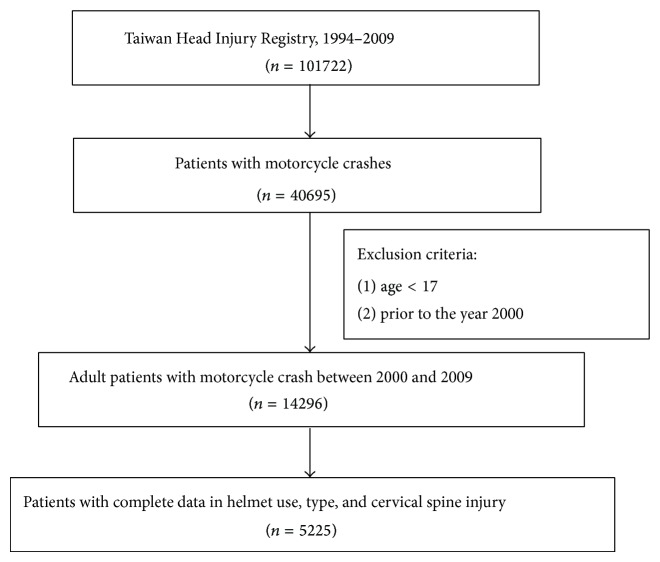
A total of 5225 patients of motorcycle crashes between 2000 and 2009 were extracted from the Head Injury Registry in Taiwan. These patients were divided into case and control groups according to the presence of concomitant CSI. Helmet use and types were separately compared between the two groups and the odds ratio of CSI was obtained by using multiple logistic regression analysis.
We observed that 173 (3.3%) of the HI patients were associated with CSI. The HI patients using a helmet (odds ratio (OR) = 0.31, 95% confidence interval (CI) = 0.19-0.49), full-coverage helmet (0.19, 0.10-0.36), and partial-coverage helmet (0.35, 0.21-0.56) exhibited a significantly decreased rate of CSI compared with those without a helmet.
Wearing full-coverage and partial-coverage helmets significantly reduced the risk of CSI among HI patients following motorcycle crashes. This effect may be due to the smooth surface and hard padding materials of helmet.
在摩托车碰撞后头部受伤(HI)患者中,颈椎损伤(CSI)与头盔之间的关系至关重要。争议仍然存在;因此,我们评估了各种类型头盔对摩托车碰撞后HI患者CSI的影响,并研究了这种影响的机制。
从台湾头部损伤登记处提取了2000年至2009年间共5225例摩托车碰撞患者。根据是否伴有CSI将这些患者分为病例组和对照组。分别比较两组之间的头盔使用情况和类型,并通过多元逻辑回归分析获得CSI的比值比。
我们观察到173例(3.3%)HI患者伴有CSI。与未戴头盔的患者相比,戴头盔的HI患者(比值比(OR)=0.31,95%置信区间(CI)=0.19-0.49)、全覆盖头盔(0.19,0.10-0.36)和部分覆盖头盔(0.35,0.21-0.56)的CSI发生率显著降低。
佩戴全覆盖和部分覆盖头盔可显著降低摩托车碰撞后HI患者发生CSI的风险。这种效果可能归因于头盔光滑的表面和硬质衬垫材料。